Trap: Shyamalan's Attention Problem
M. Night Shyamalan's August 2024 thriller had a genuinely great first act and two acts that could not sustain the premise. A year later, the unevenness is worth thinking about.
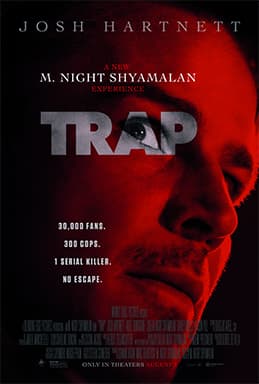
Poster / promotional material via Wikipedia, Trap (2024 film). Used under fair use for criticism and review.
I want to write about Trap, M. Night Shyamalan’s August 2024 thriller, because it is a film that I keep thinking about, despite the fact that I did not, on first viewing, entirely like it. A year later, the film has resolved in my head into a clearer shape than the one the reviews gave it, and the shape is worth describing.
What the film is
Cooper Adams (Josh Hartnett) is a mild-mannered Philadelphia dad who has taken his teenage daughter Riley to a pop concert by Lady Raven (Saleka Shyamalan, the director’s daughter). As they settle into their seats, Cooper gradually realises that the stadium is crawling with police officers, and that the concert is, specifically, a trap intended to catch a serial killer known as “the Butcher.”
Cooper is the Butcher. He spends the rest of the concert trying to evade the police long enough to get out of the arena undetected.
The first act is one of the best things Shyamalan has ever directed
The concert-trap sequence, which runs for roughly the first fifty minutes of the film, is genuinely masterful suspense direction. Shyamalan does four specific things that most contemporary thrillers cannot do.
First, the geography of the arena is established cleanly. You always know where Cooper is. You always know where the exits are. You always know which exits are guarded. The viewer can run the tactical calculation alongside him.
Second, the stakes of failure are kept small and specific. Cooper is not trying to escape to freedom; he is trying to extract himself from a single public event without being identified. The stakes are contained. This is a specifically Hitchcockian move that most contemporary American thrillers do not attempt.
Third, the daughter’s point of view is maintained. Riley is present throughout the first act, which means Cooper is performing “normal dad” while also internally running his evasion calculations. Hartnett plays this split with specific precision.
Fourth, Shyamalan weaponises the pop concert itself as part of the suspense. The music, the lights, the specific crowd-behavior of a teenage-skewing audience, all become tactical elements Cooper has to read and exploit. The concert is not setting. It is mechanism.
On the first act alone, Trap is one of the best American thrillers of 2024.
Where the film falls apart
And then the first act ends. The second act, which relocates the action from the arena to Cooper’s home and introduces Lady Raven herself as a character, is a specific kind of disappointing. The geography collapses. The stakes expand in vague directions. The tactical clarity the first act established disappears. Shyamalan tries to pivot from a suspense thriller to a domestic psychological drama, and the pivot does not land.
The third act, which involves a confrontation between Cooper and his wife (Alison Pill) that I will not spoil in detail, has individual moments that work but lacks the structural discipline of the opening. The film becomes a character study of Cooper, which Hartnett is certainly good enough to anchor, but the shift is not prepared for.
Why the unevenness is the interesting thing
Shyamalan has, across a thirty-year career, been both one of the most inventive genre directors of his generation and one of the most commercially erratic. His films routinely have brilliant first acts that he cannot sustain. Old (2021) had a great opening. Knock at the Cabin (2023) had a great opening. Trap has a great opening. The pattern is now predictable enough to be a subject in itself.
The diagnostic question is: why? The answer, I suspect, is that Shyamalan is a director whose genuine gift is for premise. He can construct a high-concept thriller situation with more specificity than almost any contemporary American genre filmmaker. What he is less consistently gifted at is development. His second acts tend to introduce psychological or supernatural elements that the premise cannot quite absorb, and the films wobble.
This is not a small problem. It is, however, a consistent enough problem that his films are now mostly watched for their first acts. Trap is the purest example of this pattern in his recent filmography.
Hartnett, coming back
Josh Hartnett’s Cooper is the single best thing about Trap, and the performance deserves to have repositioned him as a lead. Hartnett, after a long mid-career in character work, plays Cooper with a specific quality of performed normality that slowly curdles. He is dad. He is attentive. He is exhausted. He is engaged. He is, also, calculating exit routes in the background of every line reading. The performance is extraordinary, and on a better-structured script it would be being discussed as a career resurrection.
In the film we got, the performance is the thing that keeps the wobble watchable.
Saleka Shyamalan, the other project
Lady Raven, played by Saleka Shyamalan, has a larger role in the second half of the film than the marketing suggested. The character is, in the world of the film, Shyamalan’s actual pop-star daughter (Saleka is a real musician), and the film folds her concert persona into the fictional one in ways that are, in places, compelling and in other places a bit indulgent.
Saleka is a good musician and an inexperienced actor. The film asks her to do more acting than her current level of screen training supports. The songs she performs are good. The dialogue scenes are uneven. This is not, I think, a fatal flaw, but it is part of the film’s unevenness.
What the film will be remembered as
Trap will, I suspect, be remembered primarily as a Hartnett comeback vehicle and as a first-act masterclass that Shyamalan could not sustain. The film made $82 million on a $30 million budget, which is commercially healthy but not transformative.
Watch the first act. If you have the patience, watch the rest. The structural lesson, about Shyamalan’s specific directorial limits, is the thing the film most clearly teaches.
Marcus believes good criticism is an argument. He is almost always angry about something, usually for good reason. Horror is his first language.
MORE BY MARCUS VELL →
Heretic: Hugh Grant's Villain Era, Explained
A year and a bit on, Hugh Grant's turn in Heretic has been canonised as the late-career reinvention of the decade. The interesting question is what reinvention actually means when the performance is, in truth, an intensification of what he was always doing.
Hit Man: Richard Linklater's Star Vehicle for a Non-Star
A year on from Hit Man's Netflix release, the film is a quieter argument than it first appeared. Richard Linklater made a star-launcher for someone he knew would not, in the end, need launching.
Longlegs: What Perkins Was Really Doing
A year after Longlegs' extraordinary marketing run turned into an extraordinary opening weekend, the film looks smaller than the hype suggested and stranger than the backlash allowed.