Heretic: Hugh Grant's Villain Era, Explained
A year and a bit on, Hugh Grant's turn in Heretic has been canonised as the late-career reinvention of the decade. The interesting question is what reinvention actually means when the performance is, in truth, an intensification of what he was always doing.
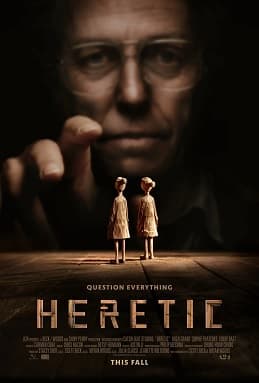
Poster / promotional material via Wikipedia, Heretic (film). Used under fair use for criticism and review.
There is a particular thing Hugh Grant has been doing for about a decade that is, I would argue, not quite reinvention. It is not a late-career pivot from romantic-comedy leading man to character actor. It is the emergence, in sharper focus, of something that was always there in Grant’s screen presence and that his early-career casting obscured. The thing he is doing is talking, and in particular, talking in a register that is formally polite and morally scurrilous at the same time. He’s been doing this at least since Paddington 2. He did it in A Very English Scandal. He did it in The Gentlemen. He did it, in a more compressed form, in Dungeons & Dragons: Honor Among Thieves.
What Heretic, the Scott Beck and Bryan Woods psychological horror that opened in November 2024, does is hand Grant a role in which the talking is the threat. Mr. Reed, the character Grant plays, is a man in a house full of words, and the film’s single best instinct is to let him use them. For close to two hours, we watch Hugh Grant, as Hugh Grant has always been, if Hugh Grant had decided to become a predator.
What the film actually is
Heretic is a chamber horror. Two young Mormon missionaries, Sister Barnes (Sophie Thatcher) and Sister Paxton (Chloe East), visit the home of a man named Mr. Reed, who has expressed interest in their faith. The film confines itself almost entirely to his house, in a single continuous night. It runs 111 minutes. It is structured as three long conversations punctuated by two horror beats. The horror beats are staged well. The conversations are the film’s real achievement.
The film’s opening half-hour is an exceptional piece of writing. Beck and Woods, who have been working together as a writer-director team since The Boogeyman and before, understand the specific rhetorical rhythm of a person who is being drawn into an argument they did not consent to. Grant’s Mr. Reed opens polite. He offers tea. He offers questions about the missionaries’ faith that are framed as curiosity. Slowly, almost imperceptibly, the questions become accusations. By the thirty-minute mark, the missionaries are inside an argument they did not realise they had agreed to have.
This is, I think, the film’s most interesting move, and the one that has been least discussed. Heretic is a film about the structure of being talked at by a man who has already decided how the conversation will end. It is, among other things, a film about gaslight, not in the vague therapeutic sense that the word has taken on, but in the specific sense of a person constructing a rhetorical frame around you inside which your options are only the options they have prepared for you. Mr. Reed’s house is a physical rendering of that frame. The doors, as the film reveals over its middle third, do not go where you think they go.
What Hugh Grant is doing
Let me try to describe the performance precisely, because “Hugh Grant’s villain era” is the kind of critical shorthand that flattens what he is actually doing in this role.
The trick of Grant’s performance is that the charm is real. It is not a mask. There is no moment in the film where the camera lingers on his face after a scene and shows you the “real” Mr. Reed underneath the charm. The charm is all there is. Mr. Reed is not a monster wearing a Hugh Grant mask. Mr. Reed is a monster whose monstrosity is made of the things Hugh Grant is charming with.
This is why the film is scarier than a more conventional horror framing would have allowed. A monster who has a “real self” underneath can, in principle, be escaped. You can duck beneath the mask and find the authentic person. A monster who is all surface offers no such exit. The charm is the danger. The argument is the knife.
Grant plays this by making almost no adjustment to his established screen grammar. The smile is the Four Weddings smile. The fluster is the About a Boy fluster. The mid-sentence revisions, the little self-correcting asides, the way he looks up and says the next sentence as if it had just occurred to him, these are Hugh Grant’s romantic-comedy tools. Beck and Woods have him deploy them as weapons. The film is a demonstration of how thin the line is between a charming conversationalist and a person who has trapped you.
The younger actresses
It is worth saying, because the Hugh Grant discourse threatens to eclipse this, that Heretic would collapse without Sophie Thatcher and Chloe East. They have the harder work. They have to react to Grant without flattening into either of the two easy shapes the film could reduce them to, terrified prey, or plucky genre-horror heroines. They have to make the missionaries think.
Thatcher, especially, in the back half of the film, does something I keep coming back to. Her Sister Barnes, the more experienced of the two missionaries, the one who has heard this kind of argument before, the one who understands what Mr. Reed is doing before her partner does, plays a rising dread that is specifically theological. She is frightened, yes. She is also working out, in real time, what her faith can and cannot survive being said to it. The performance is watchful in a way horror films rarely allow their young female leads to be.
East, as Sister Paxton, is working in a simpler register, innocence in the process of losing itself, and does it cleanly enough that the film’s final passages land harder than they had any right to.
What the film gets wrong
One honest note. Heretic does not fully stick the landing. The last ten minutes introduce a set of revelations, about the house, about the nature of Mr. Reed’s project, about what he has done before, that move the film out of the rhetorical chamber-piece register and into something closer to a conventional horror set piece. The moves are competent. They are not the movie I wanted, which is a movie that stays inside its conversation until the very last frame.
This is a small complaint. A truly rigorous chamber horror in the terms I’d have preferred would have had to do without the catharsis that the late-film horror beats provide. I understand why Beck and Woods declined to make that film. I just wish they had.
What it leaves us
A year and a bit later, Heretic has settled into its place as the film that finally clarified what Hugh Grant had become. Not a reinvention. A revelation. The charm was always the weapon. We had been willing, for three decades, to be charmed by it in a register that assumed he meant us no harm. Heretic is the film that asks, politely, what happens when he does.
Go watch it, if you haven’t. Just don’t let anyone offer you tea.
Marcus believes good criticism is an argument. He is almost always angry about something, usually for good reason. Horror is his first language.
MORE BY MARCUS VELL →
Longlegs: What Perkins Was Really Doing
A year after Longlegs' extraordinary marketing run turned into an extraordinary opening weekend, the film looks smaller than the hype suggested and stranger than the backlash allowed.
Trap: Shyamalan's Attention Problem
M. Night Shyamalan's August 2024 thriller had a genuinely great first act and two acts that could not sustain the premise. A year later, the unevenness is worth thinking about.
The Substance and the Body Horror Renaissance
Eighteen months after Coralie Fargeat's prosthetic-heavy fable drew both Oscar nominations and walkouts, the strange alchemy of The Substance has only clarified. The film is less about Hollywood than it looks, and more about what we're allowed to say with bodies on screen.