Longlegs: What Perkins Was Really Doing
A year after Longlegs' extraordinary marketing run turned into an extraordinary opening weekend, the film looks smaller than the hype suggested and stranger than the backlash allowed.
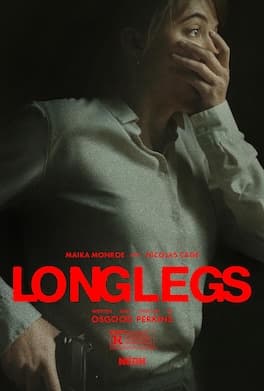
Poster / promotional material via Wikipedia, Longlegs. Used under fair use for criticism and review.
The Longlegs conversation in July 2024 was barely about Longlegs. It was about the marketing. Neon, the distributor, had run one of the most disciplined horror campaigns of the decade: cryptic billboards, no face reveal, a phone number you could call, a series of 30-second trailers that revealed almost nothing. By opening weekend, the film had a $22 million domestic gross on a reported $10 million budget, which made it, per opening-weekend per-theatre numbers, the most successful original American horror film of the year.
Then the audiences actually saw it, and the discourse went sour inside forty-eight hours.
A year later, I want to make the case for the film that got buried under both the over-praise and the subsequent disappointment. Longlegs is not the horror masterpiece the marketing promised. It is also not the empty trick the backlash called it. It is a strange and specific film that is doing exactly what Osgood Perkins, at this point in his career, has always been doing.
The Perkins filmography problem
Perkins has now made five films, and the first four, The Blackcoat’s Daughter, I Am the Pretty Thing That Lives in the House, Gretel & Hansel, The Monkey, are all united by a single formal commitment: the mood is the argument. Perkins does not make films whose horror is generated by plot mechanics. He makes films whose horror is generated by the specific atmosphere he creates, frame by frame, using extremely long takes, desaturated palettes, and a kind of floating, dreamlike camera that does not quite obey the logic of character perspective.
Longlegs is a Perkins film. Once you accept this, the film’s choices make sense. The audience expectation, set by the marketing, was a procedural serial-killer thriller in the Silence of the Lambs tradition. The film Perkins made is a horror tone piece in which the procedural elements are, deliberately, underdeveloped.
The procedural complaint
The most common criticism of Longlegs, in its opening weeks, was that the investigation conducted by Maika Monroe’s FBI agent Lee Harker does not actually work as detective fiction. Clues arrive in Harker’s notebook because the plot requires them to. Her “psychic” ability, introduced as a professional asset, functions more like a narrative convenience. The satanic mechanics of the killer’s scheme, involving porcelain dolls and coded birthday cards, are never fully explicated.
I agree with all of these complaints, and I do not think they are fatal to the film. Longlegs is not trying to be a detective film. The procedural framing is a delivery mechanism for the atmosphere, which is what Perkins is actually making. The audience who wanted the detective film has every right to be disappointed, but the disappointment is a mismatch of expectations, not a failure of execution.
Maika Monroe is the film
What Longlegs does have, and what the backlash consistently underrated, is a lead performance that is doing almost all of the atmospheric work single-handedly. Maika Monroe’s Lee Harker is a specific and fragile kind of horror protagonist: not a final girl, not a detective, but a person whose existence has already been compromised by the film’s antagonist before the film began.
Monroe plays Lee as if she is halfway through a dissociative episode for the entire run time. Her voice is quieter than the room. She registers everything about ten seconds after it happens. She is, in a specific technical sense, a broken instrument that the film is testing to see if it still produces sound. I am not being metaphorical. Watch her hands. Monroe is doing an entire performance with her hands that the reviews did not notice.
The Cage problem
Nicolas Cage’s Longlegs is the other pole of the film and the element the marketing most aggressively hid. His performance is, depending on your tolerance, either the film’s single most alarming achievement or its greatest excess. I am in the first camp, with qualifications.
Cage is doing a performance that is formally Lynchian. The speech patterns, the falsetto, the specific wrong-angled body language. It is not, strictly, a “good” performance in the conventional sense. It is a designed performance, built to be a piece of atmosphere rather than a character who inhabits a recognisable emotional register. The film uses Cage the way a horror film uses a specific sound cue. When he appears, the pitch of the film shifts.
This works in the abstract. It breaks down in the scenes, two of them, where the film asks us to understand Cage’s character as a person with a history. The performance cannot pivot. It is built for atmosphere, not for plot mechanics, and when the plot asks for mechanics the performance wobbles.
What the marketing got right, and wrong
Neon’s marketing was extraordinary. It also lied by omission. The film Perkins made is not the film the marketing sold. The marketing promised the serial killer film of the decade. Perkins delivered an atmospheric horror exercise with a terrific lead performance and a procedural frame that falls apart if you lean on it.
The mismatch matters commercially, because it is why the audience response collapsed in week two. It matters artistically, because it sent the film into a backlash it partly deserved and partly did not. And it matters for the ongoing question of how a horror film at this budget range gets to exist in the contemporary theatrical market. Longlegs opened huge and collapsed. Its successors, The Monkey and whatever Perkins does next, will have to carry the weight of that commercial pattern.
What survives
A year later, the film that remains, separated from the marketing and the backlash, is a moody, unsettling, Monroe-led horror piece with a performance from Cage that you either surrender to or you do not. The film is not the event the hype promised. It is, in a smaller and more specific way, a good film doing something unfashionable.
Watch it again, late, on a laptop, with the brightness lower than is healthy. Monroe’s hands will do the rest.
Marcus believes good criticism is an argument. He is almost always angry about something, usually for good reason. Horror is his first language.
MORE BY MARCUS VELL →
Heretic: Hugh Grant's Villain Era, Explained
A year and a bit on, Hugh Grant's turn in Heretic has been canonised as the late-career reinvention of the decade. The interesting question is what reinvention actually means when the performance is, in truth, an intensification of what he was always doing.
The Seed of the Sacred Fig: Rasoulof's House Film
Mohammad Rasoulof shot the film in secret, fled Iran during post-production, and arrived at Cannes with a three-hour domestic thriller about a judiciary father and his protesting daughters. The retrospective argument is that the long cut is the cut.
Trap: Shyamalan's Attention Problem
M. Night Shyamalan's August 2024 thriller had a genuinely great first act and two acts that could not sustain the premise. A year later, the unevenness is worth thinking about.