Thelma: June Squibb's Late-Career Lead
Josh Margolin's debut feature gave June Squibb her first leading role at 94. It was not a stunt. It was a film.
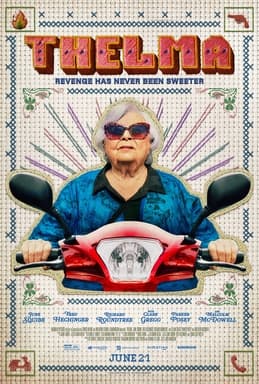
Poster / promotional material via Wikipedia, Thelma (2024 film). Used under fair use for criticism and review.
The temptation, with Thelma, was to review the story around it. June Squibb, 94 years old at the time of filming, starring in her first leading role after more than six decades of supporting work. Richard Roundtree, in his final performance before his death. A first-time director, Josh Margolin, making a small film about his actual grandmother. The packaging was made for uplift.
A year on from its release, the film itself is better than any of the packaging suggested. And it is better, specifically, because Margolin and Squibb refused the uplift.
What the film is
Thelma Post, a 93-year-old widow living alone in Los Angeles, receives a phone call from someone claiming to be her grandson in jail, asking her to wire $10,000 to cover bail. She does. It is, of course, a scam. Thelma realises this within minutes. The rest of the film is Thelma’s refusal to let the scammers keep the money, her decision to go get it back, and her recruitment of her late husband’s best friend Ben (Richard Roundtree) for the mission.
The film is structured as a deadpan action movie. The set pieces, an infiltration of a nursing home, a pursuit on a mobility scooter, a gun-adjacent confrontation in a suburban living room, are all played straight. The comedy arises from the age-inappropriate action-movie grammar being executed by two actors in their nineties and seventies.
What the film refuses
The easy version of Thelma would have been a stunt. An elderly-lead action comedy that leaned on the ironic juxtaposition for its laughs. Margolin’s film refuses this. Thelma is not played for laughs. Ben is not played for laughs. The scammers, whose final-act characterisation I will not spoil, are also not played for laughs.
What the film is actually about is the specific indignity of being an elderly person whose family has begun to treat them as an incompetent. Thelma’s daughter and grandson, played by Parker Posey and Fred Hechinger, are loving but increasingly convinced that Thelma should no longer be living independently. The action-movie premise, Thelma’s refusal to accept being scammed, is also the argument she is making to her family about her own continued agency.
June Squibb, properly led
June Squibb, across the film, is doing a specific kind of acting that she has not previously been given the canvas for. She plays Thelma as a woman with a lifetime of competence behind her, whose competence has, in the last few years, begun to slip in ways she is working hard to hide. The performance is built out of small adjustments: the specific way Thelma pretends she remembers the name of a grandnephew; the way she scans a room for the nearest handhold before crossing it; the way she gets up from a chair slower than she would like, but refuses to be helped.
These are details of actual old age, not of movie old age. Squibb has waited her entire career for a role that asked her to bring this specific material. She brings it.
Richard Roundtree’s last scene
Richard Roundtree’s Ben is the film’s emotional counterweight. Ben lives in an assisted-living facility that he has not fully reconciled with. His arc in the film is the arc of a man who is allowed, for a few hours, to be the version of himself who could still help. Roundtree plays this with a specific dignified weariness that stays with you.
The film was Roundtree’s last. He died in October 2023, before Thelma was released. Knowing this, on first viewing, I found one particular late scene, in which Ben decides what he wants to do about his assisted-living arrangement, almost unbearable to watch. On second viewing, a year after his death, the scene reads differently: not as a real-world farewell, but as a fictional character’s specific good choice, made inside the film’s own terms. That is the right way for the scene to have been staged, and Margolin has the tact not to lean on the extra-textual weight.
The Parker Posey problem
The film’s one wobble, for me, is Parker Posey’s role as Thelma’s daughter Gail. The character is written as anxious and slightly over-controlling, and Posey plays her at a specific pitch that is, in places, a little broader than the rest of the film’s naturalism supports. This is a small complaint. In scenes where Posey is allowed to be quieter, particularly a late-film kitchen scene with Squibb, the performance lands.
What the film signals
Thelma cost about $3 million to make. It grossed $13 million in US theatres, which is a significant success at that budget tier. It also re-legitimised, for this specific commercial window, the small-budget American indie whose marketing and success depend on specific word-of-mouth rather than on star presence or franchise recognition.
A year later, that economic signal looks more important than it did at the time. The indie market has continued to contract across 2024 and 2025. Thelma is the kind of film that ecosystem used to reliably produce, and that it no longer reliably does. Margolin has a second feature in development as of this writing. I hope he gets to make it.
Watch the film. Bring whoever in your family needs to be reminded that they are not, yet, as old as everyone around them has begun to assume.
Lena writes long-form essays on the films that will still be talked about in a decade. Previously at a defunct monthly whose name we do not speak.
MORE BY LENA ASHWORTH →
Anora's Best Picture Win, Defended
A year after Sean Baker's fourth feature took five Oscars including Best Picture, the predictable backlash has arrived on schedule. Here's why the Academy, improbably, got it right.
Between the Temples: Nathan Silver's Cantor
Nathan Silver's improvisational comedy about a grieving cantor and his retired music teacher is the specifically strangest American indie comedy in years. I keep coming back to it.
A Different Man: Aaron Schimberg's Face-Swap Comedy
Aaron Schimberg's 2024 comedy about an actor who gets a medical procedure and regrets it is the year's strangest mid-budget indie, and the one whose specific comic machinery I keep returning to.