Anora's Best Picture Win, Defended
A year after Sean Baker's fourth feature took five Oscars including Best Picture, the predictable backlash has arrived on schedule. Here's why the Academy, improbably, got it right.
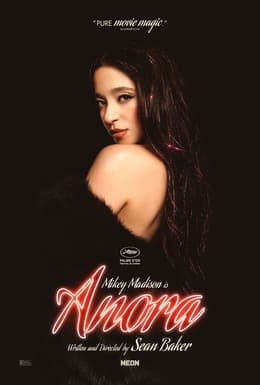
Poster / promotional material via Wikipedia, Anora. Used under fair use for criticism and review.
A year on from the 97th Academy Awards, Anora has entered the second phase of its reception, the phase in which the consensus of twelve months ago gets relitigated by people who have had time to sharpen their objections. You’ll have read them by now. That Sean Baker’s Palme d’Or and Best Picture double was a coronation out of proportion to the film. That the comedy runs too long. That the final act is a hand-held shaggy-dog sequence that the film doesn’t earn. That Mikey Madison’s performance was merely very good in a field of the year’s greater, quieter ones.
Some of those objections have a kernel of truth. Most don’t. I want to argue the bigger case: that Anora is not only the right Best Picture for 2024 but the right Best Picture that the Academy was in any realistic position to give that year.
The field it beat
Remember the field. The Brutalist, long and formally demanding. Conclave, expertly made but structurally a well-crafted procedural. The Substance, a horror film that the Academy was never going to crown, whatever its merits. Emilia Pérez, which was burning down through a separate and genuinely discrediting controversy by voting time. A Complete Unknown, a Bob Dylan biopic that did what Bob Dylan biopics do. Wicked, a first-half-of-a-musical with no second half to be judged against. Dune: Part Two, which had already had its coronation elsewhere. Nickel Boys, a formally radical adaptation of a novel whose formal radicalism the Academy was not going to reward. I’m Still Here.
This is not a weak field. It’s an interesting one. But among the films actually in contention, Anora is the one that most cleanly delivers the thing Best Picture should reward: a film whose direction, performances, editing, and argument are all pulling in the same direction with obvious control.
What Baker did
Sean Baker has been working on the same aesthetic proposition for fifteen years. Tangerine (2015) did it on an iPhone. The Florida Project (2017) did it with a Kodak 35mm and a child lead. Red Rocket (2021) did it with a hurricane and a Simon Rex performance that still feels underrated. The proposition: comedies of class that refuse both the sentimentality of the “humane portrait” and the cruelty of the “unflinching look.” Characters you like who do things that cost them. Situations you find funny because they’re specific, not because they’re flattering.
Anora is Baker at his most structurally confident. The film opens as one movie, a Pretty Woman setup, a whirlwind romance between a Brooklyn sex worker and a Russian oligarch’s son, a quick Vegas wedding that the film seems to be taking sincerely, and then, forty minutes in, becomes something else. The handlers arrive. The romance reveals itself to be someone else’s liability. And the film follows the liability through a long night of damage control that is, from that point on, neither a romance nor a comedy in any conventional sense. It’s a procedural about someone’s life being cancelled, in real time, by people who are not particularly cruel and not particularly kind. They just have a job.
Mikey Madison’s year
Mikey Madison’s Best Actress win was, at the time, one of the three or four biggest surprises of awards night. A year later, it doesn’t feel like a surprise at all. What she does in the back half of the film, the transition from bravado to desperation to something colder than either, is acting of the kind the Academy has historically rewarded when it’s done by more established actors. Madison is in her mid-twenties, this was her first leading role in a film at this scale, and the performance does not have a weak twenty seconds in it.
The long sequence in the second half of the film, where she’s being hustled from apartment to apartment by three men who are themselves not quite sure what they’re doing, is the best argument for her win. The men are played with comic precision. But Madison is doing something underneath the comedy, a kind of clench-jawed refusal to become the victim the scene keeps trying to cast her as, that gives the sequence its real weight. Without her performance, it plays as a broad ensemble comedy. With her performance, the comedy is a byproduct of her refusal to cry.
The final scene
There was a lot of writing, in the first months after release, about the film’s final scene. I won’t spoil it. I’ll say that it is the single most argued-over closing image of the last five years of American cinema, and that the arguments remain productive. Some read the scene as devastating. Some read it as sentimental. Some read it as something the film earned. Some read it as something the film reached for.
A year later, I’m in the first camp and more confident about it than I was. The scene works because Baker has spent the entire film teaching us to watch Ani’s body language, the way she composes herself, the micro-adjustments she makes in response to men, and the final scene is that training paid out. What happens in the car is not about the man. It’s about what she has learned, over the preceding two and a half hours, about who is allowed to be vulnerable in front of whom, and at what cost.
Call that sentimental if you want. I call it earned.
The Oscar as endorsement
The Academy is not, historically, good at this. It rewards period dramas, biopics, and well-made studio films. It rewards, occasionally, films that are obviously, formally, canonically Important. It does not often reward comedies, and it does not often reward films about sex workers who do not die by the end.
That Anora won Best Picture was, measured against that history, a small miracle. It was also, and this is the harder thing to say, the correct call on the merits. Not in a “it would be nice to see the Academy loosen up” way. In a plain “this was the best-directed, best-structured, best-performed film among the nominees” way.
A year on, I’d rather argue for it than against it. The backlash is coming from exactly the places you’d expect, and the film is still sitting there, pleased with itself, knowing what it is.
Lena writes long-form essays on the films that will still be talked about in a decade. Previously at a defunct monthly whose name we do not speak.
MORE BY LENA ASHWORTH →
Between the Temples: Nathan Silver's Cantor
Nathan Silver's improvisational comedy about a grieving cantor and his retired music teacher is the specifically strangest American indie comedy in years. I keep coming back to it.
Thelma: June Squibb's Late-Career Lead
Josh Margolin's debut feature gave June Squibb her first leading role at 94. It was not a stunt. It was a film.
A Different Man: Aaron Schimberg's Face-Swap Comedy
Aaron Schimberg's 2024 comedy about an actor who gets a medical procedure and regrets it is the year's strangest mid-budget indie, and the one whose specific comic machinery I keep returning to.