The Apprentice: The Trump Film Nobody Watched
Ali Abbasi's Trump origin story arrived in American theatres three weeks before the 2024 election, flopped, and has barely been discussed since. The film deserved better.
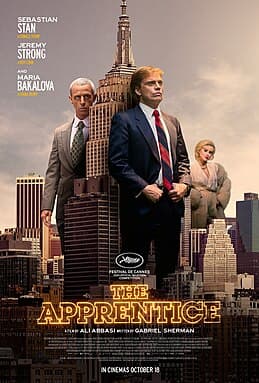
Poster / promotional material via Wikipedia, The Apprentice (2024 film). Used under fair use for criticism and review.
The Apprentice is, in purely commercial terms, the failed release of 2024. Ali Abbasi’s Donald Trump origin story, starring Sebastian Stan as young Trump and Jeremy Strong as Roy Cohn, opened in American theatres on October 11, 2024, twenty-six days before the presidential election. It earned $4 million in its domestic opening weekend, less than a tenth of what its producers had projected, and failed to expand meaningfully in subsequent weeks.
Most of the explanations offered at the time are correct. The film was dropped by its major distribution partners. It was released without the kind of marketing support a political-season film requires. It carried real-world legal threats from Trump’s team that scared other exhibitors. Audiences, understandably, had limited appetite for an origin story about a man whose actual ongoing presidency was, for them, a source of daily attention.
A year later, with the election resolved and some cultural distance acquired, I want to argue for what the film actually accomplished. The Apprentice is a very specific and very well-executed piece of political cinema, and its commercial collapse is not an argument against its quality.
What the film is
The film covers the years 1973 through the late 1980s, following a young Donald Trump (Sebastian Stan) as he falls under the mentorship of the lawyer-fixer Roy Cohn (Jeremy Strong). Cohn teaches Trump the three rules that will define his career: attack, deny everything, and never admit defeat. The film follows Trump’s rise through the New York real-estate scene, his abusive first marriage to Ivana, his increasing cocaine use, and his eventual betrayal of Cohn on Cohn’s deathbed.
The film is, structurally, a story about mentorship and about what a specific kind of teaching does to a specific kind of student. Cohn makes Trump. Trump then, when Cohn is dying of AIDS and has become a liability, discards him. The arc is biographically accurate and morally devastating.
Sebastian Stan, doing the hardest thing
Sebastian Stan’s Trump is the single hardest acting challenge any American actor took on in 2024. The temptation of the role, for any actor asked to play a public figure of this level of cultural saturation, is either to do an impression or to do a decisive re-interpretation. Stan refuses both routes.
What Stan does instead is play Trump as a specific young man in his twenties and thirties, before the mannerisms that the broader culture knows had fully ossified. The Trump of The Apprentice is unsure, even vulnerable in places, specifically because he is still forming. Stan plays the ossification happening in real time, scene by scene, under Cohn’s direct tutorial pressure.
This is a historically-precise performance. The early Trump was not yet the figure we know. The early Trump was genuinely coached, in specific ways, by specific people, into becoming the figure we know. Abbasi and screenwriter Gabriel Sherman have reconstructed this coaching with care, and Stan gives the reconstruction flesh.
Jeremy Strong, the other argument
Jeremy Strong’s Roy Cohn is the performance that should have dominated the awards conversation and was, instead, largely ignored because of the commercial failure of the film around it. Strong plays Cohn at three distinct phases of the character’s life: the power-broker lawyer in full command, the declining political operator losing his grip, and the dying man watching his protégé turn away.
Strong has, across his Succession years, developed a specific screen register for playing broken men whose power has been structural rather than personal. His Cohn is the apotheosis of this register. The performance is both loving (Cohn is, in the film’s portrayal, not a one-dimensional villain) and honest (Cohn is, in the film’s portrayal, responsible for specific lasting damage to American political culture).
The scene in which Cohn is dying in a hospital bed and Trump arrives to visit him, briefly, before leaving with a specific non-apology, is the film’s emotional climax and one of the best pieces of American acting of 2024. Strong does almost no speaking in the scene. He does not need to.
What Abbasi is doing
Ali Abbasi, whose previous films include the Iranian supernatural-thriller Border and the Iranian serial-killer procedural Holy Spider, is an unusual choice of director for a Trump biopic. The choice is, on reflection, exactly right. Abbasi is unbothered by American political reverence. He approaches the material with the specific flatness of a director who is not, himself, culturally implicated in the story.
This flatness is the film’s defining feature. The Apprentice does not sentimentalise or demonise. It documents. It shows what Cohn taught and what Trump absorbed and what the absorption cost both of them. There is no score-based emotional coaching. There is no triumphant moralising. The film treats its subject with a specific and clinical distance, and the distance is the moral position.
Why it should have been watched
Here is the argument. The Apprentice, viewed a year later, is perhaps the single most informative American film of the 2024 election year. It explains, in concrete biographical and psychological terms, how the specific political figure at the centre of that year was constructed. It shows the construction happening. It names the architect.
This is politically useful material, not as propaganda, but as specific biographical information that a democratic electorate would, in principle, benefit from having access to.
That American audiences largely did not watch it is, I think, partially a function of election-year exhaustion and partially a function of the specific distribution sabotage Trump’s legal operation achieved. Both factors are legitimate. Neither factor changes the fact that the film is good.
Where it sits
The Apprentice has had a slow afterlife on streaming. It is now, as of mid-2025, available more widely than it was during its theatrical release, and it is finding some of the audience it deserved. Sebastian Stan received an Oscar nomination for Best Actor. The film itself was not nominated for Best Picture, a decision that looks, on reflection, like a specific act of political timidity by the Academy.
Watch it. It is a serious film. It deserves to have been treated as one.
Marcus believes good criticism is an argument. He is almost always angry about something, usually for good reason. Horror is his first language.
MORE BY MARCUS VELL →
A Complete Unknown: Why the Dylan Biopic Works When Most Don't
A year after James Mangold's Dylan biopic arrived in the middle of a tired genre, the film's decisions keep looking smarter. An argument for the underrated music biopic of the decade.

Thelma: June Squibb's Late-Career Lead
Josh Margolin's debut feature gave June Squibb her first leading role at 94. It was not a stunt. It was a film.

Civil War: Alex Garland's Failure of Nerve
Alex Garland made a film about an American civil war and deliberately stripped out the politics. A year and a half later, the emptiness in the middle of Civil War is not a choice to respect. It is the thing that breaks the film.