Civil War: Alex Garland's Failure of Nerve
Alex Garland made a film about an American civil war and deliberately stripped out the politics. A year and a half later, the emptiness in the middle of Civil War is not a choice to respect. It is the thing that breaks the film.
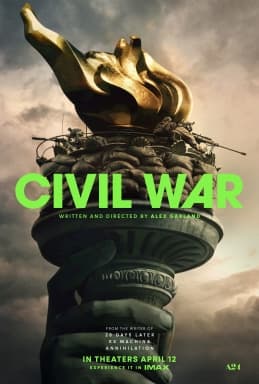
Poster / promotional material via Wikipedia, Civil War (film). Used under fair use for criticism and review.
I want to be fair to Civil War upfront. It is, at the level of craft, a competent war film. Kirsten Dunst gives a disciplined performance. Cailee Spaeny does the film’s emotional heavy lifting. Rob Hardy’s photography has a grim restraint that works. The set pieces, particularly the sniper sequence and the White House breach, are staged with a clarity that most American action filmmakers cannot manage.
A film can have all of those things and still be a moral dodge. Civil War, released in April 2024 and frequently cited since as one of the year’s important American films, is a moral dodge.
The premise and the evasion
The setup, briefly. An American civil war is underway. A coalition of California and Texas, the “Western Forces”, has seceded from a federal government run by a third-term president played, in a handful of short scenes, by Nick Offerman. Four journalists, Dunst’s Lee, a veteran war photographer, Spaeny’s Jessie, a rookie, Wagner Moura’s reporter, Stephen McKinley Henderson’s elder statesman, travel from New York to Washington to interview the president before the Western Forces take the capital.
The evasion, such as it is, becomes apparent in the premise itself. California and Texas, in 2024 America, are the two largest states at the two furthest political poles. The idea of them as coalition partners against a federal government requires specific American political contortions that the film refuses to explain. We are told, in one line, that the president has “banned the FBI” and is serving a “third term.” That is the entirety of the film’s account of why this war is happening.
Garland’s defenders argued, at the time, that the film is deliberately avoiding specifics to make a more universal point about political violence. I heard the argument. I did not find it convincing in April 2024 and I find it less convincing now.
Why vagueness is the problem
Here is the thing. Political violence, in the real world, has specific causes. People fight civil wars over specific disagreements, specific injustices, specific economic and ethnic and religious and geographic fault lines. When you make a film about an American civil war and refuse to say what people are fighting over, you are not making a film “about political violence in general.” You are making a film that has decided, for commercial or temperamental reasons, not to pick a side in the fight the audience would actually have to take a side in.
That is not neutrality. That is a specific American kind of bothsidesism, and it plays badly in a country where one of the two sides of the actual political divide has been, during the period of the film’s production, openly rehearsing the logic of constitutional collapse.
The journalism thesis
Civil War is, ostensibly, about journalism. The four journalists are the film’s moral centre. Lee, the hardened veteran, has lost her belief in the mission. Jessie, the rookie, still has it. The film is about whether the mission is still worth having, whether photography of atrocity can change anything, whether the journalists are documenting the collapse or profiting from it.
This is a serious question and the film does address it seriously in its final third. The sequence at the Washington checkpoint, in which a militiaman, played with terrifying precision by Jesse Plemons, asks each journalist “what kind of American” they are, is the film’s single best scene, and it does real work. The specific horror of that moment, a man with a gun deciding on the basis of accent and surname who gets to live, is the kind of specific horror the film largely avoids elsewhere.
But the journalism thesis is being asked to carry a political film that has refused its own politics. The weight is too much for the thesis to bear.
Dunst is right, the film is not
Kirsten Dunst’s Lee is the performance the film deserves. She plays Lee as a person who has seen too much specifically-political violence in other countries to be moved by the specifically-American version of it, and the film treats her exhaustion with appropriate respect. Her final act in the film, the specific thing she does in the final set piece, is the cleanest moral statement Civil War makes.
The problem is that her performance keeps wanting to be in a more serious film than the one Garland wrote.
The sniper sequence
The one sequence I still think about is the sniper exchange. Our four journalists stumble upon a firefight between two soldiers pinned down in a field and a sniper they cannot see. They ask what side the soldiers are on. The soldiers do not understand the question. The enemy is the person shooting at them. That is what the enemy is. “Us versus them” has, under fire, become literal, immediate, tactical.
This sequence works. It is, in fact, the film’s argument in compressed form: that political violence strips ideology away and leaves only the pragmatic question of whether the bullet is incoming. As a snapshot of a war zone, it is true.
But Civil War wants us to generalise from the sniper field to the entire conflict, and the generalisation will not hold. Real civil wars are not fought by soldiers who no longer know why they are fighting. They are fought, at the leadership level, by people who know exactly what they want. The film’s politics are not the soldiers’ politics. The film’s refusal to have politics is the film’s own decision, and it cannot be displaced onto the grunts in the field.
What it means now
In the eighteen months since release, the American political situation has continued to clarify in exactly the ways Civil War was careful not to acknowledge. A film that could have been a serious intervention has, in hindsight, come to feel like a missed opportunity at best and an act of cowardice at worst.
Garland, whose Men and Ex Machina are both more rigorous films about more difficult subjects, is capable of better. I hope, on his next film, he does the thing Civil War refused to do: pick a side, defend it, take the commercial risk.
Until then, the film is what it is. Technically competent. Politically hollow. Watch the sniper sequence. Skip the rest.
Marcus believes good criticism is an argument. He is almost always angry about something, usually for good reason. Horror is his first language.
MORE BY MARCUS VELL →
We Live in Time: Crowley's Non-Linear Gamble
John Crowley's third collaboration with A24 runs the ten-year relationship in a non-linear shuffle, and the shuffle is what makes the film survive its cancer-drama premise. Just barely, but it does.
Warfare: Mendoza and Garland's Real-Time Iraq
Ray Mendoza and Alex Garland's second collaboration rebuilds a 2006 Ramadi engagement from the memories of the men who survived it, and the film's claim on attention is its specific refusal to shape.
A Different Man: Aaron Schimberg's Face-Swap Comedy
Aaron Schimberg's 2024 comedy about an actor who gets a medical procedure and regrets it is the year's strangest mid-budget indie, and the one whose specific comic machinery I keep returning to.