The Seed of the Sacred Fig: Rasoulof's House Film
Mohammad Rasoulof shot the film in secret, fled Iran during post-production, and arrived at Cannes with a three-hour domestic thriller about a judiciary father and his protesting daughters. The retrospective argument is that the long cut is the cut.
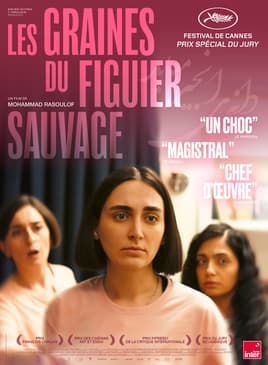
Poster / promotional material via Wikipedia, The Seed of the Sacred Fig. Used under fair use for criticism and review.
Mohammad Rasoulof made The Seed of the Sacred Fig while under an eight-year prison sentence imposed by the Iranian judiciary. He shot in secret, with a small crew, on locations that could plausibly be read as incidental rather than cinematic. When the Iranian authorities moved to enforce the sentence in May 2024, he crossed the border on foot and reached Germany in time to attend the film’s Cannes premiere. The film won the Special Jury Prize and was Germany’s 2025 submission for the International Feature Oscar. Neon handled US distribution; the film opened in New York in November 2024, expanded gently through early 2025, and finished its theatrical run at around $1 million domestic.
That production story is where discussion of the film usually begins and, too often, ends. It should not. The film is the achievement, not its circumstances.
What the film is
Iman (Missagh Zareh), a mid-level jurist in Tehran’s revolutionary court, has just been promoted to investigating judge. The promotion confers a company pistol, a secure apartment, and a specific new proximity to the machinery of the state. His wife Najmeh (Soheila Golestani) and his two teenage daughters, Rezvan (Mahsa Rostami) and Sana (Setareh Maleki), are told to be discreet about his work.
The film’s first hour sets up the household. The promotion coincides with the 2022 Mahsa Amini protests. Rezvan and Sana are watching the protests on Instagram; Najmeh is trying to maintain the family’s facade of political neutrality; Iman is signing off on judicial decisions he has not read, at a volume that suggests he is part of an apparatus executing protesters in numbers the press is not permitted to report.
Iman’s pistol disappears from the apartment. He believes one of the women in his household has taken it. The second half of the film is the family’s disintegration under his investigation of them.
What Rasoulof is doing
The film is three hours long. The length is not incidental. Rasoulof is asking the viewer to watch, in near real time, a judicial apparatus turn itself on the household it has been supporting. The tempo of the middle act (the interrogations, the searching of phones, the isolation of each daughter in turn) is the tempo of an actual carceral process. Rasoulof’s working method, across his career, has been to apply the pace of political reality to narrative film. There Is No Evil (2020) did it with capital punishment. A Man of Integrity (2017) did it with rural corruption. The Seed of the Sacred Fig applies it to the household.
The specific formal move is to fold documentary protest footage (largely vertical phone video, clearly taken from Iranian social media during the 2022 protests) into the narrative. Rezvan and Sana watch the footage on their phones; the footage then occasionally appears at full screen, without narrative framing, inserted into the film as a kind of interruption. The effect is that the film is aware, at every moment, of the reality its fiction is costuming.
The performances
Soheila Golestani, as Najmeh, gives the film its difficult centre. Najmeh has spent the marriage managing Iman’s state career, and she is the first to understand that the apparatus she has been domesticating is going to come for her daughters. The performance is mostly interior. Golestani plays Najmeh’s slow arrival at the recognition that her husband is, in any functional sense, dangerous, and that the house they share is the site of the danger.
Missagh Zareh, as Iman, has the harder assignment. Iman is not a monster. He is a civil servant who has convinced himself that the work he does is administrative rather than violent. Zareh plays the collapse of that conviction, across the film’s final hour, with an escalating physical presence that the earlier hours do not prepare the viewer for. Iman becomes, in the final third, physically imposing in ways he has not been until his authority is challenged by his own daughters. The performance is specifically frightening because it is continuous with the earlier domestic scenes. The same man is in both registers.
Mahsa Rostami and Setareh Maleki, as the daughters, are the film’s moral engine. Rezvan is older, more cautious, more compromised by the household’s terms. Sana is younger, less negotiable, more clearly in sympathy with the street protests. The two performances are carefully differentiated; the sisters are not a unit. They respond to their father’s investigation with different risk calculations, and the specific grain of those calculations is the film’s most politically observant element.
The final act
The final hour takes the family to Iman’s childhood village, where Iman believes he can isolate and question the women outside the city’s surveillance. The village sequence is shot in open landscapes, with long takes, in a register that recalls Kiarostami’s rural films. The tonal shift is significant. The film has, until this point, been a domestic interior drama. The village opens it onto a wider physical space, and the violence that has been threatened in the apartment becomes physical in the landscape.
I will not describe the resolution. I will say that Rasoulof commits to an ending that refuses the consolation the preceding three hours have earned. The refusal is the film’s final political claim. A narrative resolution would, in the context of the film’s subject, be a betrayal of the subject. Rasoulof does not offer one.
The cinematography and editing
Pooyan Aghababaei shot the film under conditions the film itself cannot explicitly acknowledge. The image is handheld, in available light, with the compositional restraint of a film that could not afford to stage anything twice. Andrew Bird, the editor, holds the conversation scenes past their conventional length; the viewer is given time to notice which silences are choices and which are withholdings. The film’s pace is the pace of its subject.
Where it sits
The Seed of the Sacred Fig will have a long afterlife. It is one of the two or three best political thrillers made in this decade, and the strongest recent entry in a specifically Iranian tradition (Panahi, Makhmalbaf, Farhadi, Rasoulof himself) of films made under censorship that end up formally more serious than the films being made in systems without it.
Neon’s commitment to the film in the US is the kind of work the specialty distribution ecosystem still does occasionally well. Watch it at home with three hours cleared, at night, with no interruption. The film does not reward half-attention. It rewards giving it the tempo it was made in.
Lena writes long-form essays on the films that will still be talked about in a decade. Previously at a defunct monthly whose name we do not speak.
MORE BY LENA ASHWORTH →
We Live in Time: Crowley's Non-Linear Gamble
John Crowley's third collaboration with A24 runs the ten-year relationship in a non-linear shuffle, and the shuffle is what makes the film survive its cancer-drama premise. Just barely, but it does.

Love Lies Bleeding: Rose Glass Goes Pulp
Rose Glass's second feature dragged the lesbian bodybuilder noir into A24 territory and got reviewed as a tonal mess. The case I want to make is that the tonal mess is the movie, and the movie earns it.

Anatomy of a $200M Musical Flop: What Killed Folie à Deux
Eighteen months after Todd Phillips' much-hated sequel opened to a $37 million weekend and a 30% audience score, it is time to autopsy the corpse. The film isn't good. It also isn't quite what you've been told.