We Live in Time: Crowley's Non-Linear Gamble
John Crowley's third collaboration with A24 runs the ten-year relationship in a non-linear shuffle, and the shuffle is what makes the film survive its cancer-drama premise. Just barely, but it does.
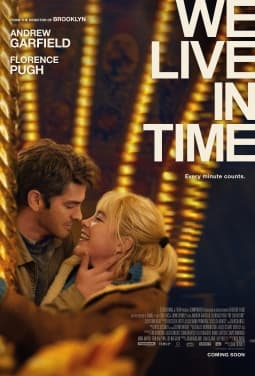
Poster / promotional material via Wikipedia, We Live in Time. Used under fair use for criticism and review.
I have a difficult relationship with what the industry has taken to calling the “illness-romance” subgenre. Love Story. Sweet November. Me Before You. The Fault in Our Stars. The form has a specific sentimental gravity that I find it difficult to engage with honestly. Most films in the form are emotional manipulation at the specific register of asking the viewer to cry on cue, and the specific manipulations are usually clumsier than the films think they are.
We Live in Time is an illness-romance. John Crowley directs. Nick Payne, the playwright behind Constellations, writes. Andrew Garfield and Florence Pugh play the two leads. A24 distributed it in October 2024. It grossed around $18 million globally, which is specifically strong for its register. I went into it specifically resistant.
I was, it turns out, wrong to be resistant. Not completely wrong. The film is not without its specific manipulations. But it is a smarter and more formally disciplined illness-romance than the form usually produces, and the specific reason is the structural choice Payne built the screenplay around.
What the film is
Almut (Florence Pugh), a London chef, and Tobias (Andrew Garfield), a Weetabix cereal-company executive (it is specifically this detail that the film keeps returning to), meet when she hits him with her car. This is the specific opening scene, and it is specifically a romantic comedy beat. They begin dating. They move in together. They have a daughter, Ella. Almut is diagnosed with ovarian cancer. The cancer goes into remission. The cancer returns. The film tracks the relationship across approximately ten years.
But the film does not track the relationship in order. The narrative is cut into approximately three alternating timelines: early relationship, mid-relationship-including-pregnancy, and late relationship-including-cancer. The scenes shuffle across the three timelines without specific chronological markers. The viewer reconstructs the timeline from specific visual and situational cues.
Why the shuffle matters
The non-linear structure is the film’s specific argument. Payne is writing against the illness-romance convention of building toward the specific emotional climax of the illness’s resolution. By shuffling the timeline, the film denies the viewer the specific narrative anticipation the convention relies on. We know, from early in the film, that Almut will have cancer. We know, from early in the film, that she will survive some portion of it. We know, from early in the film, that they will have a daughter.
What we do not know is the specific shape of a given scene we are watching. Is this scene early love, or late love? Is this scene before the diagnosis, or after the remission? The film uses specific haircut continuity, specific wardrobe choices, and specific environmental cues to situate each scene, but the situating is the viewer’s active work across the running time.
The effect is that the film becomes, specifically, a meditation on the temporal structure of a relationship rather than on the specific plot points of illness narrative. What we are watching is not a specific story moving forward; it is a specific life already lived, reconstructed in the way memory reconstructs lives: in associations, in specific returns, in emotional adjacencies rather than chronological order.
The Pugh and Garfield performances
Florence Pugh, as Almut, is the film’s specific centre of gravity. Pugh has been, across the last five years, the English actress whose specifically naturalistic performance register has most consistently elevated the material she is in (Lady Macbeth, Midsommar, Little Women, the Dune films). Here she is working with specifically different demands. Almut is healthy. Almut is dying. Almut is recovering. Almut is actively parenting. Pugh has to play all of these states across the shuffled timeline, often adjacent to each other in the edit.
What she does specifically well is maintain a specific physical continuity across the states. Almut’s body across the film is specifically Pugh’s body, adjusted for the specific physiological conditions of each timeline strand. The specific weight of post-chemotherapy exhaustion. The specific energy of early-relationship possibility. The specific fatigue of ongoing parenting. Each state is specifically embodied in ways that do not rely on makeup or prosthetics to signal.
Andrew Garfield, as Tobias, has the film’s quieter performance. Tobias is specifically a steady person. He is not a narrative engine. What Garfield plays is the specific quality of being present to another person across a decade of shared life, including the specific difficulties of that presence during illness. The performance is specifically generous to the actor opposite him. Garfield is, across the running time, specifically attending to Pugh.
Their chemistry is the film’s specific achievement. The two performers have found a specific comfort with each other that reads as years of relationship rather than as rehearsed scenework. The small specific physical comfort of two people who have lived together is specifically present in the scenes that depict the lived-together condition.
The specific scene I keep thinking about
The film’s centrepiece, for me, is a specific sequence in a petrol-station bathroom during Almut’s labour. The scene is played for specific comedy. Almut is in active labour. They have not made it to the hospital. Tobias is specifically panicking. The scene is specifically funny, specifically tense, specifically physical. It is also, specifically, the beginning of their daughter’s life, and the scene is staged with a specific attention to the specific extremity of childbirth that the illness-romance tradition has largely refused to depict.
The sequence ends with the specific first moments of the baby’s life on a petrol-station bathroom floor. The film does not over-light the scene. It does not score it extravagantly. It simply records the specific occurrence at the specific register of what it was. The specific refusal of sentimental staging is, for me, where the film earns its tonal permissions.
The Crowley direction
John Crowley has made Boy A (2007), Brooklyn (2015), The Goldfinch (2019), and now this. His directorial temperament is specifically patient, specifically focused on performers, specifically unwilling to push scenes past the performers’ specific register. We Live in Time is the film where the patience most specifically serves the material. The shuffled timeline requires the viewer to maintain specific emotional engagement across fragments; Crowley’s specific commitment to each fragment as a complete scene is what makes the fragmentation cumulative rather than dispersive.
Stuart Bentley’s cinematography gives the film a specific soft-lit domestic register: bathroom lights, kitchen fluorescents, the specific green of English gardens. The visual continuity is specifically maintained across the timeline strands, which would be easier if the film were linear; the specific work of keeping the look consistent across non-chronological scenes is an editorial achievement (Justine Wright edits) more than a cinematographic one.
Where it sits
We Live in Time is the specific illness-romance that the form has needed for some time. It will not resolve the genre’s specific tendencies, but it demonstrates that the form can still produce specifically formally serious films when the specific right people are making them. A24’s continued willingness to fund this register is the specific industrial condition that made the film possible.
Watch it with someone you love, with specific preparation for the specific emotional register it operates at. It will make you specifically cry. The crying is, at least in this case, specifically earned.
Jules writes the kind of pieces that come from wandering somewhere and overhearing something. On Frame Junkie's masthead since the beginning.
MORE BY JULES OKONKWO →
Hard Truths: Leigh's Return to Pansy
Mike Leigh's first film since 2018 reunited him with Marianne Jean-Baptiste for a character study of sustained anger. The argument is that the film is one of his best, and the conditions that produced it are the ones his method has been waiting to find.
Bird: Arnold's Kent Fable
Andrea Arnold's fifth feature split the reviews, and the split was real. The retrospective argument is that the film's unexpected magical turn is not a failure of the social-realist grammar, it's what the grammar was always walking toward.
A Different Man: Aaron Schimberg's Face-Swap Comedy
Aaron Schimberg's 2024 comedy about an actor who gets a medical procedure and regrets it is the year's strangest mid-budget indie, and the one whose specific comic machinery I keep returning to.