Saltburn: A Thin Reading of the English Country House
Emerald Fennell's second feature wants to be a class-war satire and a Brideshead pastiche and a body-horror provocation. It pulls off one of the three, sometimes two.
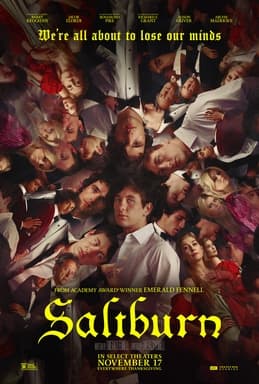
Poster / promotional material via Wikipedia, Saltburn (film). Used under fair use for criticism and review.
Let me get the thing that works out of the way first. Barry Keoghan, as Oliver Quick, is doing excellent work in Saltburn, and the film is, whenever it is trained on him, an interesting film. Keoghan is one of the two or three most committed young actors in English-language cinema, and his performance here, a controlled, watchful, opaque rendering of a man pretending to be two or three different people in sequence, is the single thing in the film that is unambiguously good.
The rest of Saltburn, which opened in late November and has been drifting through its commercial run through the winter, is considerably less certain.
The film’s surface
The plot, briefly. Oliver Quick, a working-class Oxford student, befriends and then becomes obsessed with Felix Catton, a beautiful aristocrat, played by Jacob Elordi. Felix invites Oliver to spend the summer at his family estate, Saltburn. Over the course of the summer, Oliver’s position in the household shifts in ways that the film signals, ambiguously, might be accidental or might be the result of a careful long con. A body-horror-adjacent provocation lands in the final reel. Oliver dances naked in a hallway.
Saltburn has been marketed, and to some extent received, as a class-war satire in the Patricia Highsmith/Talented Mr. Ripley tradition. This is where I want to push back. Saltburn is not, finally, a class-war satire. It is a Brideshead pastiche with a Highsmith-shaped hole cut out of it, and the hole is where the politics would go if Fennell were actually interested in them.
What Fennell cares about
Promising Young Woman, Fennell’s 2020 debut, revealed a specific directorial sensibility: high-gloss production design, a willingness to be shocking, a loose hand with narrative logic when the provocation is worth the logic cost. Saltburn continues all of these tendencies, arguably at higher intensity.
The thing Fennell cares about, visible in both films, is the tableau. She shoots Saltburn as a sequence of extraordinary, extremely composed static images of beautiful rich people doing beautiful rich-person things. The production design by Suzie Davies is genuinely outstanding. Linus Sandgren’s cinematography is, across the summer sequences, magnificent.
But the images are the point, and the class politics are, mostly, a scaffold for the images. When Oliver dances naked through the halls of Saltburn at the end, set to Sophie Ellis-Bextor’s “Murder on the Dancefloor,” the moment is designed as an iconic image first and a character moment second. Social media confirmed that design: the sequence has become the film’s most reproduced fragment, divorced almost entirely from its narrative context.
Where the Ripley comparison breaks
Patricia Highsmith’s novel is about class in a specific and disciplined way. Ripley’s murders are staged as the logical endpoint of a system that denies working-class Americans access to the European leisure economy. The Greenleaf family, in the novel, are specifically characterised as a certain kind of complacent American wealth; their treatment of Tom is the novel’s moral engine.
Saltburn’s Catton family are not specifically characterised. Rosamund Pike’s Elspeth is a collection of witty lines about famous people she used to know. Richard E. Grant’s Sir James is a diffuse amiable background figure. Archie Madekwe’s Farleigh, the Black American cousin, is the film’s single best-drawn aristocrat, and Madekwe is the film’s second-best performance, but he is a supporting role at best.
Without a specific account of what kind of wealth the Cattons represent, and what kind of injustice that wealth is built on, the class-war reading loses traction. Oliver’s vengeance, if it is vengeance, is not clearly a vengeance against anything. It is a vengeance for its own sake, and “vengeance for its own sake” is not a class politics, it is a mood.
The final act
The final-act reveal, which I will not spoil in detail, asks us to retroactively reinterpret large chunks of the film as the product of Oliver’s cunning long-con. I was, on first watch, willing to buy the reveal. On reflection, the math does not work. Too many of the turns in the middle of the film require Oliver to have had information he could not plausibly have had at the time, and too many of the Cattons’ decisions require a specific combination of stupidity and compassion that the film has not established.
A tighter film, 15 minutes shorter, with two fewer major characters, could have pulled the reveal off. Saltburn at 131 minutes cannot.
What the film is, then
Strip away the Highsmith framing and the class-war pose, and what is Saltburn? It is a well-produced, sometimes gorgeous, often provocative, structurally wobbly film that takes enormous narrative risks and mostly does not pay them off. Keoghan is great. The production design is great. The sequence at the bathtub, the sequence at the grave, the final dance: these are memorable images, and the film deserves credit for making them.
It does not, however, deserve to be positioned as a serious class-politics film, because the politics are absent and the positioning is marketing.
Where it will sit
Saltburn has had an interesting second-life on streaming. The film opened to middling reviews and then, on Amazon Prime, became a genuine cultural moment in early 2024, particularly with viewers too young to have read Highsmith or seen Brideshead Revisited. The sequences that work in isolation (the dance, the bathtub, the grave) travel well on social media. The film has, in other words, found its audience at the level of images.
Fennell’s next film will tell us whether she is a director growing into a voice or a director building a brand. I am, on present evidence, betting on the brand. I would be happy to be wrong.
Watch Saltburn once, at home, with the assumption that it is not what it is selling itself as. The dance will still work. The rest will land better if you were not expecting Highsmith.
Marcus believes good criticism is an argument. He is almost always angry about something, usually for good reason. Horror is his first language.
MORE BY MARCUS VELL →
Megalopolis: Coppola's $120 Million Argument With Himself
Francis Ford Coppola self-funded his first film in thirteen years. It is nearly unwatchable in specific places and almost-great in others. The project is the point.

Cuckoo: Tilman Singer's Weird Alpine Fever Dream
Tilman Singer's second feature is one of the weirdest mid-budget horror films of the year, and one of the least bothered about making sense. An argument for the horror film that works on dream logic.

Strange Darling: A Formal Con in Six Parts
JT Mollner's non-linear indie thriller has a gimmick and knows it. A case for the film that uses its structural trick as an actual argument.