Strange Darling: A Formal Con in Six Parts
JT Mollner's non-linear indie thriller has a gimmick and knows it. A case for the film that uses its structural trick as an actual argument.
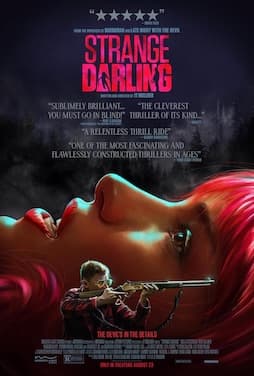
Poster / promotional material via Wikipedia, Strange Darling. Used under fair use for criticism and review.
Strange Darling, JT Mollner’s sophomore feature released in late August, is one of the year’s most structurally playful films and, for specific audiences, one of its most satisfying horror-thriller experiments. It is also a film that is deeply hostile to being described, because its central structural gimmick is the thing the film is about and also the thing any description of the film would ruin.
I am going to try to write about it without giving away the specific twist. Readers who have not seen it should probably bookmark this piece and come back.
What can be safely said
The film is structured in six explicitly-labelled chapters, presented out of chronological order. The chapters are titled (Chapter 3, Chapter 5, Chapter 1, Chapter 4, Chapter 6, Chapter 2, or similar). The film opens with a chase through rural Oregon wilderness in which a woman, played by Willa Fitzgerald, is being pursued by a man, played by Kyle Gallner. The subsequent chapters, presented out of order, slowly recontextualise this opening scenario.
Mollner wrote and directed the film. Giovanni Ribisi, making his cinematography debut, shot it on 35mm film. The cast is compact (Fitzgerald and Gallner are on screen for the majority of the running time, with a handful of supporting performances). The film runs 96 minutes.
What the film is doing
The non-linear structure is not, as some critics at the time claimed, a gimmick in service of nothing. It is a specific rhetorical strategy. The film is teaching the viewer, across its six rearranged chapters, to make specific assumptions about each character, and then systematically recontextualising those assumptions as new information arrives.
This is the Memento move, and it is also the Arrival move, and it has been done, in various forms, across American cinema for twenty-five years. What Strange Darling adds is a specifically contemporary politics about gendered assumption. The film’s central trick depends on the viewer making specific assumptions about who is the victim and who is the predator in the opening scenario, assumptions that the film’s mid-sequence chapters invite the viewer to double-check.
I am deliberately being vague, because the specific shape of the revision is what the film is about. Audiences who come to the film cold have the strongest experience.
The Willa Fitzgerald performance
Willa Fitzgerald, previously known for television work (Reacher, Scream: The TV Series), is the film’s lead, and her performance is the anchoring achievement. The role asks her to play, across the non-linear structure, several effectively-different characters, each consistent with a different reading of the narrative. Fitzgerald manages to be all of these simultaneously. The performance is recognisably the same person across the chapters, even as the character’s moral and practical position is being continuously reframed.
This is a very difficult acting challenge. Fitzgerald delivers it with a specific unnerving calm that is the film’s most consistent tonal thread. She has, effectively, made the decision to play every scene as if the viewer already knows the twist, which means her performance is readable differently on first and second viewing, and both readings are coherent.
Kyle Gallner, matched
Kyle Gallner’s counterpart performance is less structurally ambitious but equally well-calibrated. Gallner, who has been a reliable character actor across indie horror for more than a decade, plays his role with a specific jittery intensity that registers, on first viewing, as one thing and, on second viewing, as something structurally different.
The chemistry between Fitzgerald and Gallner, in the scenes that predate the film’s opening action (ie, the chronologically-earlier chapters revealed later), is the film’s single most unnerving element. Mollner has shot these scenes with the specific intimate register of a romantic drama, and the register is the point.
The Ribisi cinematography
Giovanni Ribisi, the actor turned cinematographer for this film, shoots Strange Darling with a specific 35mm-film grain that is increasingly rare in contemporary indie production. The visual register is deliberately old-school: specific magic-hour compositions, deliberately shallow focus, specific saturation choices that evoke 1970s American thrillers.
The visual choice is consistent with the film’s larger formal project. Strange Darling is, in its deepest structure, an homage to the specific kind of 1970s-1980s psychological thriller (Badlands, The Vanishing, The Honeymoon Killers) whose tropes the film is reworking for a contemporary gender politics. The 35mm texture is part of the homage.
Where the film is weakest
One complaint. Strange Darling has, in its final twenty minutes, a sequence of revelation that moves faster than the earlier, more patient chapters prepared for. The final chapter (whatever chapter the film chooses to end on) has to deliver a specific amount of retroactive-clarity work, and the pacing of that delivery is less disciplined than the rest of the film.
This is a small complaint. The film overall commits to its structure cleanly. The last twenty minutes pay off the setup, even if they pay off at a slightly quicker tempo than ideal.
Where the film sits
Strange Darling has made about $11 million on a reported $2.3 million budget. By any indie-horror standard, this is a very successful commercial run. The film is already being discussed in specific-film circles as one of the year’s most formally interesting American independent releases.
Mollner has confirmed he is at work on a third feature. Whatever he does next, the Strange Darling model (compact cast, non-linear structure, moderate budget, specific film-stock commitment) is a viable production template for the next generation of American indie filmmakers. The film is an argument for its own method.
Watch Strange Darling without reading more about it. Watch it alone. Watch it again, two weeks later, once you know the specific shape of the revision. The second watch is the one that delivers the argument.
Marcus believes good criticism is an argument. He is almost always angry about something, usually for good reason. Horror is his first language.
MORE BY MARCUS VELL →
Cuckoo: Tilman Singer's Weird Alpine Fever Dream
Tilman Singer's second feature is one of the weirdest mid-budget horror films of the year, and one of the least bothered about making sense. An argument for the horror film that works on dream logic.
Trap: Shyamalan's Attention Problem
M. Night Shyamalan's August 2024 thriller had a genuinely great first act and two acts that could not sustain the premise. A year later, the unevenness is worth thinking about.
Beetlejuice Beetlejuice: The Rare Legacy Sequel That Remembers What the Original Was
Tim Burton returns to Beetlejuice after 36 years and makes a legacy sequel that actually works, mostly because he refused to make a serious one.