Megalopolis: Coppola's $120 Million Argument With Himself
Francis Ford Coppola self-funded his first film in thirteen years. It is nearly unwatchable in specific places and almost-great in others. The project is the point.
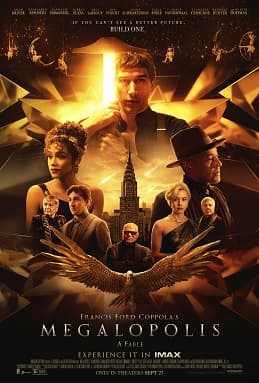
Poster / promotional material via Wikipedia, Megalopolis (film). Used under fair use for criticism and review.
Francis Ford Coppola, eighty-five years old, spent more than four decades trying to get Megalopolis made. The project originated in the early 1980s. He wrote and rewrote scripts. He attempted productions in the 1990s and 2000s that collapsed under studio pressure. He self-financed the film over the last decade, reportedly contributing somewhere around $120 million of his own money, most of it from the sale of parts of his winery business, to get it finished.
The film opened in American theatres in September and is, by any conventional measure, a commercial disaster. It will make, perhaps, $15 million against its production cost. The reviews have been, on balance, unkind. Audiences have mostly declined to show up.
Here is the thing. Megalopolis is a mess. It is also, in specific sequences, the most ambitious American film of 2024. I want to try to say something useful about it that acknowledges both facts.
What the film is trying to be
Megalopolis is, nominally, a near-future allegory about a Roman-Empire-coded New York (“New Rome”) whose collapsing civic order is being challenged by an idealist architect-scientist named Cesar Catilina, played by Adam Driver. Catilina has invented a substance called “Megalon” that can be used to build a utopian city of the future. The mayor, Cicero (Giancarlo Esposito), opposes the project for political and personal reasons. Catilina has the additional ability to stop time, which the film introduces without significant explanation or structural consequence.
The film is dense with political allegory (Roman history, Catilinian conspiracies, specific parallels to American political decline), scientific mysticism, family melodrama, visionary architecture, and a specific recurring theme about the responsibility of the artist-visionary to a degraded civic public. All of these threads are, at various points, taken up and dropped.
Where the film is unbearable
I am going to be specific about the failures, because they are real. Megalopolis has a tonal problem from its opening minutes. The film’s register oscillates between straight-faced epic (“Cesar is trying to build a better world”) and campy self-parody (“Shia LaBeouf’s Clodio is giving a specific performance register that cannot co-exist with the film’s stated ambitions”). The oscillation is not controlled. Different scenes are in different films.
The screenplay, credited to Coppola, has specific problems at the level of individual lines of dialogue. Characters frequently speak in declamatory aphorisms that read as if translated from an earlier draft in a different language. Jon Voight’s character, specifically, is given lines that are so strange they almost read as satire; except the film is not, on balance, operating in a satirical register.
The film’s central romantic plot (Cesar’s relationship with Cicero’s daughter Julia, played by Nathalie Emmanuel) is underwritten. The film’s political plot is under-staged. The film’s central mystical concept (Cesar’s time-stopping ability) is neither dramatically activated nor narratively explained.
These are real problems. No defence of the film can dismiss them.
Where the film is great
And yet. There are specific sequences in Megalopolis that are as formally ambitious as anything in American cinema in the last fifteen years.
The opening sequence, in which Cesar stands on the ledge of the Chrysler Building and stops time for a minute of held stillness, is genuinely extraordinary. The photography by Mihai Mălaimare Jr. is operating at a level of visual ambition that very few contemporary American films attempt. The circus sequences, in which Clodio orchestrates the public humiliation of Cesar, have a specific theatrical maximalism that reads like a fever dream of 1970s-era Coppola.
The film’s final third, which I will not spoil in specifics, contains a sequence of architectural unveiling that I have gone back to three times. The idea the film is reaching for (a specifically Coppola idea about visionary architecture as civic rescue) does not quite land, but the sequence itself, in its ambition and its willingness to be sincere about the possibility of utopia, is the kind of thing that American cinema almost never does.
What Driver is doing
Adam Driver’s Cesar is the performance the film is built around, and Driver is, as ever, fully committed. What he does specifically, across the running time, is play Cesar with a specific Christ-figure humility undercut by a specific arrogance. Cesar is a man who believes he is saving humanity and who is, also, insufferable about it. Driver plays both registers without flinching.
The performance is not, I think, going to be remembered as Driver’s best. The film does not give him the kind of character development that his previous auteur-driven performances have been built on. But within the constraints the film imposes, Driver is doing everything the role can support.
The project is the point
Here is what I keep coming back to. Megalopolis, as a film, is a mixed and often-failing object. Megalopolis, as a project, is the specific act of an eighty-five-year-old filmmaker who has, across a half-century career, earned every dollar of American cultural respect there is, spending a meaningful portion of his personal fortune to make a film nobody will commercially reward him for.
This is a specific kind of artistic insistence. Coppola is, across this film, making an argument about what American cinema should still be permitted to attempt. The argument is: large-scale, expensive, unashamedly earnest, formally adventurous, politically ambitious films, made by specific filmmakers with specific visions, should continue to exist. The argument is correct. The film that delivers the argument is partially broken.
Both things can be true at the same time.
Where the film goes from here
Megalopolis will not, commercially, recover. It will be studied, across the next decade, as a specific kind of late-career auteur project whose ambitions exceeded its execution. It will be defended by specific critics and rejected by others. It will, I suspect, age into a specific cult-respect that its first-week reception did not offer it.
Coppola, as of this writing, has announced a follow-up project. I hope he gets to make it. The industry owes him the space, whether the audiences show up or not.
Watch Megalopolis once, with generous expectations and low specific expectations. The sequences that work are worth finding. The sequences that do not are easier to forgive in context.
Lena writes long-form essays on the films that will still be talked about in a decade. Previously at a defunct monthly whose name we do not speak.
MORE BY LENA ASHWORTH →
Poor Things: Lanthimos Unleashed
Emma Stone's performance as Bella Baxter does something almost no leading actress is allowed to do in a studio film: she becomes less polite, less articulate, less easy to root for, and the film rewards her for it.

The Wild Robot: Animation, Still
Chris Sanders' adaptation of Peter Brown's novel is the best animated feature of the year and an argument for DreamWorks doing specifically what Pixar has stopped doing.

Alien: Romulus and the Legacyquel Problem
Fede Álvarez's Alien entry is a competent piece of horror filmmaking that wants, urgently, to remind you of other films. The reminders are where it falters.