The Room Next Door: Almodóvar in English, Finally
Almodóvar's first English-language feature is the film he has spent his whole career preparing to make. A year later, the patience was worth waiting for.
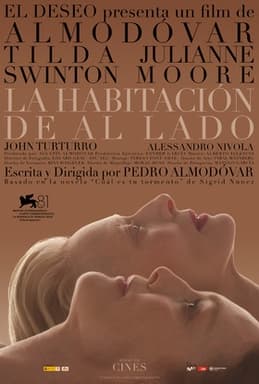
Poster / promotional material via Wikipedia, The Room Next Door. Used under fair use for criticism and review.
Pedro Almodóvar has spent fifty years saying he would never make a film in English. He has written English-language scripts (Pain and Glory in an early form, a version of A Manual for Cleaning Women) and declined to direct them, each time citing the same reason: he would lose the specific tonal register that the Spanish language gives him.
He was right, and The Room Next Door, released in late 2024 after its Venice premiere, is the proof. The film is, for long stretches, the most tonally uncertain work of his career. It is also, for other stretches, among the most devastating. A year on, this unevenness is the thing I want to think about.
What the film is
Ingrid (Julianne Moore), a successful novelist, reconnects with her old friend Martha (Tilda Swinton), a former war correspondent who is now dying of cervical cancer. Martha, over the course of the film, asks Ingrid to accompany her to a rented house upstate, where Martha intends to end her life on a date of her choosing using an illegally-obtained euthanasia drug. Ingrid is not asked to assist, only to be in the next room when it happens, so that Martha will not die alone.
The film is, structurally, a two-hander that slowly expands to include Martha’s estranged daughter, a former lover both women have shared, and a police officer whose involvement in the final act I will not spoil. The central dramatic weight is on the Moore-Swinton pairing.
What Almodóvar is adapting
The source is Sigrid Nunez’s 2020 novel What Are You Going Through, a first-person reflection on friendship, mortality, and assisted dying. Nunez’s prose is spare, direct, and aphoristic in a specifically contemporary-American way. Almodóvar’s screen grammar is operatic, heightened, and unabashedly melodramatic in a specifically Spanish way. The tonal gap between these two registers is the film’s central challenge, and Almodóvar, across the two-hour running time, does not always bridge it.
When the register works, which is most often in the Swinton-Moore dialogue scenes, the film is extraordinary. When it does not, which is occasionally in the scenes involving supporting characters, the film reads as a director working with language he cannot fully modulate.
Tilda Swinton, the thesis
Tilda Swinton is the performance that carries the film and, frankly, that permits Almodóvar to have made it in English at all. Swinton is one of the few English-language actors whose screen register is sufficiently non-naturalistic to accommodate Almodóvar’s tonal requirements. She can deliver a heightened line reading without the heightening reading as bad acting. She can be arch without being camp, melodramatic without being parody.
What Swinton does as Martha is play a woman whose profession (war correspondent) has given her a very specific lifelong relationship with her own mortality, and whose cancer diagnosis, rather than transforming that relationship, has simply made it contemporary. Martha is not afraid of dying. She is afraid of dying badly. Swinton plays the specific distinction with a precision that the script, in places, does not quite earn but that her performance retroactively provides.
The scene in which Martha explains to Ingrid exactly how she plans the final day, what she will eat, what she will listen to, what she will wear, is the film’s emotional spine, and Swinton delivers it with a level of craft that I have rarely seen matched in recent memory.
Moore, in receiving mode
Julianne Moore as Ingrid has the structurally harder role. She is the film’s audience surrogate, the person who receives Martha’s request and is asked, across the film, to hold it. Moore plays her without flinching, but also without much variation. Ingrid is, for most of the film, horrified and also committed, and Moore plays her at a fairly level emotional register throughout.
This is, I think, the correct choice for the character, but it means the film is tonally uneven in ways that read as Moore’s problem more than they are. Her performance is asked to stay at a specific calm; Swinton’s performance is allowed to modulate freely across the film. The imbalance is structural.
Where the English fails
The dialogue, on multiple occasions, lands strangely in English. Almodóvar tends to write in a Spanish register that is comfortable with direct statement of emotion, high-rhetorical turns, and literary reference dropped casually into conversation. Translated to English, these moves can read as stilted. Some of the supporting-character scenes, particularly the one with Martha’s daughter, suffer from this.
I suspect the film would play differently in a Spanish dub (which Almodóvar has, to my knowledge, declined to authorise). The register would find its natural fit. In English, the script occasionally stumbles over its own formality.
The ending
I will not spoil the film’s final act, but I will note that it contains a specific structural choice about the moral weight of Ingrid’s complicity. The choice is brave. It is also slightly soft around the edges. A more rigorous version of the film would have let the legal and emotional consequences of Martha’s decision fall more heavily on Ingrid. Almodóvar’s version shields her, and the film is gentler for it, and I have gone back and forth on whether the gentleness is earned.
On this most recent watch, I think it is. The film is not about the law. The film is about what one woman is willing to offer another at the end of a friendship, and the offering is the subject. The legal epilogue is, correctly, handled briefly.
What the film leaves
The Room Next Door won the Golden Lion at Venice in 2024, making Almodóvar the first director to win the festival’s top prize with a film in a language other than his own native one. The Academy was less kind, but the Venice win is the one that will sit on his mantelpiece.
A year on, the film is less widely discussed than some of the 2024 prestige releases. This is a mistake. It is, on most of its central scenes, one of Almodóvar’s best films, and easily the most formally interesting English-language debut by a foreign auteur in recent memory.
Watch it alone. Bring tissues. Resist the urge to discuss it immediately afterward.
Lena writes long-form essays on the films that will still be talked about in a decade. Previously at a defunct monthly whose name we do not speak.
MORE BY LENA ASHWORTH →
Thelma: June Squibb's Late-Career Lead
Josh Margolin's debut feature gave June Squibb her first leading role at 94. It was not a stunt. It was a film.
Queer: Guadagnino's Burroughs and the Case for Tenderness
Guadagnino's second film of 2024 was the quieter one, the one with the more difficult source material, and the one that has settled, a year later, as the more specifically strange.
The Apprentice: The Trump Film Nobody Watched
Ali Abbasi's Trump origin story arrived in American theatres three weeks before the 2024 election, flopped, and has barely been discussed since. The film deserved better.