Queer: Guadagnino's Burroughs and the Case for Tenderness
Guadagnino's second film of 2024 was the quieter one, the one with the more difficult source material, and the one that has settled, a year later, as the more specifically strange.
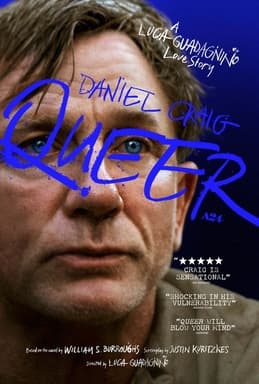
Poster / promotional material via Wikipedia, Queer (film). Used under fair use for criticism and review.
Luca Guadagnino released two films in 2024, and we mostly talked about the wrong one. Challengers, the April release, was the cultural event; Queer, the November release, was the more formally audacious piece, the more difficult source material, the one that sat less easily in the year’s conversation. A year later, Queer is the one I keep returning to.
What the source material is
William S. Burroughs wrote Queer in 1952, in Mexico City, in the aftermath of accidentally shooting and killing his wife Joan Vollmer. The book was not published until 1985. It is, by Burroughs’ own account, a pre-Naked Lunch piece, a relatively naturalistic fragment about a middle-aged addict’s obsession with a younger man in the Mexico City expat scene of the early 1950s.
The book is not, primarily, narrative. It is atmospheric, unresolved, often embarrassing in its specificity about the protagonist William Lee’s one-sided pursuit. It is also deeply queer in the specific mid-century sense: about the unresolvable loneliness of a man for whom public sexuality is always an act of risk management.
Adapting it required a director who would not try to fix it.
What Guadagnino does
Guadagnino and screenwriter Justin Kuritzkes (his regular collaborator now, after Challengers) have made a film that mostly refuses to tidy the source. The plot, such as it is, follows Lee (Daniel Craig) and his obsessive pursuit of Eugene Allerton (Drew Starkey), a younger American in the Mexico City expat circle. The two men do eventually engage sexually, but the film is not interested in consummation-as-resolution. It is interested in the specific texture of one-sided desire, and it stays inside that texture for its two-hour running time.
Guadagnino photographs Mexico City (built on sets in Rome) as a specifically sweaty, ochre-lit dream space. The film is not naturalistic. It moves at the pace of Lee’s consciousness, which is to say it moves slowly, recursively, and with intermittent hallucinatory intrusions that escalate toward the final act’s ayahuasca sequence.
Daniel Craig, stripped
Daniel Craig as Lee is doing a specifically remarkable thing, and it is the performance that will define the late-phase of his career. Craig, post-Bond, has been deliberately reinventing his screen presence in roles that work against his established action-star grammar (Knives Out, Glass Onion, now Queer). Queer is the furthest he has pushed this reinvention.
What Craig is doing in the film is playing a middle-aged gay American expat in the early 1950s who has spent decades accruing the specific armor of charm, wit, and narrative confidence that such a man required to survive in public, and then, under the pressure of his obsession with Allerton, watching that armor come apart in small real-time increments.
The performance is not glamorous. Craig looks, deliberately, tired, older than he is, sweatier than he is, more unsteady on his feet than we have ever seen him. The 2024 reviews that focused on his “brave” willingness to be unattractive were not wrong, but they missed the subtler work. Craig is playing Lee as a man who has stopped being able to perform the version of himself his social world requires. The drunken non-sequiturs. The hand-on-the-knee that is not reciprocated. The increasingly desperate attempts at intellectual exchange. All of these are beats Craig plays with a precision that only an actor deeply practiced in Lee’s opposite register could manage.
Drew Starkey, harder than he looks
Drew Starkey as Allerton has the more difficult role. Allerton is not a Burroughs-novel foil; he is a character whose own desires the film keeps partially opaque. Is he gay? Is he not? Is he entertaining Lee’s pursuit because he is curious, because he is bored, because he benefits from it socially, because he is, himself, in some unresolved way, attracted? The film, correctly, refuses to settle the question.
Starkey plays Allerton as a young man who is still figuring out what he wants, and who is, in the meantime, using Lee’s attention as a kind of weather he is not quite ready to commit to. The performance requires Starkey to register the character’s emotional uncertainty without that uncertainty becoming the film’s subject. He does it.
The ayahuasca sequence
The film’s final act, in which Lee and Allerton travel to the Ecuadorian jungle to sample the drug yagé (ayahuasca), is the sequence that most divided viewers at the time of release. The hallucinatory imagery is explicit. The metaphysical claim, that the drug allows a literal mind-meld between Lee and Allerton, is the film’s most overt departure from realism.
Watching it now, a year out, I find the sequence bolder than I did on first viewing. It is the film’s answer to the central question it has been asking: can Lee ever actually be seen by Allerton in the specific way his love requires? The answer the film gives, delivered through the hallucinatory fusion, is a qualified yes, the fusion is real, the fusion is temporary, the fusion does not resolve the distance between them. This is the specific tragedy of Burroughs’ novel, and the film honours it.
The Trent Reznor and Atticus Ross score, again
Reznor and Ross, having scored Challengers earlier in the same year, score Queer as well, and the two scores are deliberately different. Challengers was acid-house propulsion. Queer is a specific melancholic minimalism, sometimes spare piano, sometimes distorted strings. The score does work the film’s slower pace requires: it provides an undertow that the viewer feels before they consciously register it.
Where it sits
Queer underperformed commercially. It earned Craig some awards-season attention but did not gather the critical consensus Challengers did. A year out, I think that reception balance will reverse itself in the longer cultural memory. Queer is the more ambitious film, the more specific film, the film most aligned with Guadagnino’s career-long interests.
Watch it slowly, preferably alone, preferably after reading the novel. The film will not hold your hand. It is not trying to.
Lena writes long-form essays on the films that will still be talked about in a decade. Previously at a defunct monthly whose name we do not speak.
MORE BY LENA ASHWORTH →
Challengers and the Year Guadagnino Made Sport Sexy
Two years after Challengers arrived in its pastel pressure-cooker, the film's trick is clearer: it is not really about tennis. It is about what love looks like when three people are too competitive to admit they love anything but competition.
All of Us Strangers: Andrew Haigh's Ghost Story for Survivors
Andrew Haigh's film is a queer ghost story, a family reconciliation, and a grief piece. What it does with all three in 105 minutes is astonishing.
Thelma: June Squibb's Late-Career Lead
Josh Margolin's debut feature gave June Squibb her first leading role at 94. It was not a stunt. It was a film.