All of Us Strangers: Andrew Haigh's Ghost Story for Survivors
Andrew Haigh's film is a queer ghost story, a family reconciliation, and a grief piece. What it does with all three in 105 minutes is astonishing.
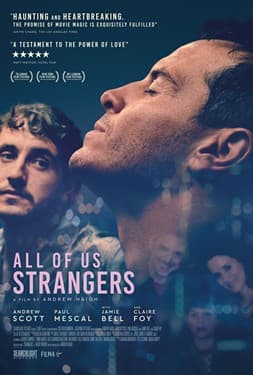
Poster / promotional material via Wikipedia, All of Us Strangers. Used under fair use for criticism and review.
There is a long conversation in All of Us Strangers between Andrew Scott’s Adam and his mother, played by Claire Foy, in which Adam comes out to her. He is forty-five. She is dead. The conversation is happening in the suburban house Adam grew up in, which his parents still occupy, which they did in fact occupy for about twelve years before they died in a car accident when he was twelve, which is a very long time ago now.
This conversation takes, roughly, seven minutes of screen time. It is, for my money, the best sustained scene of British cinema of 2023–24.
The premise, stated plainly
Adam is a screenwriter in London, alone, living in a mostly-empty tower block. He is working on a script about his dead parents. One night, he visits the suburban house where he grew up and finds, impossibly, his parents there, still in their early thirties, as they were when they died. He begins to visit them. They are kind, curious, and present. They know they are dead. He knows they are dead. The visits continue.
Meanwhile, back in London, Adam begins a relationship with Harry, played by Paul Mescal, a much younger neighbour in the same tower block. The film cross-cuts between the two relationships, the parents, in the suburban house, who give Adam the family he never got, and Harry, in the London high-rise, who gives Adam a partner he has spent decades not permitting himself.
What Haigh is doing
Andrew Haigh is adapting the Taichi Yamada novel Strangers (1987) and making it specifically queer, specifically British, and specifically about the cohort of gay men who came of age during the AIDS crisis and whose emotional development was interrupted in ways that have not fully resolved. This is the film’s quiet thesis: Adam, at forty-five, is still, in ways he is just beginning to understand, the twelve-year-old whose parents died before he could come out to them, whose adolescence arrived in a plague that he largely escaped but whose shape made ordinary attachment difficult, who has lived alone and worked alone and come to a kind of functional peace that is also, it turns out, a ghost-peace.
The film is about whether that ghost-peace can be undone.
The Scott and Mescal pairing
Andrew Scott is doing career-best work. His Adam is a person whose specific quality is carefulness: with his voice, with his posture, with his attention, with his emotions. Scott plays the carefulness as armour, and the armour as exhaustion. The moments where Adam allows the armour to come down, with his parents, with Harry, are the film’s most devastating sequences.
Paul Mescal, as Harry, has less screen time but does something equally precise. His Harry is younger, queer in a different way (he describes himself as “gayish” in an early scene, meaning he has not sorted the language out yet), open in a way that is partly generational and partly desperate. Mescal plays the desperation under the openness without letting it ever fully surface. The performance is generous to the character and to the viewer.
The sex scenes between Scott and Mescal, and I want to say this plainly, are some of the most tender, adult, non-performative sex scenes in contemporary English-language cinema. They are not explicit in the conventional sense. They are patient. The camera is at the level of the characters’ faces. The sound design pays attention to breath. This is not a film flattering itself by being progressive. This is a film trying to show two specific people in bed, and it does.
The parents
Claire Foy and Jamie Bell, as Adam’s dead parents, are doing the hardest work in the film. They have to play two ordinary early-1980s parents with the specific language and attitudes of that period, while also knowing, in the film’s frame, that they are dead and are being visited by their adult son. They cannot register the metaphysical weight of the situation too heavily; they also cannot pretend it is not there.
Both actors find a register that works. Foy’s mother, when she realises Adam is gay and begins to work out what that meant for her son in the 1980s and 90s, plays a specific late-arriving grief that is heartbreaking because it is gentle. She does not know what to do with the information. She wants to do right by her son, twenty years late. The film lets her try.
Jamie Bell’s father is, if anything, the trickier role. He has to apologise, in a specific scene, for a specific form of emotional absence that he barely had language for when he was alive. Bell plays the apology as a clumsy, committed, incomplete attempt. It lands.
The ending
I am not going to spoil the final sequence. I will say only that the film’s final twenty minutes do something structurally brave, involving a revelation about Harry that recontextualises the entire London half of the film. The revelation is, depending on your reading, either the most devastating closing move in a British film of the decade or a sentimental overreach.
I am in the first camp. The move is earned. The film has been, throughout, interested in what grief looks like when it is kept company for long enough. The ending delivers the specific kind of company the film has been building toward.
Where it sits
All of Us Strangers came out in the US in late December 2023 and in the UK in January 2024. It was shut out of the Oscars, which in retrospect looks like a specific failure of the Academy’s queer-film imagination. It will age better than most of the films that made the nominations list.
Watch it alone. Bring tissues. You have been warned.
Lena writes long-form essays on the films that will still be talked about in a decade. Previously at a defunct monthly whose name we do not speak.
MORE BY LENA ASHWORTH →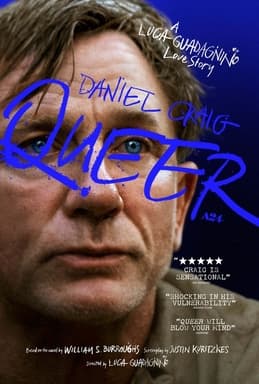
Queer: Guadagnino's Burroughs and the Case for Tenderness
Guadagnino's second film of 2024 was the quieter one, the one with the more difficult source material, and the one that has settled, a year later, as the more specifically strange.
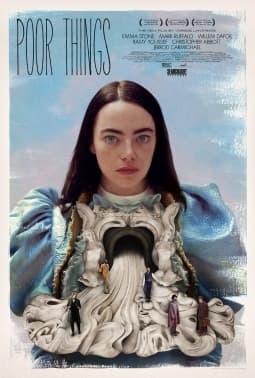
Poor Things: Lanthimos Unleashed
Emma Stone's performance as Bella Baxter does something almost no leading actress is allowed to do in a studio film: she becomes less polite, less articulate, less easy to root for, and the film rewards her for it.
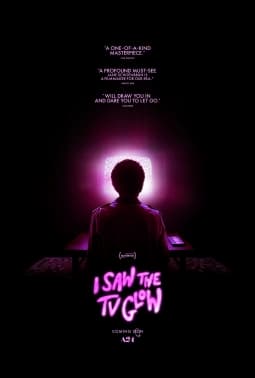
I Saw the TV Glow: The Trans Allegory Hollywood Couldn't Place
Jane Schoenbrun's sophomore feature played small in theatres, spoke loudly to the audience it was made for, and kept speaking afterwards. A year later, it is still teaching viewers how to be seen.