Conclave and the Surprise Return of the Talk Movie
Fifteen months after Conclave's surprise commercial run, Edward Berger's Vatican procedural still feels like an argument from another era of filmmaking. The genre it quietly revived, the talk movie, is worth examining.
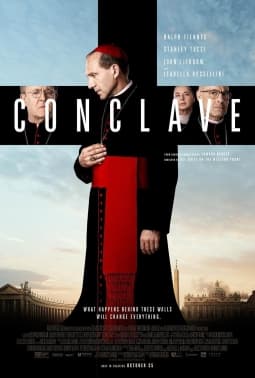
Poster / promotional material via Wikipedia, Conclave (film). Used under fair use for criticism and review.
Here is a fact that still quietly astonishes me. Conclave, a film about a gathering of cardinals electing a pope, in which approximately 90% of the running time is given to adults in plain dark clothes having quiet conversations in a series of beige rooms, made almost $120 million worldwide. In 2024–25. In a theatrical market that was, at the same time, declining to show up for $170 million Mad Max prequels.
This is not, I want to insist, a feel-good story about “audiences craving smart adult cinema.” The feel-good story is a convenient industry narrative that does not survive contact with the evidence. Audiences did not, in 2024, en masse crave smart adult cinema. They showed up for a specific film, made in a specific way, that did a specific thing with unusual confidence. Conclave is the film that made that thing look easy, and by doing so revived, unexpectedly and, possibly, temporarily, the talk movie.
What a talk movie is
Terms of reference first. A “talk movie,” as I’m using it here, is a film in which the primary unit of dramatic construction is the conversation. Not the scene, not the set piece, not the reveal, the conversation. Two or three characters in a room. One leaves. Two different characters arrive. A new conversation starts. The plot advances not through action but through what people say to each other in those rooms.
The talk movie used to be a completely standard American studio product. Twelve Angry Men. Glengarry Glen Ross. The Verdict. A Few Good Men. The Insider. Michael Clayton. These are films built, fundamentally, out of rhetorical exchanges. The direction is the lighting of those exchanges, the placement of those exchanges, the order in which we are given them. The screenplays are the film.
The talk movie atrophied during the 2010s, as studios learned that international markets preferred action, and that domestic audiences could be trained to prefer spectacle too. The talk movie became “prestige television”, prestige television is essentially a talk movie that goes on for ten hours, and the theatrical talk movie dwindled to a handful of exceptions a year.
Conclave is a full-throated return to the form, made by a director, Edward Berger, who had previously worked in a more kinetic register on All Quiet on the Western Front.
What Berger does
Berger’s direction of Conclave is a fine demonstration that the talk movie is not, in fact, an easy thing to direct. A conversation-driven film is only as good as its blocking, its cutting, its intuition about when to let a line land. Berger is superb at this. There’s a scene about an hour in where Cardinal Lawrence (Ralph Fiennes, in his best work since The Grand Budapest Hotel) is being told a piece of unwelcome information by Cardinal Bellini (Stanley Tucci), and the camera simply stays on Fiennes’ face as he absorbs it. The scene could have been thirty seconds. Berger gives it ninety. He trusts the face.
This is a directorial discipline that has become rare. The instinct, in contemporary studio filmmaking, is to keep the camera moving during dialogue, to cut more often than necessary, to treat silence as dead air. Berger’s direction refuses all of that. Conclave is full of the specific American-director phobia’s least favourite thing: sustained shots of adults listening. It is, to be blunt about it, very good for you.
Fiennes, and the case for interior drama
Fiennes’ performance as Cardinal Lawrence, the Dean of the College of Cardinals, tasked with administering the conclave that elects the next pope, is an argument, by itself, for the talk movie as a genre. Lawrence is a man whose crisis is entirely interior. He is, for most of the film, a man of procedure being slowly confronted with the fact that his faith is failing him. The faith is not failing him dramatically. It is not failing him because he has seen a horror. It is failing him because he is sixty-three years old and the ritual forms of his vocation are no longer, in some quiet way, doing the work they used to do.
You cannot film that with action. You can only film it with conversation. Specifically, with Lawrence in conversation with other cardinals who are, in their various ways, more or less settled in their own faith, and with the camera watching the small adjustments in his face as he measures his own drift against theirs. Fiennes does this with extraordinary precision. His Lawrence is, I think, the best-acted role of 2024 by a margin, the kind of performance that does not get Oscar traction because it does not announce itself, but that will be the one people revisit in ten years when the louder performances of that year have dimmed.
The ensemble
The supporting cast, all of whom are working in the same key, is what allows Fiennes’ performance to breathe. Stanley Tucci as Bellini, the liberal candidate who is worried he might actually win. John Lithgow as Tremblay, the Canadian cardinal whose maneuverings turn out to have a specific and consequential history. Isabella Rossellini as Sister Agnes, in a small role that the screenplay hands the film’s single best delivered line. Lucian Msamati as Adeyemi, a character whose arc has become one of the film’s most argued-about elements.
The argument about Adeyemi, whose candidacy is derailed by the revelation of a decades-old indiscretion, with racial implications that the film handles with varying degrees of subtlety, is a legitimate one. I understand the critiques. I also think the film earns the complication: it is not a film that wants to flatter anyone, and Adeyemi’s arc is part of a larger argument about the impossibility of anyone emerging from a long clerical career with their moral ledger fully clean.
The ending
I won’t spoil the ending, but I will say this: a year later, I’m more convinced than I was at release that the ending is right. It is the kind of ending that Conclave had been earning all along, and that the film structures its entire rhetorical architecture to make possible. Some viewers found it too tidy. I find it, on rewatch, structurally inevitable. The film’s closing revelation is the answer to the question the film has been asking for two hours, which is: what kind of pope is it possible to elect in this century, with this body of electors, under these specific spiritual pressures?
The answer is strange, and generous, and slightly utopian. Conclave is, underneath its procedural surface, a film that believes in the possibility of grace entering the room late. That is not a cynical reading. It is a reading the film has earned.
What it set up
I don’t know if the talk movie will continue to have theatrical viability on this scale. Possibly Conclave was a one-off, a film that caught a specific moment of audience appetite and may not be replicable. Possibly there is a larger lesson here about what audiences are actually willing to see when the craft is this evident.
Either way, the film is a reminder that the conversation, unhurried, adult, carefully lit, is still one of the most powerful tools cinema has. It is not a reminder we needed. But we got it. And it was good.
Jules writes the kind of pieces that come from wandering somewhere and overhearing something. On Frame Junkie's masthead since the beginning.
MORE BY JULES OKONKWO →
Anatomy of a $200M Musical Flop: What Killed Folie à Deux
Eighteen months after Todd Phillips' much-hated sequel opened to a $37 million weekend and a 30% audience score, it is time to autopsy the corpse. The film isn't good. It also isn't quite what you've been told.
The Seed of the Sacred Fig: Rasoulof's House Film
Mohammad Rasoulof shot the film in secret, fled Iran during post-production, and arrived at Cannes with a three-hour domestic thriller about a judiciary father and his protesting daughters. The retrospective argument is that the long cut is the cut.
We Live in Time: Crowley's Non-Linear Gamble
John Crowley's third collaboration with A24 runs the ten-year relationship in a non-linear shuffle, and the shuffle is what makes the film survive its cancer-drama premise. Just barely, but it does.