The Zone of Interest and the Sound as Argument
Jonathan Glazer's Holocaust film works by almost never showing us the Holocaust. Two years out, the sound design is still one of the most radical formal choices of the decade.
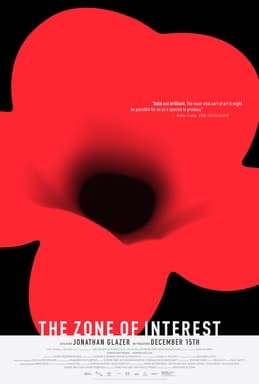
Poster / promotional material via Wikipedia, The Zone of Interest (film). Used under fair use for criticism and review.
The Zone of Interest is a film I think about every time I start to write about another film. Not because I want to imitate it, but because Jonathan Glazer’s film is a standing reminder of how much of the craft of cinema lives in what you choose not to show.
A brief description, for anyone who has somehow gone two years without encountering it. The film follows the Höss family, Rudolf Höss is the commandant of Auschwitz, living in a house directly adjacent to the camp. The wife gardens. The children play. The servants clean. A new rose variety is cultivated. The entire film is about their ordinary domestic life, which is to say it is about the specific, terrifying mundanity of a household that has installed itself in a garden next to a factory for killing people.
We do not see the camp. We hear it.
The sound design as argument
Mica Levi’s score and Johnnie Burn’s sound design are the film’s argument. Through the entire running time, underneath and sometimes over the dialogue, we hear what is happening on the other side of the garden wall: trains, shouts, gunshots, the mechanical sounds of crematoria, occasionally the specific terrible sound of a human voice where a human voice should not be. The wall is visible throughout the film. We see it constantly. But we are not permitted to cross it with our eyes.
This is a formal choice of extraordinary specificity, and it is doing several things at once.
First, it refuses the Holocaust film’s traditional grammar of representation, which tends, even at its most conscientious, to show us the victims in ways that risk aestheticising their suffering. Glazer’s position, made explicit in interviews, is that such representation is no longer ethically available. The film treats the atrocity as present but unrepresentable.
Second, and I think more interestingly, the sound design implicates the audience in exactly the mental move the Höss family is making. We are, like them, living in the house. We hear what they hear. The garden party. The child’s birthday. And, underneath, the factory. The film’s central question becomes: how do we choose to not notice what is happening on the other side of the wall?
The answer, the film suggests, is that you do not have to choose anything. You only have to live your ordinary life. The noticing is the opt-out, and the opt-out requires effort.
Sandra Hüller, who had two of the films of 2023
Sandra Hüller’s work as Hedwig Höss is, along with her work in Anatomy of a Fall the same year, the most formidable year any European actress has had in a decade. The performances do not resemble each other. In Anatomy of a Fall she plays a woman under maximum public scrutiny; here she plays a woman under no public scrutiny at all, and the interior private-self she constructs is, if anything, more unsettling.
The specific thing Hüller does in The Zone of Interest is play domestic contentment so clearly that the viewer cannot quite catch her out. There is no moment where the performance signals awareness of the atrocity. She is not performing repression or denial. She is performing a person whose daily life genuinely gives her satisfaction. The pleasure she takes in her garden is real pleasure. The care she takes with her wardrobe is real care. The film is unflinching about this because the historical record is unflinching about this: the human capacity for compartmentalisation is larger and more terrible than we like to admit.
The thermal imagery
There are two sequences in the film that step outside the dominant register: thermal-camera-style negatives showing a young Polish girl leaving food for the camp prisoners. These sequences arrived to some critical puzzlement at the time.
Two years later, I think they are the film’s most generous gesture. The girl exists. She did this. The film documents her resistance, at night, as a kind of photographic negative of the Höss family’s daylight life. The thermal imagery is not a formal flourish. It is an assertion that, inside the same historical moment, different choices were possible. The Höss family chose one thing. This girl chose another. The film will not let us pretend the possibility was not there.
What it changed
Holocaust cinema, after The Zone of Interest, is different. Not permanently, not absolutely, but noticeably. A generation of documentary and fiction filmmakers are now, in real time, reconsidering the ethics of showing. The question is no longer “can we represent this?” but “under what conditions have we earned the right to?” Glazer’s film has moved the conversation forward in a way that a more conventional treatment, even a conventionally excellent one, could not have.
The film is also, I want to note, about something larger than the specific historical moment. It is a film about the walls we all install around our ordinary lives, about the work of selective attention. The Holocaust is the limit case of the phenomenon. The phenomenon itself is everywhere.
The Oscar and after
The Zone of Interest won Best International Feature at the 96th Academy Awards. Glazer’s acceptance speech, which called out the ongoing violence in Gaza using the film’s central metaphor, produced exactly the kind of backlash the speech predicted. I am not going to wade into that discourse here. I will only say: the film is not unrelated to that speech. A filmmaker who spent years making this film was never going to accept that award and say nothing.
Watch it again, if you can stand it. Pay attention to the sound. Notice when you stop noticing. That is the moment the film is about.
Lena writes long-form essays on the films that will still be talked about in a decade. Previously at a defunct monthly whose name we do not speak.
MORE BY LENA ASHWORTH →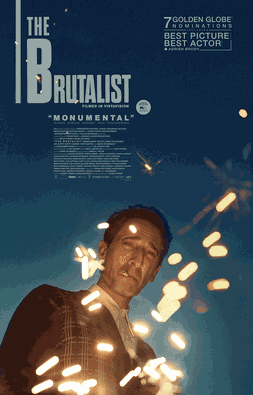
The Brutalist: In Defence of the 3.5-Hour Epic
A year after The Brutalist swept its technical categories and divided audiences, its length has stopped looking like a gamble and started looking like the point. An argument for the long film in a short-film decade.
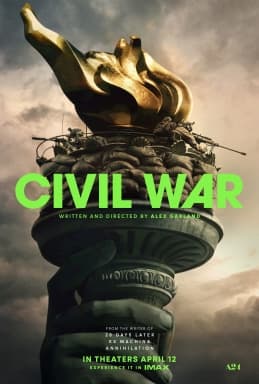
Civil War: Alex Garland's Failure of Nerve
Alex Garland made a film about an American civil war and deliberately stripped out the politics. A year and a half later, the emptiness in the middle of Civil War is not a choice to respect. It is the thing that breaks the film.
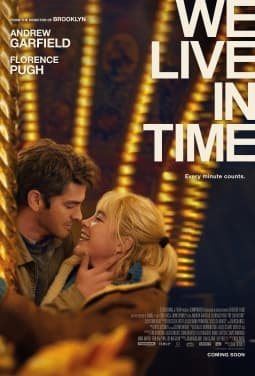
We Live in Time: Crowley's Non-Linear Gamble
John Crowley's third collaboration with A24 runs the ten-year relationship in a non-linear shuffle, and the shuffle is what makes the film survive its cancer-drama premise. Just barely, but it does.