The Brutalist: In Defence of the 3.5-Hour Epic
A year after The Brutalist swept its technical categories and divided audiences, its length has stopped looking like a gamble and started looking like the point. An argument for the long film in a short-film decade.
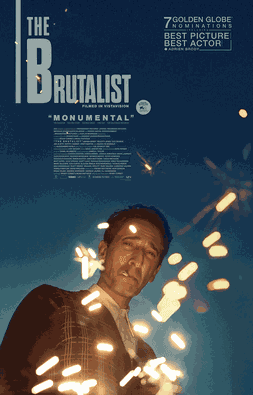
Poster / promotional material via Wikipedia, The Brutalist. Used under fair use for criticism and review.
When Brady Corbet’s The Brutalist opened in December 2024, the conversation was immediately about its runtime. Three hours thirty-five minutes. An intermission. A VistaVision aspect ratio that cinemas had to be coached on projecting properly. A reported $9.6 million budget, which, stretched across a film of this scale, was either a miracle of resource management or an explanation for why the film looks the way it does, depending on which critic you trusted.
A year on, the runtime has stopped being the story. Or rather, it has become a different story: the story of how badly contemporary film discourse has atrophied its ability to accommodate length.
The cult of the short film
For the last decade, the default assumption in studio-era American cinema has been that audiences will not sit still for more than two and a quarter hours. There are exceptions, the Marvel finales, the Scorsese exceptions, but the rule has held. Films that want to be taken seriously have been cut tighter and tighter, on the theory that the audience attention span is a finite quantity that must be rationed.
This has produced some genuinely good 110-minute films. It has also produced an entire category of prestige cinema that mistakes compression for discipline. There are films in the 2022–2024 period, I’ll spare you the list, that feel like novels abridged down to their plot beats. The editing is clean. The pacing is efficient. The emotional experience is of a book you read the Wikipedia summary of.
The Brutalist is the opposite of that. It is a film that wants you to live in it. The runtime is not a flex, not a statement of auteur ambition, not a provocation aimed at critics. It’s the amount of time the film requires to do what it does. Cut half an hour from The Brutalist and you do not get a tighter Brutalist. You get a worse film with the same premise.
What the length is for
The central argument of the film, that a European-Jewish architect’s post-war career in America is a study in slow, structural erosion of the self, is a durational argument. It has to be felt in time. The years have to pass. The patron’s fondness has to curdle into ownership. The buildings have to rise so slowly that by the time they are complete, the man who designed them has been hollowed out to match them.
You cannot stage that in ninety minutes. You could gesture at it, a few time-lapse montages, a few careful scenes of business pressure and marital strain. It would not be the same film. It would be a film about someone else, an American character in an American story, compressed to fit the shape of a 2020s mid-budget drama.
What Corbet and co-writer Mona Fastvold do instead is let the architect’s American life happen in something closer to real time. The friendships take years. The professional humiliations take years. Even the good scenes, the early elation of a first important commission, the shorter interludes of happiness with his wife, are located within a structure that is itself patient. The film says: this man had a life, and a life is long, and if you want to understand what happened to him you are going to have to sit with him while it did.
Adrien Brody’s return
There was a narrative, during the awards run, about Adrien Brody’s Best Actor win being a comeback, a return to the world of his Pianist Oscar. I don’t think that’s quite right. The Brody of The Pianist was working in a register of extreme restraint, a man shrinking to survive. The Brody of The Brutalist is working in a register of slow moral corrosion, which is a different thing entirely.
What he does in the second half of the film, particularly in the long sequence at the quarry in Italy, and in the late-night scene with his wife that follows, is hold two incompatible impulses in the same face at the same time. He has become what he was trying not to become, and he is aware of it, and he is grateful for the vehicle that has made it possible. You watch the gratitude and the self-loathing co-exist without either one winning. It is superb, unshowy, adult acting.
The VistaVision question
There were, during release, ambivalent reactions to the film’s visual approach. VistaVision, a horizontal film format last used widely in the 1950s, was championed by cinematographer Lol Crawley as the right technical choice for a film partly about mid-century American building projects. Some critics found the aspect ratio overly wide for a character drama, the frames too architectural, the compositions too photographed-to-be-admired.
A year later, in a smaller-screen rewatch, the format works differently than it did in a full theatrical context. The film’s wideness stops reading as show-offy and starts reading as environmental. The characters are almost always placed against horizons, of buildings, of landscapes, of social structures, that dwarf them. The VistaVision frame is the film’s thesis made visible. These people are small inside a country that was always going to be bigger than their ambitions.
The backlash, and why it misread the film
The Brutalist had a backlash in its second month of release, from a direction that had nothing to do with the film’s formal choices. The disclosure that certain dialogue passages had been refined using an AI tool, and that some Hungarian-accented readings had been lightly tuned, was turned into an argument that the film’s craft was suspect.
I found the discourse frustrating at the time and I find it more frustrating now. The tools used were limited and disclosed. The film’s central performances were not generated or materially altered. The question of where AI assistance should and should not appear in filmmaking is a serious one that deserves serious debate, but that debate does not get clearer by being grafted onto a three-and-a-half-hour drama that was so clearly, in every frame, the work of a small and specific group of humans.
What the AI discourse accomplished, briefly, was to flatten an extraordinary achievement into a talking point. A year later, the talking point has faded and the film remains. You can watch it now without the weight of that argument. You should.
What it’s worth
Not every film needs to be this long. Most don’t. But some do, and the discipline of letting those films be that long is a kind of critical trust that the culture has been losing. The Brutalist is an argument, made in thirty-five more minutes than the market thought we had the patience for, that the long serious film is still possible.
The film will not be for everyone. It was not for everyone a year ago. But if you declined to see it then because of the runtime, I’d ask you to reconsider. The runtime is not the obstacle. It’s the offer.
Lena writes long-form essays on the films that will still be talked about in a decade. Previously at a defunct monthly whose name we do not speak.
MORE BY LENA ASHWORTH →
La Chimera: Rohrwacher's Ghost Story
Alice Rohrwacher's 2023 film about a British grave-robber in 1980s Italy is the kind of quiet, strange, specifically rewarding film that the American art-house circuit was once built to deliver. It still can.
The Zone of Interest and the Sound as Argument
Jonathan Glazer's Holocaust film works by almost never showing us the Holocaust. Two years out, the sound design is still one of the most radical formal choices of the decade.
We Live in Time: Crowley's Non-Linear Gamble
John Crowley's third collaboration with A24 runs the ten-year relationship in a non-linear shuffle, and the shuffle is what makes the film survive its cancer-drama premise. Just barely, but it does.