Hard Truths: Leigh's Return to Pansy
Mike Leigh's first film since 2018 reunited him with Marianne Jean-Baptiste for a character study of sustained anger. The argument is that the film is one of his best, and the conditions that produced it are the ones his method has been waiting to find.
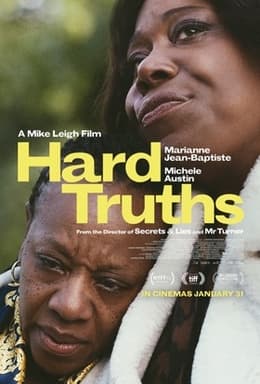
Poster / promotional material via Wikipedia, Hard Truths. Used under fair use for criticism and review.
Mike Leigh is eighty-two. His method, developed across five decades from Bleak Moments (1971) through Peterloo (2018), involves extended rehearsal periods with his cast in which the characters are collectively built through improvisation before shooting begins. The method has produced High Hopes (1988), Naked (1993), Secrets & Lies (1996), Vera Drake (2004), and Another Year (2010), among others. It is one of the most specifically distinctive working methods in contemporary narrative cinema, and it has not produced a weak film.
Hard Truths, his first feature since 2018, reunites him with Marianne Jean-Baptiste, who won the Academy Award nomination for Supporting Actress for Secrets & Lies twenty-eight years ago. The film premiered at Toronto in September 2024, was distributed in the US by Bleecker Street in December 2024, and grossed around $1.5 million theatrically. It was not, despite the performance at its centre, seriously campaigned for awards. This was a mistake, and one the film will continue to rebuke.
What the film is
Pansy Deacon (Marianne Jean-Baptiste), a middle-aged Black woman in suburban London, is specifically angry. The anger is the film’s continuous condition. Pansy is angry at her husband Curtley (David Webber), a quiet plumber who has retreated into specifically economical responses to her outbursts. She is angry at her twenty-two-year-old son Moses (Tuwaine Barrett), who sits in his bedroom eating Doritos. She is angry at her sister Chantelle (Michele Austin), a warm hair-salon owner raising two young-adult daughters in a household whose specifically different emotional register is the film’s central structural contrast.
The film, across 97 minutes, observes Pansy in her specific daily operations. She shops. She cleans. She attends specific medical appointments. She speaks with her GP about a specifically wide range of somatic complaints. She visits Chantelle. She argues with Moses. She argues with Curtley. The argument never fully resolves into a specific conflict-driven plot. The film is, specifically, a character study.
What Leigh is doing
Leigh’s specific formal operation across Hard Truths is to refuse the narrative arc that character studies of specifically difficult women usually require. The film does not explain Pansy’s anger. It does not provide a backstory event that caused the anger. It does not offer a treatment that resolves the anger. Pansy is angry across the running time, and the film’s interest is in observing the specific texture of the anger rather than in diagnosing or curing it.
This is specifically risky formal territory. The dominant contemporary narrative grammar around female protagonist-difficulty is either the trauma-reveal grammar (the character is difficult because of a specific event; the event is disclosed; the character is healed or at least explained) or the redemption grammar (the character is difficult, then meets people or circumstances that soften them). Leigh refuses both. Pansy is specifically the specifically angry woman she is. The film is specifically interested in what her specific anger looks like across a specific set of days.
The Jean-Baptiste performance
Marianne Jean-Baptiste’s performance as Pansy is one of the five best screen performances of the year and the specific argument the film would need no other argument to make. The performance is specifically sustained. Pansy is angry at specifically differentiated pitches across the running time, and Jean-Baptiste finds the specific register for each pitch: the weary domestic irritation of a morning with her husband, the specifically escalating public anger at a supermarket, the specifically wounded anger of an extended dinner at Chantelle’s house, the specifically quieter anger of a GP visit.
What Jean-Baptiste does specifically well is play the anger as the physical condition it actually is. Pansy’s body is carrying the anger. Her shoulders are set. Her jaw holds specifically. The anger is not performed facially; it is worn in the specific way the character moves through space. The performance is, in this respect, closer to the physical-performance registers of European arthouse cinema than to the psychological-realism registers the awards circuit typically honours.
The film’s late scene, in which Pansy has an exchange with her sister at a specifically emotional juncture I will not describe, is the performance’s specific peak. Jean-Baptiste plays a specific moment of possible softening that the film does not allow to become a transformation. Pansy does not change. She is, for a specific twenty-second window, slightly more available to another person than she has been elsewhere in the film. The film ends before we can know whether the availability will persist. The specific refusal of resolution is the film’s most formally disciplined choice.
The supporting cast
Michele Austin, as Chantelle, is the specific counterweight to Jean-Baptiste’s performance. Chantelle is specifically warm. Her household is specifically hospitable. Her daughters (played by Ani Nelson and Sophia Brown) are specifically affectionate. The contrast with Pansy’s household is specifically legible without being forced; the film never explicitly asks the viewer to compare the two households, but the comparison is structurally built into the specific alternation of sequences.
What Austin does specifically well is play Chantelle as a specifically complete person rather than as a foil to Pansy. Chantelle has her specific concerns, her specific professional competence, her specific affection for the sister she has known across a lifetime. The sisterhood is the film’s emotional scaffolding, and the specific long shared history between the two characters is legible in every scene they share.
David Webber, as Curtley, gives the film its quietest and most technically difficult performance. Curtley is specifically economical: he responds minimally, he withholds, he retreats into his specific work. Webber plays the economy as a specific marital adaptation. Curtley has been Pansy’s husband for long enough to know what specific responses produce what specific escalations, and the specific restraint of his responses is the specific shape of the marriage.
Tuwaine Barrett, as Moses, has perhaps the film’s most emotionally specific scene: a late sequence in which Moses is alone in his bedroom and does something the film does not pay off narratively, but which establishes what has been happening to him across the running time. Barrett plays Moses with a specific physical inwardness that the film treats as both specifically sympathetic and specifically concerning.
The formal restraint
Hard Truths is shot by Dick Pope, Leigh’s long-time cinematographer, in a specifically unshowy domestic register. The compositions are centred. The camera is largely static. The light is the specific light of suburban British interiors in autumn and winter. The film does not stylise Pansy’s environment. It observes it at the specific register of what the household actually looks like.
The editing (by Tania Reddin) holds scenes past their conventional narrative function. Conversations run to their specific natural end. Silences are specifically long. The viewer is given time to notice what is happening in rooms.
Where it sits
Hard Truths is a major late-career work from a director whose method has produced a specific body of films whose collective weight will outlast most of the work being produced around them. Leigh’s next project, whatever it is, is worth waiting for. Jean-Baptiste’s performance here is the second-best of her career (after Secrets & Lies) and, more importantly, confirms that the pairing of her specific performance sensibility with Leigh’s specific directorial method produces results neither of them achieves elsewhere.
Watch it in winter, in a specifically quiet room, with no ambient distraction. The film asks attention to specifically small gestures. The attention is rewarded.
Lena writes long-form essays on the films that will still be talked about in a decade. Previously at a defunct monthly whose name we do not speak.
MORE BY LENA ASHWORTH →
We Live in Time: Crowley's Non-Linear Gamble
John Crowley's third collaboration with A24 runs the ten-year relationship in a non-linear shuffle, and the shuffle is what makes the film survive its cancer-drama premise. Just barely, but it does.
Bird: Arnold's Kent Fable
Andrea Arnold's fifth feature split the reviews, and the split was real. The retrospective argument is that the film's unexpected magical turn is not a failure of the social-realist grammar, it's what the grammar was always walking toward.
Small Things Like These: Murphy's Quiet Indictment
Tim Mielants's adaptation of the Claire Keegan novella was reviewed as a modest Cillian Murphy vehicle. The careful reading is that the film's restraint is the indictment, and the restraint is harder to film than the indictment would have been.