The Order: Justin Kurzel's Patient Procedural
Justin Kurzel's FBI procedural about white supremacist terrorism in 1980s Idaho was one of the most under-watched American films of 2024. It is also one of the best, and the under-watching is a specific commercial failure worth understanding.
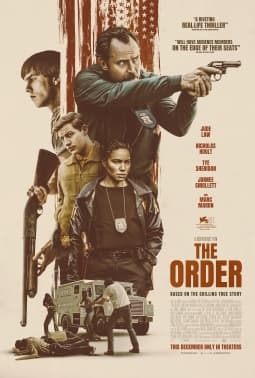
Poster / promotional material via Wikipedia, The Order (2024 film). Used under fair use for criticism and review.
The Order opened on approximately 1,300 American screens in December 2024 and grossed roughly $4.5 million domestically on a reported $35 million production budget. It is, by any reasonable measure, a commercial failure. It is also, by any reasonable measure, the best American crime drama of the 2024 release calendar, and the disconnect between its quality and its reception is the specific problem worth diagnosing.
A year on, the film has acquired a minor cult presence on streaming (it sits on Amazon Prime Video, which distributed it). The streaming half-life is the half-life the film has. Let me argue for why it deserves more.
What the film is
Bob Matthews (Nicholas Hoult) is the leader of a white supremacist terrorist cell called The Order, operating out of rural Idaho in 1983. Matthews, who believes that a Turner Diaries-style racial revolution is imminent, organises his followers into a sequence of armoured car robberies and assassinations intended to finance and catalyse the overthrow of the United States government. Terry Husk (Jude Law), an FBI agent working out of a Coeur d’Alene field office, begins to track the group across a series of increasingly violent incidents.
The film is based on Kevin Flynn and Gary Gerhardt’s 1989 non-fiction book The Silent Brotherhood, and it covers the specific historical period between the group’s first major robbery and its eventual dissolution following the assassination of radio host Alan Berg and an FBI stand-off on Whidbey Island.
Why Kurzel is the right director
Justin Kurzel, the Australian director whose previous features include Snowtown (2011), True History of the Kelly Gang (2019), and Nitram (2021), has a specific filmography organised around the question of how rural violence metabolises into ideology, and how ideology then produces further rural violence. Snowtown is about a serial killer operating in a specific South Australian suburb. Nitram is about the gunman responsible for the 1996 Port Arthur massacre. The specific director of these films was always going to bring something particular to a story about Idaho white nationalism.
What Kurzel brings, specifically, is a refusal to treat his violent subjects as exceptional pathological individuals. His films are consistently about the specific social architecture that allows violent men to recruit, organise, and sustain their violence, and The Order extends this project into an American context. The film is not about Bob Matthews as a psychological monster. It is about the specific north Idaho social infrastructure (the Aryan Nations compound near Hayden Lake, the specific talk-radio ecosystem, the specific economic conditions in rural Pacific Northwest towns during the Reagan recession) that produced Matthews and will produce his successors.
Hoult, doing specific work
Nicholas Hoult’s Bob Matthews is the performance that anchors the film. Hoult, who has had a specifically interesting career across the last decade (The Favourite, The Great, Renfield), plays Matthews as a specifically American charismatic: a man whose violent ideology is articulated in plain, unhesitating terms, and whose ability to organise other men is specifically tied to his lack of apparent doubt.
The performance is not built around menace. It is built around competence. Matthews in the film is a specifically effective operational leader. He is organised, he is physically fit, he is verbally articulate within his specific ideological vocabulary, he inspires a specific kind of fraternal loyalty. Hoult plays these traits without softening their horror. The film’s argument is that charismatic white nationalism, in the American tradition, is specifically organised by exactly these operational capacities, and Hoult’s performance is the specific demonstration of the argument.
Jude Law’s Husk
Jude Law’s Terry Husk is a specific kind of compromised federal investigator. He has been transferred from a major metropolitan office to the Coeur d’Alene field following a specific professional setback (his previous work on a mafia investigation in New York). He is at the end of a marriage. He is drinking. He is carrying specific health problems the film alludes to without dramatising.
Law plays Husk as a particular kind of late-career American procedural protagonist: a man whose professional competence is real but whose personal life is, in specific ways, contracted. The performance is an interesting mid-career pivot for Law, who has recently moved toward specifically weathered American character roles (The Nest, A Rainy Day in New York) after a long stretch of more glamorous work. His Husk is the most specifically worn version of this developing register, and it suits the film’s procedural patience.
The tye sheridan problem, unresolved
Tye Sheridan, playing Husk’s younger partner Jamie Bowen, gets the third lead and gives the film’s least-developed performance. Bowen is, on the page, the specific local agent whose specific rural Idaho background allows him to navigate the terrain Husk cannot read. In the film as shot, Bowen is a specific professional competence without much interior dimension. Sheridan does what the material allows. The material does not allow much.
This is the film’s one genuine weakness. The Order is built around the specific procedural partnership between Husk and Bowen, and the partnership would have worked harder if Bowen had been written with more specific contradictions. The script, by Zach Baylin, builds its interior richness into Husk and Matthews and leaves Bowen as the specific youthful-energy figure.
Adam Arkapaw’s photography
Adam Arkapaw, the Australian cinematographer who has been Kurzel’s primary collaborator across most of his filmography (and who shot True Detective season one for Cary Fukunaga), brings a specific attention to the north Idaho landscape that the film benefits from throughout. The pine-forested backroads, the specific grey-light register of a Pacific Northwest winter, the interiors of small-town Idaho bars and diners: all of this is shot with a particular attention that most American crime procedurals do not manage.
The specific sequence worth naming is the Whidbey Island stand-off that closes the film. Arkapaw shoots the sequence in a specific quality of early-morning grey light that strips the event of any specific dramatic heightening. The stand-off is not staged as a crisis. It is staged as a specific operational event with specific physical consequences. The particular hardness of the light is the film’s final argument.
Why the film underperformed
The commercial failure of The Order is, in my reading, specifically a distribution failure rather than an aesthetic one. Amazon MGM released the film in a specifically crowded December window, on a specific 1,300-screen platform that was not wide enough to build word of mouth and not narrow enough to concentrate critical attention. The marketing positioned the film as a conventional thriller rather than as the specifically patient procedural it is. The film’s subject (white nationalist terrorism in 1980s Idaho) is also, in a specific American 2024 context, uncomfortable in ways that may have suppressed casual ticket sales.
This is, separately, the specific problem mid-budget adult cinema now faces in the American theatrical market. Films in this register need specific distribution commitments that studios have become reluctant to make. The Order is a case study in what is lost when the commitment is not made.
Where it sits
The Order will, I suspect, age better than its 2024 reception suggested. It is a specifically serious American crime film, and the specific seriousness is the kind that ages well. Kurzel has, across his filmography, produced a specifically consistent body of work that deserves more American critical attention than it currently receives.
Watch the film on a winter evening. It rewards the specific patience it demands. The Whidbey Island sequence is the specific payoff, and the payoff is earned by the procedural patience of the preceding two hours.
Marcus believes good criticism is an argument. He is almost always angry about something, usually for good reason. Horror is his first language.
MORE BY MARCUS VELL →
Love Lies Bleeding: Rose Glass Goes Pulp
Rose Glass's second feature dragged the lesbian bodybuilder noir into A24 territory and got reviewed as a tonal mess. The case I want to make is that the tonal mess is the movie, and the movie earns it.
Anatomy of a $200M Musical Flop: What Killed Folie à Deux
Eighteen months after Todd Phillips' much-hated sequel opened to a $37 million weekend and a 30% audience score, it is time to autopsy the corpse. The film isn't good. It also isn't quite what you've been told.
Heretic: Hugh Grant's Villain Era, Explained
A year and a bit on, Hugh Grant's turn in Heretic has been canonised as the late-career reinvention of the decade. The interesting question is what reinvention actually means when the performance is, in truth, an intensification of what he was always doing.