The Last Showgirl and the Patience of Pamela Anderson
Gia Coppola's third feature hands Pamela Anderson a role that asks almost nothing performative of her, and asks everything else. The restraint is the thesis.
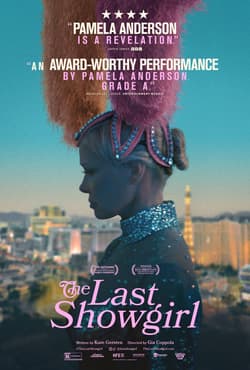
Poster / promotional material via Wikipedia, The Last Showgirl. Used under fair use for criticism and review.
Gia Coppola’s The Last Showgirl, shot in eighteen days in Las Vegas in early 2024, opened in a limited US theatrical run in December 2024 and expanded wide in January 2025. Roadside Attractions handled domestic distribution. It grossed approximately 4 million dollars theatrically. By most commercial measures it failed. By the measure that matters to the film, which is whether Pamela Anderson’s central performance would be seen with sufficient attention, the release was adequate. The Golden Globe and SAG nominations that followed were the point. The 4 million was the entry fee.
I want to describe the film, because a great deal has been written about the comeback narrative and comparatively little about the object itself.
What the film is
Shelly Gardner, played by Anderson, has been a featured dancer in Le Razzle Dazzle, a long-running Las Vegas revue, for thirty years. The show is closing. The film opens in the last two weeks of the run and follows Shelly as she auditions for other productions, fails most of those auditions, navigates a strained relationship with her adult daughter Hannah, played by Billie Lourd, and discovers that her career has prepared her for almost nothing the current industry wants.
The supporting cast is uniformly good. Jamie Lee Curtis plays Annette, a former showgirl now working as a cocktail waitress, in a performance that does most of its heavy lifting in one sustained parking-lot scene. Dave Bautista plays Eddie, the show’s manager, with the kind of physical gentleness his casting has been edging towards for some time. Brenda Song plays a younger dancer. Kiernan Shipka plays another. Each of them is given at least one scene that functions as a portrait rather than as a plot beat.
The film was shot by Autumn Durald Arkapaw on 16mm, which matters. The grain is visible throughout. Coppola, who has been an interesting director of image since Palo Alto, is using the 16mm texture to make Vegas look like a place that the digital present has moved past. The lighting in the dressing rooms, which is practical and warm, treats the performers as a documentary subject rather than as an aesthetic one. Nothing in the film is glossy. The showgirls, off stage, are tired.
Pamela Anderson, specifically
The performance has been discussed in terms of Anderson’s biography, which is understandable but incomplete. Anderson, who turned fifty-seven during production, has spent the last few years rebuilding her public image after decades in which that image had been constructed around her without her participation. Pamela, a Love Story (2023), the Netflix documentary, was part of that rebuilding. The Last Showgirl is the first project that uses the rebuilt figure as raw material rather than as subject.
What Anderson does in the film is not performance in the showy sense. Coppola and her screenwriter Kate Gersten have given Shelly a script that almost never permits her to be articulate about her own situation. Shelly’s default mode is optimism, and the optimism is not performative. She believes what she is saying. She believes that the audition will go well, that the daughter will come around, that the next show will be a good one. Anderson has to play the belief as real belief, not as denial. She does.
The film’s central scene, by the consensus of most critics who saw the film and my own sense, is the audition sequence roughly two-thirds of the way through. Shelly auditions for a contemporary production number. The choreography she is being asked to perform is sharper and more athletic than the choreography she has been doing in Le Razzle Dazzle. She does not quite get it. The director, played by a younger casting actor, is polite. Shelly walks out onto the sidewalk. The camera stays on her face for what must be ninety seconds. Durald Arkapaw holds the shot in a medium close-up. Anderson does almost nothing. She is not crying. She is not breaking. She is, very specifically, having the thought that the thing she was born to do no longer has an industry. The thought happens on her face, in real time, and the camera does not move.
This is not the kind of scene American cinema is currently built to recognise. There is no monologue. There is no breakdown. There is no catharsis. There is only a woman standing on a Las Vegas sidewalk in the middle of the afternoon looking at a problem that has arrived without notice.
Coppola’s filmmaking, matured
Gia Coppola made Palo Alto at twenty-six. She made Mainstream, which was largely disliked, at thirty-two. The Last Showgirl at thirty-seven is her first film in which the filmmaking register is entirely her own. The influence of her grandfather Francis and her aunt Sofia are present, but they no longer feel like the dominant voices. What this film has, and what her earlier work did not have, is patience with duration.
The film is ninety minutes long. It has maybe nine scenes. Each scene runs longer than the equivalent scene in a contemporary American film of similar budget. The parking-lot monologue Curtis delivers, in which Annette explains without bitterness what her career actually cost her, runs close to five minutes uninterrupted. Coppola holds the shot. Curtis, who is playing the scene with almost no movement, does the whole thing on the register of a woman who has been telling this story to herself for twenty years.
The 16mm grain, Andrew Wyatt’s score (which draws on the kind of soft saxophone register the 1980s used as a default without actually being a pastiche), and the decision to structure the film as a series of sustained portraits rather than as a narrative machine: these choices are cumulative. The film is not trying to entertain. It is trying to register a specific moment in a specific life.
What the film withholds
The film does not do the thing I was afraid it would do, which is moralise about Las Vegas. There is no framing device that treats Shelly as a symbol of a broken entertainment economy. There is no voice-over that explains what her career meant. There is no montage of the old Vegas shows intercut with the new corporate ones. The film trusts the viewer to see what Shelly’s life has been without the film having to announce it.
There is also, I want to note, no moment where the film treats Anderson’s persona as a referent. Shelly is not a version of Pamela. The film is not a comment on Anderson’s earlier roles. Casting Anderson in the part brings a certain resonance, but Coppola and Gersten have written a character, not a meta-commentary, and Anderson plays the character, not herself.
The Golden Globe and after
Anderson was nominated for a Golden Globe in the Drama category. She did not win. Fernanda Torres, for I’m Still Here, took the award in what most observers had predicted. Anderson’s SAG nomination followed. Her Academy nomination, which many of us expected, did not arrive.
The absence of the Academy nomination is, I think, the story the next decade will tell about 2025’s award season. The film was available, the performance was specific, the press was warm. What the film lacked was a major studio campaign. Roadside Attractions does not have the budget or the machinery that A24 or Searchlight bring to contender positioning. Anderson, who would have been the story of the ceremony, was edged out by performances backed by larger campaigns. The film’s theatrical infrastructure was the ceiling.
The performance, independent of the nominations, is what remains. Anderson will get other roles. She has, on the evidence of this film, the range to do much more than the comeback frame suggests. What I hope is that the next director to cast her is interested, as Coppola is, in what Anderson can do when she is not being asked to perform.
Watch the sidewalk scene twice. Watch Curtis’s parking-lot monologue twice. Pay attention to the grain. The film will reward attention, and the attention is what the film was always asking for.
Lena writes long-form essays on the films that will still be talked about in a decade. Previously at a defunct monthly whose name we do not speak.
MORE BY LENA ASHWORTH →
We Live in Time: Crowley's Non-Linear Gamble
John Crowley's third collaboration with A24 runs the ten-year relationship in a non-linear shuffle, and the shuffle is what makes the film survive its cancer-drama premise. Just barely, but it does.
The Brutalist: In Defence of the 3.5-Hour Epic
A year after The Brutalist swept its technical categories and divided audiences, its length has stopped looking like a gamble and started looking like the point. An argument for the long film in a short-film decade.
Anora's Best Picture Win, Defended
A year after Sean Baker's fourth feature took five Oscars including Best Picture, the predictable backlash has arrived on schedule. Here's why the Academy, improbably, got it right.