The Beast: Bertrand Bonello's Time-Travel Dread
Bertrand Bonello's 2023 film, released in the US in April 2024, is the strangest and most formally ambitious film I saw in either year. An argument for the specific dread of being alive in multiple decades at once.
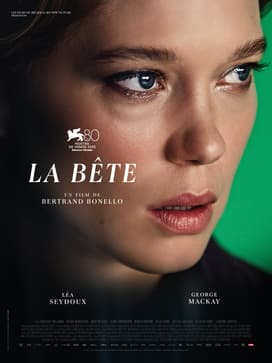
Poster / promotional material via Wikipedia, The Beast (2023 film). Used under fair use for the purpose of criticism and review.
Bertrand Bonello’s The Beast is the film from 2023-2024 I most often recommend to people who ask me what contemporary cinema is capable of. It is also, specifically, the film I have the hardest time explaining to them. The film is 146 minutes, loosely adapted from Henry James’ novella The Beast in the Jungle, structured across three timelines (1910 Paris, 2014 Los Angeles, 2044 Paris), and unified by a specific reincarnated couple played by Léa Seydoux and George MacKay.
I am going to try to describe what it accomplishes. I will probably fail. The film’s specific operation resists précis.
What the film is
The three timelines unfold in parallel across the film’s running time. In 1910 Paris, Gabrielle (Seydoux) is a concert pianist married to a specifically wealthy businessman. She meets Louis (MacKay), an Englishman attending a diplomatic function. They feel specifically drawn to each other. She has a specific premonition that something catastrophic is coming.
In 2014 Los Angeles, Gabrielle is a model-actor specifically struggling to find work. Louis is an incel, specifically identified as such, making specific misogynistic YouTube videos. They encounter each other at specific distances across the Hollywood Hills.
In 2044 Paris, Gabrielle is a specifically recovering patient undergoing a neurological procedure that is, in the film’s logic, removing her emotional affect to make her more employable in an AI-dominated economy. The procedure works by sending her consciousness into her past lives, specifically the 1910 and 2014 versions of her, and allowing her to experience the specific trauma-inducing events of those lives so that her 2044 consciousness can process them out.
The three timelines are not, in the film’s structure, alternative realities. They are all specifically real. The 1910 and 2014 Gabrielles actually lived. The 2044 Gabrielle is, specifically, the same soul having returned for a third incarnation.
What Bonello is doing
The specific formal operation of The Beast is to use the three-timeline structure to stage a specifically sustained meditation on whether human emotional vulnerability can survive in a specifically automating world. Each timeline asks the same underlying question. In 1910: can Gabrielle risk feeling what she feels for Louis, or will she protect herself from the catastrophe she senses coming? In 2014: can Gabrielle and Louis meet across the specifically dysfunctional Los Angeles environment that separates them? In 2044: can Gabrielle retain the specifically inefficient emotional architecture that the procedure is designed to remove?
The answer the film constructs, across the three timelines, is specifically uncertain. Bonello does not tell us which timeline’s answer is correct, or whether there is a correct answer at all.
The Seydoux performance
Léa Seydoux, across three specifically calibrated performances, is doing the specific lead work of the decade. Her 1910 Gabrielle is specifically restrained: a pianist who has been trained, by class and era, to keep her emotional life internal. Her 2014 Gabrielle is specifically desperate: an actor watching her career not happen, in a specifically alienating Los Angeles she has no tools to navigate. Her 2044 Gabrielle is specifically post-emotional: a patient whose consciousness has been partially sanded down, moving through a specifically sterilised future Paris.
Seydoux plays each incarnation at a specifically different register of physical presence. The 1910 Gabrielle holds herself differently from the 2014 Gabrielle. The 2044 Gabrielle has been specifically reduced. The continuity across the three, which the film asks the viewer to hold, is the specific soul the film is examining.
The MacKay performance
George MacKay, across three specifically different performances, provides the film’s other anchor. His 1910 Louis is specifically courtly. His 2014 Louis is specifically misogynistic in a way that the film treats with specific seriousness. His 2044 Louis is specifically withdrawn, a man who has, unlike Gabrielle, declined the emotional-removal procedure and is living instead as a specific social outsider.
The 2014 Louis is the specific performance worth discussing. MacKay plays the incel with a specific accuracy that is uncomfortable to watch. The character’s specific online videos, filmed as YouTube-format monologues, are shot with specific fidelity to the actual incel-vlogger register. The performance does not play the character as a joke or as a caricature. MacKay plays him as a specifically real young man with specifically dangerous ideas, and the specific danger is the film’s 2014-timeline engine.
The AI theme
The Beast is, among other things, one of the first films to integrate the specific cultural anxiety about AI automation into its thematic core. The 2044 timeline is specifically constructed around the idea that human emotional architecture has become commercially inefficient and must be removed to remain economically viable. Gabrielle’s specific procedure is the specific mechanism.
The film does not moralise the theme. It observes it. The 2044 timeline is not a dystopia in the usual SF sense. It is a specifically plausible extension of currently-observable economic logic, filmed without editorial commentary.
Where it sits
The Beast had a specifically small US theatrical run (approximately $750,000 gross). The film’s afterlife will be on streaming and in specific critical conversations over the next decade. It is, by my measurement, one of the three or four most formally ambitious films of the 2023-2024 window.
Watch it with specific patience and specific willingness to surrender to its non-linear structure. The film rewards the surrender. It does not reward resistance.
Marcus believes good criticism is an argument. He is almost always angry about something, usually for good reason. Horror is his first language.
MORE BY MARCUS VELL →
The Taste of Things: Tran Anh Hung's Culinary Romance
Tran Anh Hung's 2023 film, released theatrically in February 2024, is the best film about food and cooking since Babette's Feast. It is also a deeply disciplined romance in disguise.
We Live in Time: Crowley's Non-Linear Gamble
John Crowley's third collaboration with A24 runs the ten-year relationship in a non-linear shuffle, and the shuffle is what makes the film survive its cancer-drama premise. Just barely, but it does.
Small Things Like These: Murphy's Quiet Indictment
Tim Mielants's adaptation of the Claire Keegan novella was reviewed as a modest Cillian Murphy vehicle. The careful reading is that the film's restraint is the indictment, and the restraint is harder to film than the indictment would have been.