Small Things Like These: Murphy's Quiet Indictment
Tim Mielants's adaptation of the Claire Keegan novella was reviewed as a modest Cillian Murphy vehicle. The careful reading is that the film's restraint is the indictment, and the restraint is harder to film than the indictment would have been.
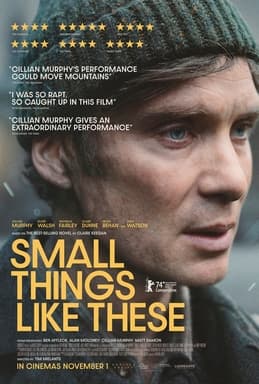
Poster / promotional material via Wikipedia, Small Things like These (film). Used under fair use for criticism and review.
Tim Mielants’s adaptation of Claire Keegan’s 2021 novella Small Things Like These opened the Berlinale in February 2024, was released in Irish and UK cinemas the same month, and arrived in the US via Lionsgate in November 2024, where it grossed around $7 million against a budget considerably below that figure. Cillian Murphy produced, through his company Big Things Films, and stars. The film was reviewed, on its US release, as a modest and dignified postscript to Murphy’s Oppenheimer year. That reception undersells what the film actually does.
The novella is 128 pages. The film is 98 minutes. The compression is near-exact; Mielants and screenwriter Enda Walsh have preserved Keegan’s structural choices almost intact. That fidelity is the film’s first interesting feature, and its difficulty.
What the film is
It is the week before Christmas 1985, in New Ross, County Wexford. Bill Furlong (Cillian Murphy), a coal and timber merchant in his early forties, is delivering fuel to the local convent, which runs a laundry for unmarried mothers and their children under the auspices of the Sisters of the Good Shepherd. Bill has a wife, Eileen (Eileen Walsh), five daughters, a viable small business, a respected place in a small Irish town.
During one delivery, Bill finds a young woman locked in the convent’s coal shed. He brings her inside. The Mother Superior (Emily Watson) serves him tea. She explains, without explaining, that Bill should not be concerning himself. The film’s remaining running time is what Bill does with the weight of what he has seen and what the town, including his wife, including his neighbours, including himself, has spent decades not seeing.
What the film is about
The Magdalene Laundries ran in Ireland for most of the twentieth century, the last one closing in 1996. They were religious institutions, operated with state funding, in which unmarried mothers and other women considered socially inconvenient were imprisoned as unpaid labour. Thousands of children were forcibly separated from their mothers. Thousands more died. The scale of the harm has been publicly acknowledged in Ireland since the late 1990s, and the legal and financial reckoning continues.
Keegan’s novella, and Mielants’s film, are not about the laundries as an institution. They are about the specific mechanism of complicity that kept the laundries operating: the refusal, by the broader Irish town around each laundry, to see what was happening in the buildings they walked past every day. The film is an indictment of that refusal, not of the institution. The institution could not have existed without the refusal.
The Murphy performance
Cillian Murphy has, across two decades, played a specific range of controlled, contained male protagonists (28 Days Later, Peaky Blinders, Oppenheimer). The containment has sometimes hardened into mannerism. Small Things Like These dismantles the mannerism and returns to what the restraint was originally capable of communicating. Bill is a man whose whole social function is to be reliable, pleasant, efficient in his deliveries, uncomplaining about the small difficulties of his days. Murphy plays the reliability as a form of self-management that is breaking under the specific moral weight of what Bill has discovered.
The performance is largely silent. Murphy carries entire sequences on facial response. A scene in which Bill, on Christmas Eve, washes his hands at his own kitchen sink after an earlier encounter at the convent, is filmed in one unbroken take. The hands scrub. The face moves. Nothing is said. The scene runs for what feels like three minutes. It is the film’s clearest argument for the restraint Mielants is operating at.
Eileen Walsh, as Bill’s wife, gives the film its second most interesting performance. Eileen is not Keegan’s villain; she is the voice of the social pragmatism that keeps the laundries possible. The scene in which she explains, at the kitchen table, why Bill must not involve himself with the convent, is the film’s most difficult dialogue. Walsh plays it not as cruelty but as specifically reasonable calculation. She is protecting her daughters’ futures. She is right, in the terms the town uses. She is also, in the film’s terms, participating in the refusal.
The Watson sequence
Emily Watson’s Mother Superior appears in one extended scene. The scene is the film’s centrepiece. The Mother Superior has invited Bill in for tea because he has asked too many questions and seen too much. Across the tea and Christmas cake she offers him, she communicates, without ever stating anything, that Bill has a family, that his family depends on the town’s continued goodwill, and that the goodwill is specifically conditional on his silence.
Watson plays the scene at a register of genteel menace that has few recent precedents in Irish-set film. The Mother Superior is not a caricature. She is a competent administrator delivering an accurate prediction of what will happen to Bill if he acts on what he has seen. The menace is entirely in the registers of politeness. Watson’s work here is, I want to argue, the supporting performance of the year.
The visual register
Frank van den Eeden, the Belgian cinematographer, shoots the film in what is, for a contemporary Irish film, a specifically restrained palette. Winter light. Kitchen interiors. The specific low-ceilinged geography of small-town Irish commercial and domestic spaces. The camera is mostly static; movements are small and purposeful. The film is visually economical, and the economy serves the tonal project.
Senjan Jansen’s score, which is specifically sparing, surfaces only at the emotional inflection points. Long passages are scoreless, carried by the ambient sound of a small town in the week before Christmas: shop doors, church bells, the movement of coal through a delivery chute.
The ending
Keegan’s novella ends on a small, specific act. The film ends on the same act, filmed without embellishment. I will not describe it. I will say that the act, in the film, is staged with a specific refusal of catharsis. It is what Bill does. It does not change what has happened. It does not rescue the broader institutional apparatus. It is one man choosing, in one specific moment, to see what he has been trained not to see and to act on what he sees.
The film ends before the consequences of the act. That choice is the film’s final formal move. The consequences, Mielants is arguing, are not the film’s subject. The moment of seeing is.
Where it sits
Small Things Like These is a modest film about a large subject, and the modesty is the formal discipline. It will not be the most-watched Cillian Murphy project of his career. It will be one of the most defensible. Big Things Films, Murphy’s production company, has indicated it will continue working at this budget tier; I hope the follow-ups maintain the specific restraint this film earned.
Watch it in winter, with the lights dim, with time afterwards to sit in the quiet. The film is specifically difficult in ways that repay the difficulty.
Lena writes long-form essays on the films that will still be talked about in a decade. Previously at a defunct monthly whose name we do not speak.
MORE BY LENA ASHWORTH →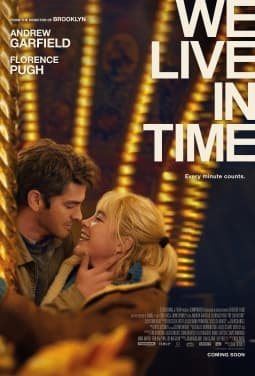
We Live in Time: Crowley's Non-Linear Gamble
John Crowley's third collaboration with A24 runs the ten-year relationship in a non-linear shuffle, and the shuffle is what makes the film survive its cancer-drama premise. Just barely, but it does.
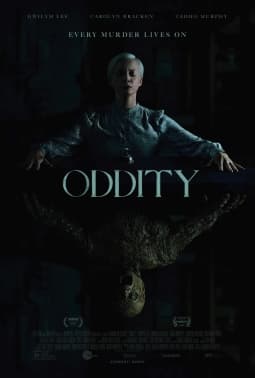
Oddity: McCarthy's Puppet as Grief
Damian McCarthy's second feature is the best pure-horror indie of 2024, and the clearest argument going for what micro-budget Irish genre cinema can do when it commits to a single effect and doesn't blink.
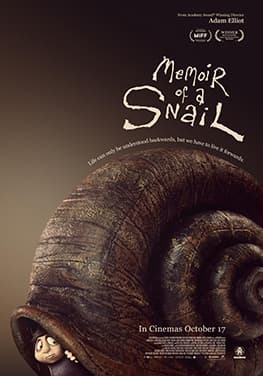
Memoir of a Snail: Elliot's Claymation Grief
Adam Elliot's second stop-motion feature took eight years to make and collected festival prizes from Annecy to Annapurna. The Australian argument is that his particular strain of misery-claymation is one of the country's more unusual exports.