Beetlejuice Beetlejuice: The Rare Legacy Sequel That Remembers What the Original Was
Tim Burton returns to Beetlejuice after 36 years and makes a legacy sequel that actually works, mostly because he refused to make a serious one.
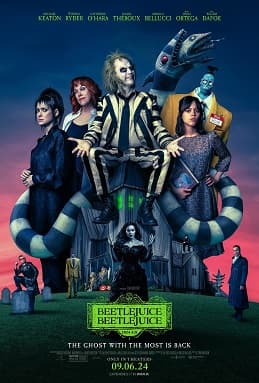
Poster / promotional material via Wikipedia, Beetlejuice Beetlejuice. Used under fair use for criticism and review.
The bar for a Beetlejuice sequel, arriving thirty-six years after the original, was on the floor. I want to say this up top, so my relative enthusiasm for Beetlejuice Beetlejuice, which opened wide in September and which I have now seen twice, is not mistaken for unconditional praise. This is not the 1988 film. Nothing will be. This is, however, a legacy sequel that has understood, correctly, what the original was actually for, and has tried to be that thing again rather than a polished-up, self-important, prestige-inflected version of that thing.
What the 1988 film was for
Tim Burton’s Beetlejuice (1988) was a specific cultural object: a weird, visually inventive, narratively loose comedy with a horror premise, carrying a horror genre-shaped engine around under a costume of practical effects, stop-motion animation, and a Danny Elfman score. The tone was genuinely strange. The plot did not fully hang together. The film worked because of its willingness to be odd at the level of individual scenes and to trust the audience to roll with the oddness.
Nobody makes films like that anymore, mostly because the studio apparatus of the 2020s cannot tolerate the risk of a film whose tone cannot be explained in a single pitch sentence.
Against that backdrop, Beetlejuice Beetlejuice is a small miracle. Burton, after a decade-plus of making films that seemed to belong to other directors (Alice in Wonderland, Dumbo, Miss Peregrine’s Home for Peculiar Children), has shown up to this sequel apparently unburdened by the obligation to make it “serious” or “modernised.” The film is weird. The plot is loose. The stop-motion is back. The tone is genuinely strange. It should not work in 2024 and it mostly does.
What the film is about
Lydia Deetz, played by Winona Ryder, is now a semi-famous TV psychic with her own supernatural-investigations show. Her stepmother Delia, Catherine O’Hara returning in fine form, is still an artist, now more successful. Her teenage daughter, Astrid, played by Jenna Ortega, is skeptical of the family’s ghost business, which has become the family business in ways Astrid resents.
A death in the family (Lydia’s father) returns all of them to the Connecticut house from the first film. Astrid, meanwhile, meets a local boy who turns out to be more complicated than he initially appears. And, in the afterlife, Beetlejuice (Michael Keaton) has his own subplot involving a vengeful ex-wife, played by Monica Bellucci, and a Willem Dafoe-as-afterlife-detective sequence that is the single most pleasurable element of the film.
Michael Keaton, as if no time has passed
Michael Keaton, at 73, returns to the Beetlejuice role with, astonishingly, no visible loss of speed. His comic timing, his specific mode of physical unsettlement, his willingness to go full weird on a line of dialogue that a lesser performer would play safe: all of these are intact. This is, I think, the third-best Michael Keaton performance of the last thirty years (behind Birdman and the original Beetlejuice), and I am aware of what I am saying.
The scene, early in the film, where Beetlejuice has to manage his afterlife call centre is a masterclass in sustained visual and verbal comedy, and it is, crucially, not a callback sequence. It is a new scene that trusts Keaton’s performance to carry a specific comic register at a specific length. The fact that Burton and his editing team (Jay Prychidny) let Keaton cook, rather than cutting away for fan-service inserts, is the film’s single best directorial decision.
Jenna Ortega, asked to hold her own
Jenna Ortega, carrying the next-generation-heroine role, has the hardest job in the film: she has to play the straight character against a returning ensemble of weird-legacy performers, without seeming like a modern graft on an 80s object. She does this pretty well. Her Astrid is specifically a teenager, not a generic teen-film protagonist: she is skeptical, slightly sullen, willing to roll her eyes at her mother, willing to be surprised when the roll-your-eyes attitude fails her.
She is not as commanding as Ryder was in 1988. That is, I think, fine. The film does not actually need her to be. Astrid is there to ground the next generation’s stakes. She grounds them.
Where the film falls short
One complaint. The film has too many plots. The Beetlejuice-Bellucci plot, the Astrid-boy plot, the Delia-artistic-widowhood plot, the Lydia-new-boyfriend (Justin Theroux) plot. Each of these has merit. Together, they crowd the film’s running time and prevent any one of them from developing fully.
A tighter version of Beetlejuice Beetlejuice, with perhaps one fewer subplot, would have been a better film. The film Burton made is still very good. It is just slightly overstuffed.
Where the sequel succeeds, structurally
The reason Beetlejuice Beetlejuice works where other legacy sequels fail is simple: Burton has not tried to be taken seriously this time. The film is unembarrassed about being a comedy first and a ghost story second. It does not apologise for the goofiness of its source material. It does not try to “elevate” the concept. It just keeps doing the things that worked in 1988, in 2024 equivalents, at the same tonal register.
This is the thing contemporary Hollywood keeps forgetting about legacy-sequel craft. The goal is not to make a “mature” version of the original. The goal is to remember what the original was for and return to doing it. Burton, for this film, remembered.
What it signals
Beetlejuice Beetlejuice has grossed more than $400 million worldwide as of this writing. The commercial message to the studios is, roughly, that audiences will show up for a legacy sequel that respects the original’s tone, and will not show up, or will show up and leave cold, for one that condescends to it.
Whether that message will be correctly translated into studio practice is a separate question. I am not optimistic. But the film itself is the strongest argument for the argument.
Watch it at home with the lights low and something sweet to eat. It will still make you laugh in specific places. The specific places are the point.
Marcus believes good criticism is an argument. He is almost always angry about something, usually for good reason. Horror is his first language.
MORE BY MARCUS VELL →
The Crow: How Not to Remake a Movie
The Crow remake, after two decades of failed attempts, finally arrived in August and confirmed every reason the attempts should have stayed failed.
Cuckoo: Tilman Singer's Weird Alpine Fever Dream
Tilman Singer's second feature is one of the weirdest mid-budget horror films of the year, and one of the least bothered about making sense. An argument for the horror film that works on dream logic.
Strange Darling: A Formal Con in Six Parts
JT Mollner's non-linear indie thriller has a gimmick and knows it. A case for the film that uses its structural trick as an actual argument.