Memoir of a Snail: Elliot's Claymation Grief
Adam Elliot's second stop-motion feature took eight years to make and collected festival prizes from Annecy to Annapurna. The Australian argument is that his particular strain of misery-claymation is one of the country's more unusual exports.
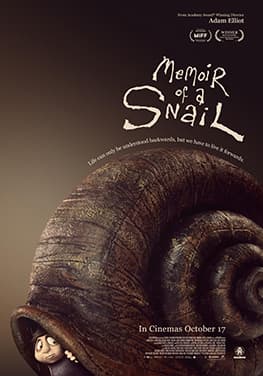
Poster / promotional material via Wikipedia, Memoir of a Snail. Used under fair use for criticism and review.
I grew up half an hour from where Adam Elliot made Mary and Max, his 2009 stop-motion feature that was, for a long time, the film I handed friends who claimed Australia didn’t make animation. Memoir of a Snail, his follow-up, took eight years to produce, premiered at Annecy in June 2024, won the Cristal award, and got US distribution through IFC Films in October. It grossed around $1.4 million in US theatres. The Australian release, handled by Madman, was smaller but specifically beloved by the Melbourne animation community that knows what a fifteen-person studio can and cannot do at this budget.
Elliot has made exactly two features in twenty-five years. Both are stop-motion. Both are about lonely people failing to connect, in ways the claymation medium somehow accommodates better than live action would. Memoir of a Snail is the better of the two, and the more difficult to describe.
What the film is
Grace Pudel (voiced by Sarah Snook), an adult woman living alone in a Melbourne share-house, is narrating her life story to her dying pet snail, Sylvia. The narration carries the film. Grace was born in the 1970s to an alcoholic father and a mother who died in childbirth; she has a twin brother, Gilbert, who was her only real attachment until the twins were separated by the foster system at age eight. Grace was sent to live with a specifically awful couple in Canberra. Gilbert was sent to a religious family in Perth. The film tracks Grace across the ensuing decades, and eventually also tracks Gilbert, whose adolescence and adulthood were their own specifically difficult narrative.
Grace also has a friend, Pinky (Jacki Weaver), an older woman whose life was specifically unconventional, who becomes Grace’s most important adult attachment. Pinky’s death, roughly two-thirds into the film, is the film’s emotional hinge.
What Elliot is doing
The stop-motion medium in Memoir of a Snail is specifically rough. The clay figures are slightly asymmetrical; the eyelines wobble; the textures are visibly handmade. Elliot has never chased the Aardman-level slickness of contemporary British claymation or the Laika-level polish of the American stop-motion industry. His work has a specific roughness that reads as deliberate: the figures look like the figures a person might shape in their kitchen, and the effect is to ground the often extreme emotional content of the stories in a craft that is specifically human rather than specifically perfected.
The narration is doing the second half of the work. Grace’s voice-over, written by Elliot, is a specifically Australian register of melancholic self-deprecation: flat, observant, funny in ways that don’t signal themselves as comic. Snook’s delivery is perfect for this. She plays Grace as someone who has spent her life narrating her own experience to herself as a form of survival, and the voice-over is the externalisation of that ongoing internal narration.
The misery and its comedy
Memoir of a Snail is a film in which a specifically large number of terrible things happen. Grace’s mother dies in childbirth. Her father dies young. Her foster family is cruel. Her brother is abused. Her first romantic relationship is exploitative. Her beloved friend dies. By the time I list these things in a sentence, the film sounds unwatchable.
It is not unwatchable. It is a comedy, in a specifically Australian mode. The mode does not soften the awful events. It narrates them with a specific dry affection and a specific willingness to find the absurdity in the suffering. Elliot’s work is, in this respect, close to the English kitchen-sink tradition filtered through an Australian suburban-outsider sensibility: Alan Bennett crossed with Barry Humphries, in clay.
The comic register matters because without it the film would be specifically punishing. With it, the film becomes a specifically generous work: generous to its damaged characters, generous to the viewer watching them struggle, generous to the possibility that lives of this kind of cumulative difficulty can still, at the end, be meaningful.
The Gilbert thread
Gilbert’s storyline is the film’s most specifically difficult material. He is sent to a Pentecostal family in Perth who attempt to conversion-counsel out of him his developing homosexuality. The Canberra and Perth threads, which alternate across the film’s running time, are constructed as a specific mirrored structure: Grace in one household failing to become what her foster parents want; Gilbert in another household being actively harmed by what his foster parents want.
Elliot handles the Pentecostal material with a specific precision that avoids both sentimentality and caricature. The Perth family are not monsters. They are people whose specific beliefs produce specific harm, and the film makes the harm visible without making the family cartoonish.
The Pinky sequences
Jacki Weaver’s Pinky is the film’s brightest thread. Pinky is an elderly woman with a specifically unconventional life story (extensive travel, multiple marriages, an active sexual history, a refusal of the conventions that Grace’s Canberra household imposes). Pinky’s relationship with Grace is the film’s one unambiguous good. Weaver’s voice work is specifically alive; Pinky is funny in a way the character animation cannot quite contain, and the animation rises to meet the voice.
The Pinky sequences are also the film’s most visually extravagant. Elliot lets the claymation loose; Pinky’s house is crammed with handmade props that reference her specifically colourful backstory. The sequences are a reminder that Elliot’s animation style, for all its roughness, can also be specifically ornate when the material requires it.
Where it sits
Memoir of a Snail is one of the year’s best animated features. It lost the Oscar to Flow, which was the correct outcome given what Flow accomplishes, but the two films are doing very different work, and Memoir of a Snail would have been a defensible winner. I hope Elliot does not take another eight years to make his next feature. The Australian animation ecosystem, such as it is, needs his output.
The specific question of whether Australia can sustain this kind of handmade auteur-scale animation is, in the context of the film industry’s current crisis, genuinely open. Memoir of a Snail is the argument that it should. Madman distributed it here with specific care. IFC did the same in the US. The film has the audience it deserves, and the audience will keep finding it.
Watch it with tissues and with patience. The film will hurt you on purpose. It will also, specifically, be kind.
Jules writes the kind of pieces that come from wandering somewhere and overhearing something. On Frame Junkie's masthead since the beginning.
MORE BY JULES OKONKWO →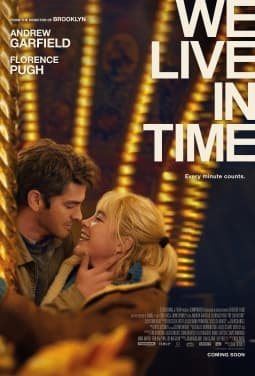
We Live in Time: Crowley's Non-Linear Gamble
John Crowley's third collaboration with A24 runs the ten-year relationship in a non-linear shuffle, and the shuffle is what makes the film survive its cancer-drama premise. Just barely, but it does.
In a Violent Nature: The Slasher from the Wrong Side
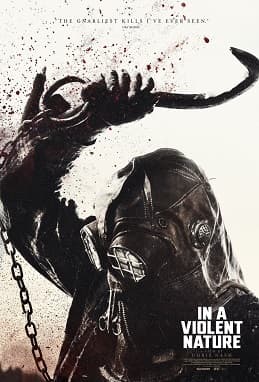
Chris Nash's debut takes the slasher apart from the killer's point of view, and the radical formal choice is also the reason the film divides its audience. I want to argue for it.
Oddity: McCarthy's Puppet as Grief
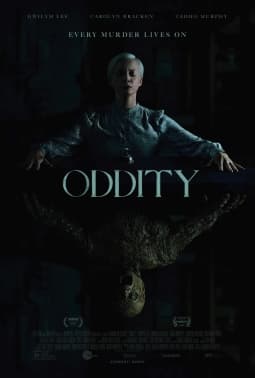
Damian McCarthy's second feature is the best pure-horror indie of 2024, and the clearest argument going for what micro-budget Irish genre cinema can do when it commits to a single effect and doesn't blink.