Ripley: The Slowness Was Always the Point
Steven Zaillian's eight-episode Netflix adaptation of Patricia Highsmith was the quiet prestige show of April 2024. A year later, its patience has only looked smarter.
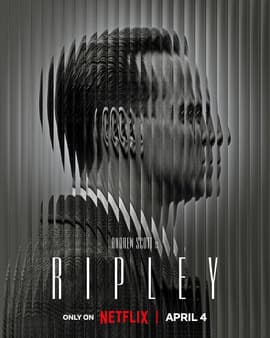
Poster / promotional material via Wikipedia, Ripley (TV series). Used under fair use for criticism and review.
I have watched Steven Zaillian’s Ripley three times now, and each watch has been slower than the one before. This is not a complaint. It is an observation about what the show is teaching its viewers to do.
Ripley, the eight-episode Netflix limited series adapting Patricia Highsmith’s The Talented Mr. Ripley, was the quiet prestige arrival of April 2024. It was overshadowed in the month’s conversation by Baby Reindeer and Fallout. It collected its Emmy nominations and its niche-critical adoration and then largely faded from the cultural centre, in the way that deliberate, slow-moving shows with no social-media quote-factory tend to.
A year out, I am here to say: it is, for my money, the best piece of television direction of 2024.
The Zaillian project
Steven Zaillian, at this point in his career, has the kind of authorial signature most American television directors are not permitted to develop. His prior The Night Of (2016), the HBO limited series about a murder trial in Queens, was a formal experiment in how long a prestige drama can dwell on procedural texture before the drama actually begins. Ripley is the next step in that project. Where The Night Of dwelt on American legal bureaucracy, Ripley dwells on Italian geography, interior decoration, and the specific physical labour of being an impostor.
Every episode of Ripley is willing to spend three to five minutes of its running time showing you Tom Ripley walking down a staircase, or lighting a cigarette, or drying dishes in a kitchen. These are not establishing shots. They are, in Zaillian’s grammar, the drama itself. What Ripley is doing, across the show, is becoming someone else, and becoming someone else is a physical project conducted in the muscles and the posture and the rhythm of daily motion.
The black-and-white argument
The most-discussed formal choice, and the most correct one, was Zaillian’s decision to shoot in black and white. Robert Elswit, the cinematographer, was given the space to photograph Italy as a sequence of high-contrast compositions: the shadows of arched windows on stone floors, the specific glare of Amalfi sunlight, the deep black of an unlit Roman stairwell at three in the morning.
Why black and white? The commercial pressure must have been considerable to shoot it in colour. Highsmith’s Italy is famously sensual, and the previous Anthony Minghella film adaptation (1999) built its aesthetic around that sensuality. Zaillian’s refusal of colour is not about austerity. It is about noir. The show is, at its core, a noir. The protagonist is a killer. The Italian setting, in colour, tempts the viewer into reading the show as a travelogue with a dark edge. In black and white, the travelogue reading is impossible. We are in a thriller at all times.
The choice also allows Elswit to do specific kinds of photographic work, deep shadow compositions, long tonal gradients across stucco walls, faces half-lit through shuttered windows, that colour cinematography simply cannot produce at the same intensity. The show looks, at times, like a sequence of stills from a 1950s Italian cinema that never quite existed.
Andrew Scott, the thesis
Andrew Scott’s Ripley is the performance the show is organised around, and it is a specifically un-showy piece of work. Scott, who can be a broad actor, a theatrical actor, a maximalist actor, has chosen to play Ripley as a person of reduced affect. He is not charming. He is not seductive. He does not perform any of the Ripley tropes that previous performers, Matt Damon, John Malkovich, Alain Delon, have leaned on. His Ripley is quiet, unsettled, watchful, and occasionally small.
The move works because Ripley, in Highsmith’s novel, is not a charming sociopath. He is a deeply awkward man who has learned to pass, through enormous cognitive labour, in rooms that do not want him. Scott plays the labour. You can see him, across any given scene, performing the micro-adjustments required to appear normal. He is always doing two things at once: the surface behaviour, and the anxious monitoring of whether the surface behaviour is landing.
The moment I remember most clearly is from episode four, after the first murder, when Ripley realises the body has been seen. Scott plays the realisation across forty seconds of screen time, without dialogue, using almost only his eyes. It is as controlled a piece of screen acting as I have seen in years.
The critic who will say the show is slow
They are right. The show is slow. Zaillian is, at moments, almost pathologically unwilling to cut. A sequence in which Ripley’s landlady brings him coffee runs longer than most full scenes in a typical streaming drama. The boat-disposal sequence, in which Ripley has to sink a body in the Mediterranean, runs close to twenty minutes and is shot with an almost real-time fidelity to the actual physical labour involved.
These sequences are not padding. They are the show. The argument Ripley is making, across its eight hours, is that a life built on deception requires enormous operational labour to sustain. We are not told this. We are shown it, in protracted physical detail, until the labour itself becomes the emotional register of the piece.
If you cannot surrender to the labour, the show will bore you. If you can, the show is hypnotic.
Dakota Fanning’s Marge
The other performance I want to flag is Dakota Fanning’s Marge, which was undervalued in the initial reviews. Marge is, in Highsmith’s novel and in every prior adaptation, the tricky role: she has to register the audience’s suspicion of Ripley while remaining plausibly vulnerable to him. Fanning plays Marge with a specific intelligence that the previous adaptations did not always grant. She knows. We can tell she knows. She does not know what to do with the knowing.
What the show left
Ripley is, structurally, a complete story. Highsmith wrote four further Ripley novels, and Zaillian has said he would like to adapt them. Whether that happens depends on Netflix’s appetite for a second season of a show whose viewing numbers, while solid, were never blockbuster. I hope it happens. I also think this eight-episode season, on its own, stands.
Watch it again, on a weekend, with the brightness on your television lowered to where the black-and-white can really work. Let Zaillian take his time. He has earned it.
Priya came to criticism sideways from theatre. She is patient with slow shows, short with bloated ones, and cheerfully vicious about lazy writing.
MORE BY PRIYA NAIR →
Shōgun's Emmy Sweep and the Future of the Limited Series
Fifteen months after Shōgun's historic Emmy sweep, and with a second season confirmed, it's worth asking what the show changed about prestige TV, and what it didn't.

The Four Seasons: Tina Fey's Middle-Aged Friendship Show
Tina Fey's adaptation of the 1981 Alan Alda film is a show about three couples, four vacations, and what middle-aged friendship sounds like when nobody is performing for an audience.

Severance Season 2 and the Mythology Problem
Eleven months after Severance returned, the second season's structural gambles are clearer. The show's patience has always been its argument; the real question is whether that argument still scales.