The Four Seasons: Tina Fey's Middle-Aged Friendship Show
Tina Fey's adaptation of the 1981 Alan Alda film is a show about three couples, four vacations, and what middle-aged friendship sounds like when nobody is performing for an audience.
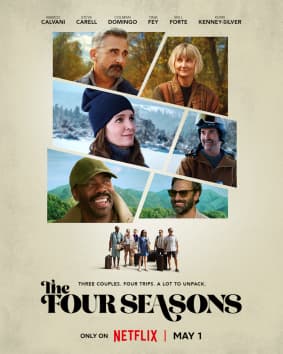
Poster / promotional material via Wikipedia, The Four Seasons (TV series). Used under fair use for criticism and review.
I had not seen The Four Seasons, the 1981 Alan Alda film, when Netflix announced that Tina Fey was adapting it as an eight-episode limited series. I watched it before the show aired in May 2025 and then again after. The film is, essentially, four long conversations among three couples taking seasonal vacations together, watching each other age, watching each other’s marriages shift, watching each other’s friendships contract and expand. It is a specific kind of American middle-class movie, shot with the specific pre-streaming patience of its era, and it has aged unevenly. Some of it plays. Some of it plays like a time capsule.
What Fey did with the property, working with co-showrunners Lang Fisher and Tracey Wigfield, is strip the 1981 period specificity back to its premise, keep the seasonal structure, and rebuild the dialogue for 2025. The show is not, strictly, a nostalgic adaptation. It is a show about what specific fifty-something American friendships sound like now, and the sound is the point.
The casting decision
Fey stars, alongside Steve Carell, Will Forte, Colman Domingo, Kerri Kenney-Silver, and Marco Calvani. Erika Henningsen plays the younger partner of Carell’s character, a specific plot-structural role that the 1981 film also had. The casting is the first place the show announces itself. These are all specific television and stage performers of a certain vintage, and the combination produces an ensemble that feels immediately like a group of people who could plausibly have known each other for twenty years.
Carell and Forte, who have not done ensemble work together before, are the show’s central bet. They play two long-married husbands who have been, across decades, each other’s pressure valve. The chemistry works, partly because Carell has been, since Foxcatcher, willing to bring a specific quiet register to his dramatic work that his earlier comic career did not require, and partly because Forte, underused as a straight dramatic actor for a decade, has the specific lived-in weariness the role requires.
Colman Domingo is playing the role that in the 1981 film went to Len Cariou. Domingo is a specific kind of actor whose stage background (The Scottsboro Boys, Summer: The Donna Summer Musical) informs the specific listening quality he brings to ensemble work. He is, consistently, the actor on screen you cannot stop watching, even when he is not speaking. The show uses this by giving Domingo long stretches of silent reaction to other characters’ conversations, and the reactions are doing real structural work.
The four seasons, structurally
The show is built as the film was: four two-episode arcs, each at a different seasonal vacation. Spring, in Napa. Summer, at a lake house in New Hampshire. Autumn, at a college campus. Winter, on a small Caribbean retreat. Each arc has its own specific location, its own visual palette, its own emotional weather.
The locations are doing more work than they initially appear to. The summer lake house, in particular, is rendered with a specific attention to the physical routines of a group of middle-aged friends sharing a borrowed vacation property: who makes the coffee, who sets the table, who retreats to the deck after dinner, who stays up drinking. This is observational writing at a specific level. Fey, whose comedy-writing reputation is for the quick-joke ensemble style, is doing something quieter here. The jokes are still there. They are slower.
What the show is actually about
The 1981 film was about marriage and infidelity, specifically the specific generational shock of Alda’s character leaving his wife for a younger woman. The show preserves that plot point, handled with reversed gender dynamics in one of the couples and with a specific contemporary register that registers, correctly, as less scandalous now than it was in 1981.
What the show is more interested in, and what takes up most of its eight hours, is the specific experience of being fifty-something and being in a friend group for twenty-plus years. The conversations are about children who are now grown, parents who are now old, careers that are now either winding down or plateauing, marriages that have accumulated specific patterns the spouses are or are not still pretending to enjoy.
This is a specific register of American life that prestige TV has not worked in much. The fifty-something friend group as a dramatic subject has been, traditionally, left to feature film (The Big Chill, The Meyerowitz Stories) rather than television. Fey’s bet is that there is enough texture in this register to carry eight episodes. The bet pays.
Specific scenes
The scene I keep coming back to is in the second episode. Carell’s Nick has just announced to the group, specifically to his best friend played by Forte, that he is leaving his wife. The announcement happens during a long Napa-wine-country dinner. The dinner has been, for the first forty minutes of the episode, a group of six old friends eating and laughing. The announcement is delivered in a specific conversational register that the group has been using all episode, and the register does not change when the announcement lands.
What the show does in the next two minutes is hold on that register. The friends do not visibly react. They continue eating. Nick continues explaining. The group continues eating. A single camera movement, slow and lateral, lets us see each friend’s face at a different point of absorption. Nobody breaks the surface of the dinner conversation. Everyone is processing. This is the show’s central formal move: specific large emotional events are absorbed by the group at the pace and register the group’s existing dynamics allow, not at the pace a prestige-TV narrative would conventionally require.
The direction, by Shawn Levy on the Napa arc and later Stella Meghie on the New Hampshire arc, is continuously attentive to this specific quality of absorption. Meghie’s work especially is doing something I want to name: she is staging the friend group’s physical geography in a specifically theatrical way, where who is sitting next to whom, who is holding whose attention, who has moved to the edge of the deck, is continuously significant.
The Henningsen problem, not a problem
Erika Henningsen’s role, as the young woman Carell’s character leaves his wife for, is the show’s most structurally delicate element. In the 1981 film, the equivalent character was handled with a specific register that was, politely, condescending. Fey’s adaptation refuses that register. Henningsen plays Ginny not as an interloper but as a specific person, with her own interiority, her own discomfort at the group’s dynamics, her own legitimate questions about what she has wandered into.
The scene where this pays off is in the summer arc. Ginny is alone on the lake-house deck after the other couples have gone to sleep. She is, specifically, processing her own uncertainty about the relationship she has entered. Henningsen plays the two-minute solo beat with the specific stillness that this kind of material requires. The show is letting her be a person. The 1981 film would not have allowed that.
The Kerri Kenney-Silver scene
Kerri Kenney-Silver plays Danny, Forte’s wife, and has in the third arc what is, to my mind, the best single scene of the season. Danny and her husband are arguing, mildly, about specific old habits of their marriage. The argument escalates at a specifically low volume. Kenney-Silver plays the scene as a woman who is finally allowing herself to say something she has been not-saying for twenty years, and who is not entirely sure, as she says it, whether she wants to be saying it.
Kenney-Silver has worked primarily in comedy (Reno 911!) and this is her first significant dramatic role at this scale. The performance is extraordinary, and it is the kind of thing that should, but probably will not, produce the next phase of her career.
What the show leaves
The Four Seasons is the prestige-TV show from last year that I have most reliably recommended to people my age, which is the show’s core demographic. It does not reinvent the limited-series form. It does not stretch into the kind of genre or political territory that other 2025 shows claimed. It does one specific thing with a specific discipline: it stages the sound of middle-aged friendship, at ensemble scale, over a defined seasonal structure, and it stages it at a register that feels continuously observed rather than performed.
Fey has said there will not be a second season. I believe her. The show is complete as an object. Watch it across two weekends. Listen to the dinner-conversation scenes. They are what the show is, and what the show is, is worth the attention.
Jules writes the kind of pieces that come from wandering somewhere and overhearing something. On Frame Junkie's masthead since the beginning.
MORE BY JULES OKONKWO →
A Man on the Inside: Mike Schur, Ted Danson, and the Comedy of Late Life
Mike Schur's Netflix show placed Ted Danson inside a retirement community as an amateur investigator. The premise is a disguise for the comedy Schur has been moving toward for a decade.

Kaos: The Netflix Myth Show That Needed a Second Season
Charlie Covell's Greek-myth reworking arrived on Netflix in August 2024 and was cancelled a month later. The show deserved better, and the cancellation revealed something specific about Netflix's renewal math.

Your Friends and Neighbors: Jon Hamm and the Middle-Aged Crisis Show
Jonathan Tropper's Apple series gave Jon Hamm a part he has been waiting a decade for. The show itself is a more complicated object.