Presumed Innocent: The David E. Kelley Engine, Warmed Up Again
Apple's Presumed Innocent is not a radical show. It is a competent one, and competent legal drama has become rare enough that the competence is worth noting.
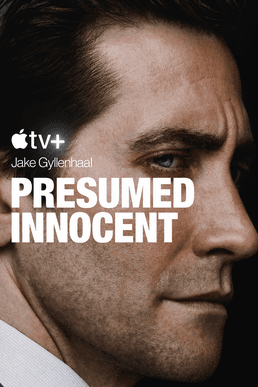
Poster / promotional material via Wikipedia, Presumed Innocent (TV series). Used under fair use for criticism and review.
Presumed Innocent, Apple TV+’s eight-episode limited series adapted from Scott Turow’s 1987 novel (previously adapted as the 1990 Harrison Ford film), finished its run last week. It is, by any measure, a polished piece of prestige television. It is also the show that reminded me, most clearly of any recent legal drama, that American television has largely forgotten how to make competent procedural television.
This is a curious moment to say so. The prestige-TV landscape is overflowing with crime-adjacent dramas. Every streamer has four of them. What is rare is the specifically competent legal procedural, the show that treats legal mechanics as the engine of the drama, hires writers who understand the law, and does not treat the trial as a delivery vehicle for themes.
David E. Kelley, who showruns this adaptation, is one of the three or four people in American television who can still make this kind of show.
What the show is
Rusty Sabich, a Chicago chief deputy prosecutor played by Jake Gyllenhaal, is assigned to investigate the murder of Carolyn Polhemus, his colleague and recent lover. The problem, rapidly established, is that Rusty is a suspect. The rest of the show is the slow public and private unraveling of his situation as the investigation turns against him, he is charged, and he goes on trial.
The thing Kelley does, and this is where the show earns its keep, is treat the mechanics of a high-profile criminal case with genuine respect. We see the plea deliberations. We see the prosecutor’s case-building. We see jury selection. We see the defence’s motion practice. We see the specific tactics of a cross-examination.
Most contemporary legal TV skips these. Kelley does not. The specific pleasure of Presumed Innocent, for someone who has watched a lot of legal TV, is the recognition that a serious mechanical account of a criminal prosecution is dramatic on its own terms.
Jake Gyllenhaal’s project
Gyllenhaal, as Rusty, is doing something interesting. Rusty is a character who has to read as both potentially innocent and potentially guilty at every moment. The show’s central tension depends on the viewer not being sure which way the performance is tilting. Gyllenhaal, across eight episodes, plays the ambiguity with careful calibration.
The achievement is that Rusty is consistently somewhat unlikeable across the season. He is self-important, unfaithful, professionally manipulative, occasionally cruel to his wife. Gyllenhaal does not flinch from any of these qualities, which is correct: Turow’s novel is partly about whether a jury can convict a man who is plausibly guilty and deeply unappealing, or whether the legal-procedural framework protects defendants like Rusty even when our sympathies have moved elsewhere.
The performance is not the acting showcase Gyllenhaal’s best work has been (Nightcrawler, Enemy, Prisoners). It is more measured, more restrained, more workmanlike. The restraint is the right choice for the material.
The supporting cast, and Ruth Negga
Ruth Negga, as Rusty’s wife Barbara, is doing the show’s most interesting acting work. Barbara is, on paper, the cuckolded spouse, a role TV has traditionally treated as either saintly victim or vengeful scorned woman. Negga refuses both frames. Her Barbara is a specific, intelligent, professional Black woman whose marriage has been wounded but who is, throughout, making her own calculations about what she wants and what she is willing to accept.
The scenes between Negga and Gyllenhaal in the marital bedroom, as the investigation closes in, are the show’s strongest sustained sequences. Negga plays Barbara across a slow arc from wounded quiet to active agent, and the arc is earned rather than dictated.
Bill Camp, as Raymond Horgan, the outgoing chief prosecutor and Rusty’s mentor, is the show’s reliable supporting-performance anchor. Camp does this kind of role in his sleep, and I mean that as high praise: his Raymond is instantly believable, instantly specific, instantly loaded with back-story the script does not have to deliver.
Peter Sarsgaard, as the ambitious deputy prosecutor who takes over Rusty’s case and builds the prosecution, is the show’s slightly misjudged supporting piece. Sarsgaard plays the character a shade too broadly; the performance reads as a specific dramatic type (the smug career-climber) rather than as a specific human being. The show needs this character to be a full person for the trial’s ethical weight to land, and Sarsgaard’s version does not quite get there.
What the show refuses
The key choice Kelley and his writers’ room make is to decline to use the case as a vehicle for commentary on contemporary sexual politics, prosecutorial misconduct, or race-in-the-legal-system discourse. Each of these themes is available in the material. Each of these themes is, in a 2024 production, almost obligatory to foreground.
Kelley foregrounds none of them. The show is, stubbornly, about the specific mechanics of a specific criminal case. The larger political frames are permitted to exist in the viewer’s head without being pushed into the foreground.
I was, on first viewing, slightly disappointed by this restraint. On second viewing, I admire it. The show is trusting the viewer to bring the political frames themselves, rather than having them delivered. It is a kind of dramatic modesty that prestige television mostly no longer performs.
Where it falters
The finale, which I will not spoil, delivers a twist that breaks the show’s otherwise-strict adherence to the novel’s plot. Some viewers have defended the twist as dramatically earned. I am less convinced. The twist requires a specific character to have been operating on a logic the show has not adequately prepared us for, and the preparation happens only in retrospect.
That said, the final episode is otherwise tight, well-directed (Greg Yaitanes), and emotionally competent.
What it signals
Presumed Innocent is Apple TV+’s most-watched original since Ted Lasso and has already been renewed for a second season, apparently with a new case and cast. Kelley has signaled interest in continuing in the Turow universe, possibly adapting The Burden of Proof or Reversible Errors next.
I will be watching. The legal procedural is, when done well, one of the most satisfying forms American television has produced. Kelley, at this point, is the specialist.
Watch the season when you have an evening. Pay attention to the trial scenes in episodes five and six. They are master-class legal writing.
Priya came to criticism sideways from theatre. She is patient with slow shows, short with bloated ones, and cheerfully vicious about lazy writing.
MORE BY PRIYA NAIR →
Slow Horses Season 4: The Gary Oldman Show
A year on from Season 4, Slow Horses is still the most consistently-good spy drama on television. An argument for the show that has quietly become one of the best.
Disclaimer: Cuarón's Expensive Mistake
Alfonso Cuarón's seven-part thriller on Apple TV was the prestige-TV arrival of October 2024. A year out, the shape of what went wrong is clearer.

Masters of the Air: Apple's Expensive Mid-Range
The third Spielberg-Hanks World War II series landed on Apple TV+ in January with enormous production ambition and uneven dramatic execution.