Masters of the Air: Apple's Expensive Mid-Range
The third Spielberg-Hanks World War II series landed on Apple TV+ in January with enormous production ambition and uneven dramatic execution.
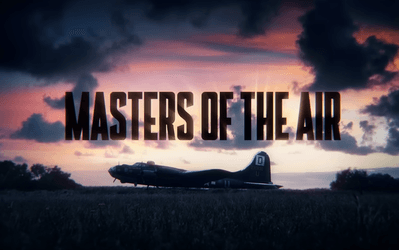
Poster / promotional material via Wikipedia, Masters of the Air. Used under fair use for criticism and review.
Masters of the Air finished its run on Apple TV+ in mid-March. It is the third World War II limited series to come from the Spielberg-Hanks production collaboration (after Band of Brothers in 2001 and The Pacific in 2010), following the 100th Bomb Group of the United States Army Air Forces across their air campaign over Europe. The reported production budget was in the range of $250 million across nine episodes, which makes it, by significant margins, the most expensive limited television series ever produced.
I want to say this clearly: Masters of the Air is not a bad show. It is, however, a specifically dispiriting one, because it demonstrates what happens when enormous production resources are deployed in the service of a specifically-narrow dramatic model.
What the show is
The central narrative follows two pilots, John “Bucky” Egan (Callum Turner) and Gale “Buck” Cleven (Austin Butler), across their tours with the 100th Bomb Group, based in Thorpe Abbotts in eastern England. The two men are close friends whose relationship provides the show’s emotional anchor. Around them, a rotating ensemble of supporting pilots, navigators, and ground crew live, fly, die, crash, and (in the later episodes) end up in German prisoner-of-war camps.
The show runs nine episodes at roughly sixty minutes each. The aerial sequences are, in isolation, extraordinary. The production design is meticulous. The costuming is period-specific. The specific sound design of the B-17 Flying Fortress engines is calibrated to be distinguishable from the specific sound of flak bursts and enemy fighter attacks.
What the show gets right
The aerial sequences are the clearest achievement. Masters of the Air uses specific visual-effects techniques (a combination of practical sets on gimbals and photo-real CG environments) that put the viewer inside the B-17 formation with a specific geographic clarity. You always know where each plane is. You always know where the German fighters are coming from. You always know which members of the formation are in trouble.
This is not trivial. Most contemporary war-film sequences fail at exactly this spatial-clarity work. Masters of the Air succeeds at it across every aerial sequence, which is remarkable given the technical difficulty.
The production’s research is also genuinely meticulous. The 100th Bomb Group was a real unit. The specific missions depicted are real missions. The specific casualty rates are historically accurate. The show treats its source material (Donald L. Miller’s 2006 book) with appropriate respect.
What the show gets wrong
And yet. The show has a specific and persistent problem: the men in the B-17s are, dramatically, interchangeable. Across the nine episodes, the pilot ensemble (dozens of named characters) is introduced, sent on missions, and, in many cases, killed, without most of them developing enough individual interiority to register as distinct people. This is, to some extent, structurally faithful to the source material and to the historical reality (bomber crew mortality rates were catastrophic, and the men who survived frequently described their fallen comrades as specific individuals they had barely had time to get to know).
The problem, for the show, is that the viewer needs some anchor characters whose specific deaths will register emotionally. Band of Brothers solved this by building a core ensemble of eight to ten named soldiers whose individual arcs were traceable across the series. The Pacific struggled with this, having three primary protagonists who did not always generate equal dramatic engagement. Masters of the Air has decided to spread its emotional weight across a larger number of characters, and the spread has diluted the individual weight.
The Butler and Turner achievement
Austin Butler and Callum Turner, as Buck and Bucky, are doing their best work. Butler, post-Elvis, has been calibrating his performance style across multiple projects (Dune: Part Two, this). His Buck is quiet, stoic, specifically Midwestern in register. Turner’s Bucky is more theatrical, more extroverted, in the specifically-Irish-Catholic-American mode. The two actors have genuine chemistry, and the scenes they share (which are, by structural necessity, limited) are the show’s most reliable emotional hits.
The specific problem is that the show’s structure separates the two men for large portions of its running time. Buck is captured and sent to a German POW camp mid-season. Bucky continues flying. The show’s emotional engine, which is their friendship, is functionally disabled for multiple episodes.
The Tuskegee sequence
The show’s later episodes introduce the 332nd Fighter Group (the Tuskegee Airmen), the all-Black American fighter escort unit whose specific historical importance the show is attempting to integrate into its main narrative. The integration does not fully work. The Tuskegee Airmen are introduced late, given limited individual characterisation, and deployed primarily as specific narrative rescue-points for Bucky’s bomber crew.
This is a missed opportunity. The Tuskegee Airmen have their own extraordinary specific story that the show is not telling. Their late appearance in Masters of the Air reads, on a third viewing, as a gesture toward historical complexity rather than as a substantive engagement with it.
What the show signals
Masters of the Air was Apple TV+’s largest dramatic investment to date. The subsequent viewership was, by available reports, modest. The show did not achieve the cultural penetration that Band of Brothers did in 2001, despite being available on a streaming service with substantial Apple-ecosystem reach.
The industrial lesson is that a very expensive World War II limited series, even with the Spielberg-Hanks brand attached, is no longer guaranteed to become a cultural event. Audiences, twenty-three years after Band of Brothers, have limited additional appetite for the form.
No follow-up Spielberg-Hanks war limited series has been announced. I suspect this is the last entry in the trilogy. The trilogy is not, on the whole, a failure. It is an ambitious body of work whose third entry did not quite land. That is the pattern that most long-running limited-series trilogies produce.
Watch the aerial sequences. The ground scenes are, mostly, skippable. The show’s best is in the air.
Priya came to criticism sideways from theatre. She is patient with slow shows, short with bloated ones, and cheerfully vicious about lazy writing.
MORE BY PRIYA NAIR →
The Sympathizer: Park Chan-wook's American Adaptation
Park Chan-wook's HBO adaptation of Viet Thanh Nguyen's novel is the most formally audacious prestige TV of the spring. A show about duality delivered by a director who specialises in it.
Presumed Innocent: The David E. Kelley Engine, Warmed Up Again
Apple's Presumed Innocent is not a radical show. It is a competent one, and competent legal drama has become rare enough that the competence is worth noting.

Slow Horses Season 4: The Gary Oldman Show
A year on from Season 4, Slow Horses is still the most consistently-good spy drama on television. An argument for the show that has quietly become one of the best.