Disclaimer: Cuarón's Expensive Mistake
Alfonso Cuarón's seven-part thriller on Apple TV was the prestige-TV arrival of October 2024. A year out, the shape of what went wrong is clearer.
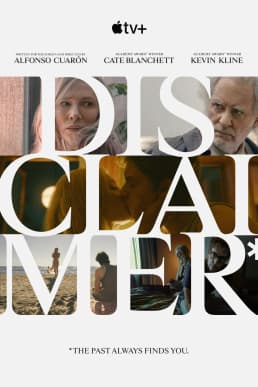
Poster / promotional material via Wikipedia, Disclaimer (TV series). Used under fair use for criticism and review.
Disclaimer, Alfonso Cuarón’s seven-episode Apple TV+ adaptation of Renée Knight’s 2015 novel, arrived with about the highest possible pedigree a prestige-TV project can carry. An Oscar-winning director making his first television drama. A cast anchored by Cate Blanchett and Kevin Kline. A reported $80 million budget. Cinematography by both Emmanuel Lubezki and Bruno Delbonnel. A book with a genuinely compelling central premise.
A year on, Disclaimer looks like the clearest case study of 2024 in how all those ingredients can combine into a show that does not work. I want to be specific about why, because the diagnostic is useful.
What the show is
Catherine Ravenscroft (Cate Blanchett) is a successful documentary filmmaker whose career has been built partly on exposing others’ secrets. A self-published novel arrives at her home. The novel, written by Stephen Brigstocke (Kevin Kline), a retired teacher, describes, in fictionalised form, a real incident from Catherine’s past involving Stephen’s now-dead son Jonathan. Catherine knows what really happened. Stephen believes he knows. The novel exists to destroy her.
The show unfolds as a dual-timeline piece: the present day, following Catherine’s increasingly desperate attempts to contain the damage; and the past, following young Jonathan (Louis Partridge) and young Catherine (Leila George) during the summer that the novel describes.
What the book does that the show cannot
The source novel, by Renée Knight, relies on a specific narrative device that is difficult to translate to the screen: the reader is allowed to believe, across most of the novel, that the novel-within-the-novel’s account of events is reliable. The reader is oriented against Catherine, who is presented, through other characters’ eyes, as the guilty party. The book’s climactic reversal, the revelation that what actually happened was radically different from what Stephen’s novel describes, recontextualises the entire novel the reader has just read.
This works in prose because the reader only has access to information through specific narrators. In television, Cuarón has to show events. When he shows the past-timeline sequences, he has to choose whose version of events he is filming.
Cuarón, across most of the season, films Stephen’s version. This is the source of the show’s central problem.
The specific misstep
The problem is not that Cuarón films Stephen’s version. The problem is that he films it as if it were true, not as if it were Stephen’s reconstructed fantasy of what must have happened based on incomplete evidence.
The past-timeline sequences, which make up roughly half the show’s running time, are staged with the full weight of Cuarón’s visual authority. The cinematography is gorgeous. The performances are committed. The dramatic beats are clear. The viewer has no narrative cues to suggest that what they are watching is a subjective reconstruction by a specific character with a specific agenda.
When the show’s penultimate episode finally reveals that the past-timeline sequences were wrong, that what actually happened was different, and specifically that a key scene of sexual violence was, in reality, consensual in a very different configuration than Stephen’s reconstruction suggested, the revelation cannot undo the weight the earlier sequences have accrued.
This is a structural error. The show has been, for six episodes, inviting the viewer to believe a version of events that it then asks them to discard. The discard does not work because the images already shown have done their work.
The gender politics problem
There is a specific ethical dimension here that the show, I think, did not fully reckon with. Disclaimer’s central reveal involves a staged-sexual-violence sequence that turns out, in the show’s telling, not to have been violence. The issue is not the fictional reveal itself. The issue is that the show has shown viewers a specifically-filmed sexual-violence sequence across its early episodes, and no subsequent reveal can un-film the images.
The show, in other words, has trafficked in the specific visual grammar of sexual violence in order to set up a twist that requires the viewer to have believed that grammar. This is a dubious use of the form.
I am willing to accept that Knight’s novel is doing something structurally similar. In prose, the device works because the reader’s imagination is the vehicle; the text is not generating images that cannot be un-seen. Cuarón’s show, because it is images, faces a problem the novel does not.
The Blanchett performance
Cate Blanchett is, as ever, delivering a fully committed performance that carries the show’s weight. Catherine is not an easy role; the character has to register as both potentially guilty and potentially innocent across every scene, without the viewer gaining clear ground on either. Blanchett plays the ambiguity with her usual precision.
The problem, for Blanchett, is that the show’s structure means her best work is happening in sequences where the show has already, through the past-timeline material, partially stacked the viewer’s sympathy against her. Her performance has to work against the weight of the images the show has supplied. She largely succeeds, but the achievement reads, on rewatch, as specifically heroic rather than necessary.
What it cost
Disclaimer was Apple TV+’s biggest prestige-drama bet of 2024. The show’s reception was mixed. Viewership numbers were, by available reports, modest. No second season has been announced or is likely.
Cuarón is, of course, Alfonso Cuarón, and will be given the resources to direct whatever he wants next. I hope what he wants next is film, not television. The specific thing he did in Disclaimer, fell into a structural trap the source material could not, in adaptation, avoid, is a trap that a second show might risk repeating.
Watch Disclaimer if you are interested in seeing, in concrete form, how a formally brilliant director can be defeated by his own material. The sequences are beautiful. The structure is broken. The diagnostic is worth the seven hours.
Priya came to criticism sideways from theatre. She is patient with slow shows, short with bloated ones, and cheerfully vicious about lazy writing.
MORE BY PRIYA NAIR →
Slow Horses Season 4: The Gary Oldman Show
A year on from Season 4, Slow Horses is still the most consistently-good spy drama on television. An argument for the show that has quietly become one of the best.

Severance Season 2 and the Mythology Problem
Eleven months after Severance returned, the second season's structural gambles are clearer. The show's patience has always been its argument; the real question is whether that argument still scales.
Presumed Innocent: The David E. Kelley Engine, Warmed Up Again
Apple's Presumed Innocent is not a radical show. It is a competent one, and competent legal drama has become rare enough that the competence is worth noting.