Poor Things: Lanthimos Unleashed
Emma Stone's performance as Bella Baxter does something almost no leading actress is allowed to do in a studio film: she becomes less polite, less articulate, less easy to root for, and the film rewards her for it.
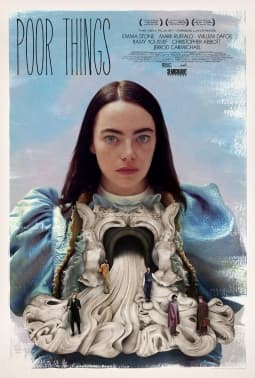
Poster / promotional material via Wikipedia, Poor Things (film). Used under fair use for criticism and review.
Poor Things arrived in American theatres in December 2023 and in the UK a month later, and by the time the Academy Award nominations landed it had become the formally adventurous prestige picture of the season. A month into its commercial run, now that the awards-campaign dust has partly settled, the film looks like something more interesting than its best-picture positioning suggests: a first-contact experiment between Yorgos Lanthimos’ European sensibility and the American star-vehicle machine.
What the film commits to
Lanthimos and screenwriter Tony McNamara, adapting the 1992 Alasdair Gray novel, have kept the novel’s central premise intact: a young woman dies, her unborn child’s brain is transplanted into her body by the mad-scientist Godwin Baxter, and she wakes up as Bella Baxter, a childlike consciousness inside an adult body. The film follows Bella’s sexual, emotional, political, and intellectual awakening across a journey from a London townhouse to Lisbon, Alexandria, and Paris.
The thing the film commits to, cleanly, is Bella’s perspective. We are inside her cognition as she develops. Her early language is broken because her brain is still forming. Her desires are crude because she has not yet learned that desires should be coded. Her discoveries about sex, about money, about philosophy, about cruelty are presented with a first-viewing freshness that requires Emma Stone to rebuild her acting technique from the ground up.
Emma Stone’s project
Stone has never done anything like this and, I suspect, will never do anything like it again. The physical work alone, the specific way she moves her limbs in the film’s first act, uncoordinated, dissociated, slightly off-tempo, is the most committed physical acting from a leading American actress in recent memory. The vocal work is its own achievement: a specific broken prosody that gradually sharpens into fluency across the film’s running time.
What the performance refuses to do is flatter the audience’s expectations. Bella, in her middle phase, is not charming. She is often difficult, self-centred, callous in ways the film does not excuse. Stone plays those qualities without softening them. The awards narrative will, inevitably, try to frame the role as “brave” because it involves extensive nudity and on-screen sex. That framing underestimates what Stone is doing. The bravery is not the nudity. The bravery is the decision to play a character whose likability is deliberately uneven.
The Lisbon midpoint
The film’s strongest section, for my money, is the Lisbon sequence, in which Bella, having escaped from the overprotective Baxter household with the lawyer Duncan Wedderburn (Mark Ruffalo), discovers sex, pastries, and the specific performance of decadent male charm. Ruffalo’s performance is a marvel. He plays Wedderburn as a man who believes he is seducing Bella and then, slowly, catastrophically, realises he is the one being educated. The comedy of that reversal is the film’s most delicate achievement.
Where the film wobbles
I want to register two reservations.
The Paris brothel sequence, in which Bella discovers wage labour and socialist politics, is the section where the film’s formal audacity starts to feel slightly overdetermined. Bella’s radicalisation happens in a montage, and the montage is quicker than the material deserves. The novel has more room for this phase. The film hurries it.
Mark Ruffalo, by contrast, is the film’s most successful supporting performance, but his collapse in the back half, specifically the Marseilles sequence where his character disintegrates, threatens to pull focus from Bella in a way the film doesn’t quite recover from. The final act has to work hard to restore the protagonist’s centrality, and the work shows.
What it is, underneath
Poor Things has been received, depending on the critic, as a feminist allegory, a steampunk fantasy, a sex comedy, a philosophical fable. All of these are defensible readings. What the film is most fundamentally about, I think, is the question of what a consciousness free of social programming actually wants. Lanthimos has been asking this question across his career, through his cruel-game films (The Lobster, The Killing of a Sacred Deer). Here the game is replaced by a genuine experiment, and Bella is the experimental subject.
The answer the film offers is that a consciousness free of social programming wants many things and is willing to cause harm in pursuit of them, but is also, given enough time and information, capable of constructing a moral frame that serves it better than the one society would have installed. That is a hopeful argument. It is also, for Lanthimos, an uncharacteristic argument. I will be curious whether he maintains it in his next film, Kinds of Kindness, which is already in post-production as of this writing.
Where it sits
Poor Things is, at this point in its run, the film most likely to split the Best Picture vote against Oppenheimer. It will not win. It will, I suspect, win Best Actress, and deservedly. More importantly, it will send Lanthimos back to his next project with the resources to do whatever he wants.
Watch it on the biggest screen available to you. Pay attention to the production design by Shona Heath and James Price, which is the most inventive visual work in a studio film of the year. Come back with your own reading. The film has room for several.
Lena writes long-form essays on the films that will still be talked about in a decade. Previously at a defunct monthly whose name we do not speak.
MORE BY LENA ASHWORTH →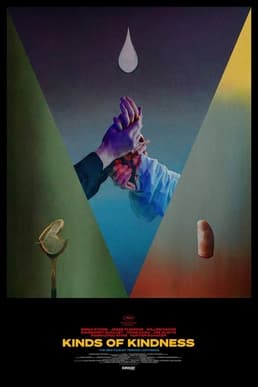
Kinds of Kindness: Lanthimos Unplugged
A year on from Lanthimos' three-part anthology, the film reads cleaner than the reviews made it sound. An argument for what happens when a director stops worrying about being liked.
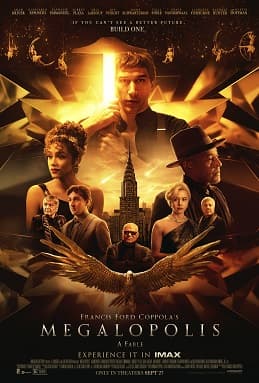
Megalopolis: Coppola's $120 Million Argument With Himself
Francis Ford Coppola self-funded his first film in thirteen years. It is nearly unwatchable in specific places and almost-great in others. The project is the point.
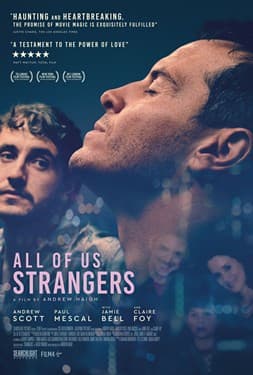
All of Us Strangers: Andrew Haigh's Ghost Story for Survivors
Andrew Haigh's film is a queer ghost story, a family reconciliation, and a grief piece. What it does with all three in 105 minutes is astonishing.