Kinds of Kindness: Lanthimos Unplugged
A year on from Lanthimos' three-part anthology, the film reads cleaner than the reviews made it sound. An argument for what happens when a director stops worrying about being liked.
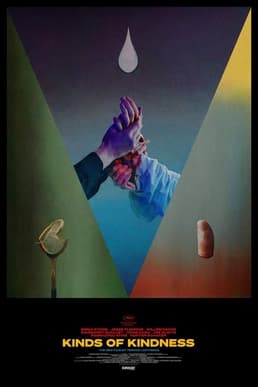
Poster / promotional material via Wikipedia, Kinds of Kindness. Used under fair use for criticism and review.
Kinds of Kindness got two kinds of reviews when it arrived in June 2024. The first kind treated it as a return to the “difficult” Lanthimos, the small-budget Greek-language Lanthimos of Dogtooth and Alps, after the mainstream success of Poor Things. The second kind treated it as a self-indulgent exercise, a director writing exclusively for himself now that the commercial reception had given him room to do so.
A year on, I think both readings missed what the film actually is, which is Lanthimos calmly refusing to let his American audience domesticate him.
What kind of film this is
Three stories, each roughly forty-five minutes, each starring the same cast, Jesse Plemons, Emma Stone, Willem Dafoe, Margaret Qualley, Hong Chau, in different configurations. The connective tissue is not narrative but tonal: each story is about the surrender of a person’s agency to another person’s design. A corporate employee whose every action is dictated by a controlling boss. A policeman whose wife returns from being lost at sea and may or may not still be his wife. A cult member searching for a woman with prophetic gifts.
On release, a lot of the discourse was about whether the three stories “added up” to anything. The critical consensus was that they did not. I disagreed at the time and I disagree more firmly now. They do not “add up” if you are looking for a unifying theme statement, but they do compound. By the third story, the viewer has been trained in a specific Lanthimos register of obedience and the way bodies respond to it, and the third story is doing work that the first two have made possible.
The Plemons problem
Jesse Plemons won Best Actor at Cannes for this film and the win was, correctly, considered a surprise. I think, fourteen months later, it was the only correct call. Plemons’ performances across the three stories, and there are three distinct performances, are the clearest argument for what Kinds of Kindness is doing. He plays three different men, and we can tell them apart not by physical transformation, he does almost none, but by the specific quality of giving himself over each character exhibits.
The first story’s Robert submits to his boss because the submission is the job. The second story’s Daniel submits to the possibility that his wife is an impostor because the suspicion is easier than the alternative. The third story’s Andrew submits to the cult because he has no other structure for being a person. Plemons plays each submission at a different register. The film is asking what kinds of kindness can exist inside that surrender.
The answer is: several, and most of them are troubling.
Emma Stone, the other key
Emma Stone’s work here is, for my money, more interesting than her work in Poor Things, though it will not be remembered that way. Poor Things was a tour-de-force role that asked her to do large things on screen. Kinds of Kindness asks her to do three roles of varying importance, two of them relatively small, and the disciplined thing Stone is doing is deliberately underplaying. She is not trying to dominate. She is accepting the ensemble frame.
Watch her in the third story, the cult member who thinks she has found the prophet. The performance is almost completely composed around a single physical choice: Stone walks, throughout, like a person who has recently been told to walk. There is a flatness in her step. She has given her body up and has forgotten how to carry it, and Stone plays this across two acts without ever announcing it.
What the film is actually about
The pattern that emerges across the three stories, I think, is a specific investigation into what people will do to be seen by a figure they have agreed to worship. The corporate boss, the suspect wife, the cult leader: these are all figures whose regard is the currency the protagonists are trying to buy. The price is always some version of the protagonist’s own agency. The film is interested in the transaction.
This is not, in itself, a new Lanthimos theme. The Lobster and The Killing of a Sacred Deer were both about people obeying arbitrary rules under threat of losing love. But Kinds of Kindness is bleaker than either of those, because the threat is not external. Nobody is forcing the characters into the transactions. They choose them. They choose them because they do not know what else to do with themselves.
The reception, re-examined
The negative reviews, and there were a lot of them, clustered around two complaints: the film is “too long” at 164 minutes, and the stories “don’t connect.”
Both complaints are wrong. The length is the point. Kinds of Kindness is attempting to simulate, across its running time, the slow accumulation of obedience. Cutting it shorter would break the effect. The stories connect not thematically but somatically: the same bodies keep returning in slightly different degrees of submission. By the third one, we recognise the posture.
What it leaves us
A year on, Kinds of Kindness sits in Lanthimos’ filmography as the moment he stopped worrying about the American audience he had, briefly, acquired. It is the work of a director declining to be translated. The next film, whatever it is, will either continue the experiment or retreat into more accessible territory. I am hoping for the continuation.
Watch it again, alone, in a dark room, without pausing. Let the obedience accumulate. Then notice the posture in your own shoulders by the end.
Lena writes long-form essays on the films that will still be talked about in a decade. Previously at a defunct monthly whose name we do not speak.
MORE BY LENA ASHWORTH →
Poor Things: Lanthimos Unleashed
Emma Stone's performance as Bella Baxter does something almost no leading actress is allowed to do in a studio film: she becomes less polite, less articulate, less easy to root for, and the film rewards her for it.

We Live in Time: Crowley's Non-Linear Gamble
John Crowley's third collaboration with A24 runs the ten-year relationship in a non-linear shuffle, and the shuffle is what makes the film survive its cancer-drama premise. Just barely, but it does.

The Brutalist: In Defence of the 3.5-Hour Epic
A year after The Brutalist swept its technical categories and divided audiences, its length has stopped looking like a gamble and started looking like the point. An argument for the long film in a short-film decade.