Nickel Boys: Ross's First-Person Adaptation
RaMell Ross adapted Colson Whitehead's Pulitzer-winning novel through a first-person camera almost continuously across two hours. The argument is that the formal gamble is the adaptation, and the adaptation is, so far, the film of the awards year.
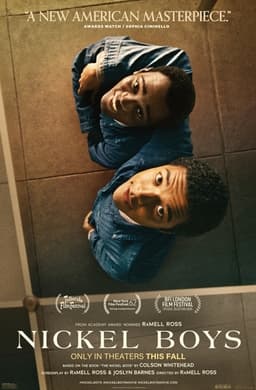
Poster / promotional material via Wikipedia, Nickel Boys. Used under fair use for criticism and review.
RaMell Ross’s first narrative feature, Nickel Boys, adapts Colson Whitehead’s 2019 Pulitzer-winning novel about a fictionalised version of the Arthur G. Dozier School for Boys, a Florida reform school whose documented history of abuse, forced labour, and unmarked graves became a matter of state investigation from 2012 onwards. The novel, which won the Pulitzer Prize for Fiction in 2020, follows two young Black men, Elwood and Turner, sent to the school in the early 1960s. The film was released in limited US theatres by Orion Pictures (Amazon MGM’s specialty label) in December 2024, expanded through January 2025, and received two Oscar nominations (Best Picture, Adapted Screenplay) in March 2025.
Ross’s previous feature, the documentary Hale County This Morning, This Evening (2018), established him as one of the more formally patient American non-fiction directors of his generation. Nickel Boys is the narrative follow-up, and it is, I want to argue, a specifically more ambitious adaptation than the reviews suggested.
The formal choice
The film is shot almost entirely in first-person. The camera occupies the point of view of Elwood (Ethan Herisse) and Turner (Brandon Wilson) alternately across the running time, in a way the film introduces gradually. Ross establishes the grammar in the film’s first ten minutes: the camera is Elwood’s eyes. We see his grandmother Hattie (Aunjanue Ellis-Taylor) looking directly at us. We see the Tallahassee street where Elwood walks home from school as Elwood would see it. We do not see Elwood’s face except in mirrors, reflections, specific held shots in which he is turned to a window.
The first-person grammar holds, with specific interruptions, for the full 140 minutes. The interruptions are deliberate. Ross occasionally cuts to archival footage (civil rights newsreel, period photographs, specific documentary fragments from the Dozier investigation). The archive operates as a specific secondary layer of witness: the first-person camera is Elwood’s or Turner’s subjective experience; the archive is the historical record the subjective experience is embedded in.
Why the choice works
The first-person adaptation is one of the most difficult formal gambles a narrative feature can attempt. It has been tried (Lady in the Lake, 1947; Enter the Void, 2009; Hardcore Henry, 2015), and has mostly produced films whose formal gambit becomes the film’s single subject, eclipsing whatever else it was trying to do. Ross’s version succeeds because the formal gambit is, in this specific case, continuous with the novel’s thematic project.
Whitehead’s novel is about the specific experience of being a young Black man inside a specifically racist institutional apparatus. The novel’s prose is third-person but is tightly tethered to Elwood’s and Turner’s consciousnesses. Ross’s adaptation takes the third-person consciousness and translates it into first-person embodiment. What the characters see is what the viewer sees. What the characters feel (in the specific register of how a camera moves in response to an event) is what the viewer feels.
The specific racial-institutional content of the novel is served by this grammar because the grammar forces the viewer into the specific embodied experience of being looked at by the institution. Elwood and Turner are looked at by white staff. The camera, which is Elwood’s or Turner’s eyes, records the looking. The viewer is inside the experience of being the one looked at, in a way a third-person camera cannot reproduce.
The performances
Ethan Herisse, as Elwood, gives the performance largely through voice and through the camera’s specific attention to what he is seeing. The face is only occasionally available. The performance operates through the specific quality of Elwood’s looking: the pace of his attention, the duration of his focus on particular objects, the specific hesitations between seeing something and responding to it.
Brandon Wilson, as Turner, has the harder assignment. Turner is Elwood’s counterweight, the more cautious friend who has been at Nickel longer and who has been specifically disabused of Elwood’s belief that the institution might operate according to its stated rules. Wilson has to convey Turner’s specific weary knowledge through a first-person grammar that only shows him intermittently. The performance lives in the specific scenes where Turner’s face is visible (roughly the middle third of the film, when Elwood and Turner are sharing a dormitory and the camera finds specific opportunities to hold on Turner as Elwood is looking at him).
Aunjanue Ellis-Taylor, as Hattie, is the film’s emotional anchor. Her scenes, specifically the scenes in which she visits Elwood at Nickel, are filmed with the first-person camera looking directly at her face. She performs directly to the lens, specifically to Elwood as the viewer stand-in. The scenes are devastating because Ellis-Taylor is acting to the specific emotional position the camera has constructed: a grandson whose experience she cannot reach because the institution is interposing itself.
The Jomo Fray cinematography
Jomo Fray is the film’s specific technical achievement. Working in 35mm, Fray had to solve the specific problem of making the first-person camera feel inhabited rather than mechanical. He does this through a combination of specific breathing rhythms in the camera movement, specific depth-of-field choices that approximate the way human vision actually focuses, and specific attention to the edges of the frame that mimics peripheral awareness.
The specific light of north Florida (the reform school sequences are shot on location in actual abandoned institutional spaces) is rendered with specific heat and specific humidity. You can feel the air in the film. This is not a metaphor. The light is specifically soaked in the humidity, the camera operates at the specific slight distortion that humid air produces, and the sensory register of the film is specifically Floridian in ways that a studio-lit adaptation could not have reproduced.
The archive and the contemporary frame
The film’s late move is to introduce a contemporary framing device: an adult character (Daveed Diggs) who I will not identify in terms of the plot, encountering the Dozier investigation in the present day. The contemporary sequences are shot in a different register (conventional third-person, with the adult character on camera throughout) and they operate as the specific frame that clarifies the film’s temporal and evidentiary position.
The contemporary frame is where the archival material most directly surfaces. The adult character is engaging with actual documented records from the Dozier investigation. The film is, at this level, aware that it is a fictional adaptation of a fictional novel about a fictional institution that is in every significant respect the actual institution the documented investigation pertains to. The layering is specifically careful, and the care is Ross’s.
Where it sits
Nickel Boys is, as of March 2025, one of the two or three best films of the 2024 awards cycle. Its two Oscar nominations do not fully reflect what the film achieves. It is a specifically formally serious adaptation of a specifically serious novel about a specifically documented historical atrocity, and it has executed its adaptation at a formal register that the American narrative feature rarely attempts.
Ross’s next project will be worth waiting for. The documentary-to-narrative transition has produced, in his specific case, a filmmaker who brings the specific discipline of non-fiction observation to the narrative register without losing the narrative register’s emotional tools. That combination is specifically rare. Watch Nickel Boys on a large screen, with no interruption, with the knowledge that the first-person grammar is a specific active engagement rather than a passive one. The film asks a particular attention, and the attention is rewarded.
Lena writes long-form essays on the films that will still be talked about in a decade. Previously at a defunct monthly whose name we do not speak.
MORE BY LENA ASHWORTH →
Nickel Boys and the Camera That Remembers
RaMell Ross adapted Colson Whitehead's Pulitzer novel by refusing the one thing most literary adaptations insist on. The camera is the character, and the choice changes what the film can do.
We Live in Time: Crowley's Non-Linear Gamble
John Crowley's third collaboration with A24 runs the ten-year relationship in a non-linear shuffle, and the shuffle is what makes the film survive its cancer-drama premise. Just barely, but it does.
Small Things Like These: Murphy's Quiet Indictment
Tim Mielants's adaptation of the Claire Keegan novella was reviewed as a modest Cillian Murphy vehicle. The careful reading is that the film's restraint is the indictment, and the restraint is harder to film than the indictment would have been.