Nickel Boys and the Camera That Remembers
RaMell Ross adapted Colson Whitehead's Pulitzer novel by refusing the one thing most literary adaptations insist on. The camera is the character, and the choice changes what the film can do.
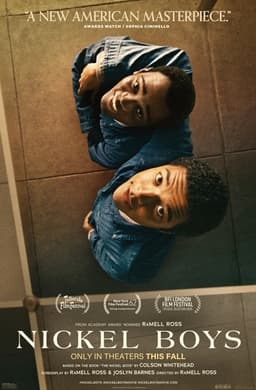
Poster / promotional material via Wikipedia, Nickel Boys. Used under fair use for criticism and review.
The first thing to notice about RaMell Ross’s Nickel Boys is how rarely you see the face of its protagonist. For roughly the first hour of the film, Elwood Curtis (Ethan Herisse) is a pair of hands, a voice, a reflection in a storefront window. The camera is where his eyes are. What he sees, we see. What he does not see, we do not.
Ross, whose previous work was the Oscar-nominated documentary Hale County This Morning, This Evening (2018), is making a specific claim with this choice. The claim is that the cinematic language available to a Black American filmmaker working with the material of the civil rights era has, until now, been organised around the wrong grammar. Nickel Boys is an attempt to build a different grammar.
The reception
Nickel Boys opened in limited release in December 2024 and expanded through January 2025. It received a Best Picture and Best Adapted Screenplay nomination at the Academy Awards, lost both, and grossed roughly $2 million against a $23 million budget. The critical reception was reverent and, in places, bewildered. Several of the most admiring reviews admitted, in passing, that the first-person technique took time to settle into. A few less admiring ones treated the technique as a stunt.
A year on, the first-person choice is clearly the film. It is also clearly defensible.
What Ross is doing with the camera
The dominant contemporary mode for adapting civil rights-era material is, broadly speaking, the observational historical drama. The camera is placed at a specific ethical remove from its subjects. The viewer watches the characters suffer, act, resist, and die. The camera is witness, and the viewer inherits the witness position. 12 Years a Slave, Selma, The Best of Enemies, The Help, whatever their other differences, all share this basic grammar.
The specific problem with the grammar, from Ross’s perspective, is that it confirms a particular relationship between the viewer and the depicted Black life: the relationship is spectatorial. The viewer sits outside the experience and looks in. Even when the camera is intimate, even when the direction is sympathetic, the form itself places the viewer at a specific distance that replicates a specific historical gaze.
The first-person camera in Nickel Boys refuses this. The viewer cannot be a witness to Elwood’s experience, because the camera is where Elwood is. We see what he sees. We do not see him. When he meets Turner (Brandon Wilson), the other Black boy who will become his friend at the Nickel Academy reform school, we see Turner as Elwood sees him. When Turner looks at us, he is looking at Elwood.
The shift, midway
Roughly halfway through the film, the camera switches. The point of view moves from Elwood to Turner. The change is formally radical and almost unannounced. Ross lets the viewer notice, or not, that the hands we now see, the reflections we now see, belong to a different body. Elwood, for the first time, becomes a face in the frame.
The reason for the shift, which I will not fully spoil, is the film’s largest structural argument. Ross is claiming that the witness position in this material must be occupied by a Black character, not by the viewer, and that the witness must be specifically another Black character who survives. The shift redistributes the burden of testimony, and the redistribution is the film’s politics.
The performances, under the camera
Working with a first-person camera places specific demands on the actors. Herisse and Wilson spend much of the film either looking directly into the lens (their conversations with each other become face-to-face address to the camera) or performing their bodies through the camera’s limited coverage (their hands, their gait, their specific physical habits). Both young actors manage the demands with a specific poise that suggests careful rehearsal and specific directorial patience.
Ethan Herisse, who was previously in Netflix’s When They See Us, plays Elwood as a boy whose intellectual seriousness is the thing the school is trying to break. His line readings are delivered, mostly, from outside the frame. His voice carries the interiority the camera cannot show. The performance is almost entirely vocal, and Herisse rises to the constraint.
Brandon Wilson, who was effectively a newcomer at the time of casting, gives the film its second act. Turner is, on the page, Elwood’s opposite: pragmatic where Elwood is idealistic, cautious where Elwood is principled. Wilson plays the contrast across specific small physical choices, the way he holds a cigarette, the way he sits in a doorway, the way his posture shifts between compliance and resistance. When the camera moves to his point of view, his voice has to do what Herisse’s did in the first half. It does.
Jomo Fray’s cinematography
Jomo Fray, whose work on All Dirt Roads Taste of Salt (Raven Jackson, 2023) established him as one of the most distinctive American cinematographers working in first-person and close-to-first-person registers, shoots Nickel Boys with an eye for the specific texture of Florida light. The Nickel Academy sequences are shot in a particular quality of pine-filtered afternoon sun that is period-accurate without being museum-ified. The exteriors breathe. The interiors do not.
One specific choice worth flagging: Fray and Ross use archival footage and still photography at specific intervals, cutting in photographs from the historical record of the real school the novel is based on (the Dozier School for Boys in Marianna, Florida). These cuts are not framed as flashbacks or historical context. They are placed in the flow of the film as if the characters are perceiving them. The effect is to fold the historical record into the first-person experience rather than to separate the fiction from the documentation.
The literary problem, sidestepped
Colson Whitehead’s 2019 novel is a specific kind of literary object: a compact, formally disciplined, third-person narrative that depends on a particular narrative restraint to generate its force. Most adaptations of literary material of this kind either attempt to translate the prose tone (the Jesmyn Ward or James Baldwin mode) or abandon it for a more propulsive cinematic register (the Kasi Lemmons mode).
Ross has done neither. He has treated the novel as a source of specific scenes and specific historical details and specific thematic concerns, and has made a formally different object that carries the novel’s weight through different means. Whitehead, to his credit, has publicly supported the adaptation. The writer-director relationship here is one of the more successful contemporary examples of how a novelist can give a filmmaker permission to reinvent.
Where it sits
Nickel Boys is, in my view, the most formally ambitious American film of 2024, and the film most likely, of that year’s releases, to sustain long-term critical attention. Its commercial performance was modest, its awards performance was respectable without being dominant, and its presence in ongoing cinema conversation has been steadier than the 2024 consensus predicted.
Ross has, after Hale County and Nickel Boys, established himself as one of the specifically important American filmmakers of the current decade. His next project has not been formally announced. Whatever it is, the camera will be doing something particular, and the particular thing will be the film. Watch Nickel Boys twice. The second viewing, when you know where the camera is going to go, is where the formal argument clarifies.
Lena writes long-form essays on the films that will still be talked about in a decade. Previously at a defunct monthly whose name we do not speak.
MORE BY LENA ASHWORTH →
Nickel Boys: Ross's First-Person Adaptation
RaMell Ross adapted Colson Whitehead's Pulitzer-winning novel through a first-person camera almost continuously across two hours. The argument is that the formal gamble is the adaptation, and the adaptation is, so far, the film of the awards year.
We Live in Time: Crowley's Non-Linear Gamble
John Crowley's third collaboration with A24 runs the ten-year relationship in a non-linear shuffle, and the shuffle is what makes the film survive its cancer-drama premise. Just barely, but it does.
The Brutalist: In Defence of the 3.5-Hour Epic
A year after The Brutalist swept its technical categories and divided audiences, its length has stopped looking like a gamble and started looking like the point. An argument for the long film in a short-film decade.