In a Violent Nature: The Slasher from the Wrong Side
Chris Nash's debut takes the slasher apart from the killer's point of view, and the radical formal choice is also the reason the film divides its audience. I want to argue for it.
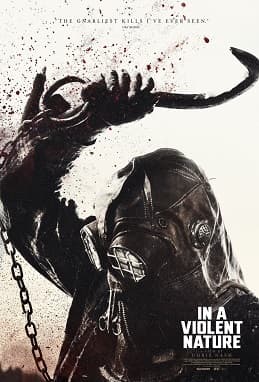
Poster / promotional material via Wikipedia, In a Violent Nature. Used under fair use for criticism and review.
Chris Nash’s In a Violent Nature is the slasher film as long-take nature walk, and if that description sounds like a contradiction, it is the contradiction the film is deliberately constructing. It premiered at Sundance in January 2024, was distributed in the US by IFC Films and Shudder in May, and grossed around $3 million in the US theatrical window. The reviews split along predictable lines. The horror press mostly loved it. The mainstream film press mostly found it boring. Both reactions are legible, and the legibility is the film’s design.
I am with the horror press.
What the film is
A group of young adults is camping at a remote Ontario lodge. One of them, for stupid reasons, removes a locket from a rotting fire-watch tower. The removal wakes Johnny (Ry Barrett), an enormous semi-supernatural killer who has been dormant in the forest floor for an unspecified period of time. Johnny retrieves his father’s fire-helmet from a shed. He retrieves, over the course of the film, a series of edged weapons. He systematically kills the camping party.
The formal operation of the film is that the camera stays with Johnny, not with the victims. The victims are encountered the way Johnny encounters them: as people Johnny is walking toward through forest. The kills are filmed from proximity to the killer. The survival narrative that is typically the slasher’s emotional scaffolding is entirely absent. We do not know these people. We do not root for them. We follow Johnny through the trees.
Why this matters
The slasher as a genre has a specific formal grammar developed across the late 1970s and 1980s. The audience identifies with the victim pool. The killer is a figure of menace who is revealed gradually through mounting body count and increasingly claustrophobic geography. The final girl emerges. The killer is defeated or escapes. The structure is specifically durable and has been replicated across hundreds of films.
Nash’s move is to invert the identification. The camera stays with Johnny, so the viewer is never given the specific tools the genre uses to generate suspense. We are not wondering whether Johnny will find the victims; we are with Johnny finding them. The suspense grammar of the slasher is dismantled, and the film has to generate a different kind of attention.
The attention it generates is meditative. The long walks through forest, scored almost entirely by ambient sound (birdsong, footsteps, the creak of old metal), take up the majority of the film’s 94-minute running time. Johnny walks. The camera watches him walking. The specific texture of the Ontario forest in late summer becomes the film’s primary visual register. The kills, when they arrive, are sudden interruptions of the walking.
The kills and what they do
The kills are staged with a specific extremity that the film’s slow pace makes more difficult to metabolise. The film’s most-discussed kill (which I will not describe in detail) is a specific three-minute sequence that deploys a weapon in a way that most slasher films, even at the extreme end of the genre, do not commit to. The effect work is practical. The staging is unblinking. The camera holds.
What Nash is doing with the kills is using them as the formal opposite of the walking. The film is slow, patient, almost ambient, until the violence arrives, and then the violence is presented at a specifically uncomfortable duration. The alternation produces a specific cognitive dislocation. You do not become desensitised to the kills, because the film has not been building up the kinetic momentum slasher films usually build. Each kill is a specific interruption that the film’s pace refuses to cushion.
The Barrett performance
Ry Barrett, as Johnny, gives the film its specific physical centre. Johnny does not speak. He does not emote. His face, for most of the running time, is covered by the rusted fire-helmet. The performance is entirely physical, and it is specifically good physical work. Barrett walks with a specific weight. He handles objects with a specific deliberateness that reads as inhuman without tipping into parody. His specific scale and physical presence (the casting here is critical) is the film’s most reliable atmospheric effect.
Barrett is working in a tradition that runs from the Jason Voorhees of Friday the 13th Part 2 through the mute physical killers of seventies Canadian horror (Prom Night, My Bloody Valentine). The performance is the contemporary refinement of that tradition, and it is specifically committed.
The lake monologue
The film’s most-argued-about scene is a monologue delivered by a single character, late in the running time, about a bear attack she witnessed as a child. The monologue runs for approximately seven minutes. It is delivered at a campfire, in one long take. It is, in terms of the film’s overall running time, a significant percentage of the total.
The scene is the film’s explicit philosophical centre. The bear story is, on its face, about the specific amorality of animal predation in the wild. It is also, in the film’s context, about Johnny: about what it means for a predatory figure to move through a landscape without the moral framework that slasher films usually impose on their killers. Johnny is not evil. Johnny is not redeemable. Johnny is a specific kind of natural force, or quasi-natural force, who operates on the specific terms the bear story describes.
Some viewers find the monologue pretentious. I find it the film’s specific thesis statement. Nash has used ninety minutes of slow forest walking to prepare the viewer to hear the monologue in the specific register the film is asking for. Whether you accept the preparation or not is the primary variable in whether you accept the film.
The Canadian horror tradition
Nash is working specifically within a Canadian horror lineage that the American horror press does not always credit. The specific geography (Ontario forest, abandoned lodges, obsolete fire-watch infrastructure), the specific tonal restraint, the specific willingness to linger on landscape: all of these have antecedents in Canadian genre cinema from David Cronenberg’s early films through Bruce McDonald’s work through the recent output of directors like Justin Benson (with Aaron Moorhead, making American films but working in a specifically adjacent register).
The point is that In a Violent Nature is not a formal novelty imposed on the slasher. It is a specific national-cinematic inflection of the slasher that reads as novel to the American horror audience because the American horror audience does not watch much Canadian horror.
Where it sits
In a Violent Nature will continue to be argued about. It is the kind of film that splits its audience for structural reasons: the formal gamble is specifically legible, and viewers are allowed to disagree about whether the gamble pays off. I think it does. The film is a specific achievement in a genre that has been calcified by decades of formal repetition.
Nash’s follow-up, whatever it is, will be worth watching. Watch this one in summer, during daylight, in a room where the windows are open to whatever nature you have access to. The film’s effect depends on the viewer being specifically present to the rhythm of outdoor space. Let the walking do its work.
Marcus believes good criticism is an argument. He is almost always angry about something, usually for good reason. Horror is his first language.
MORE BY MARCUS VELL →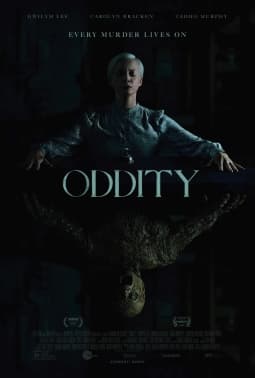
Oddity: McCarthy's Puppet as Grief
Damian McCarthy's second feature is the best pure-horror indie of 2024, and the clearest argument going for what micro-budget Irish genre cinema can do when it commits to a single effect and doesn't blink.
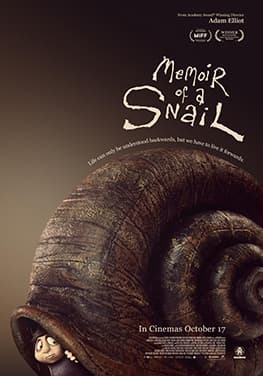
Memoir of a Snail: Elliot's Claymation Grief
Adam Elliot's second stop-motion feature took eight years to make and collected festival prizes from Annecy to Annapurna. The Australian argument is that his particular strain of misery-claymation is one of the country's more unusual exports.
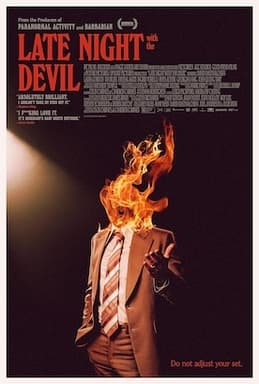
Late Night with the Devil: Found-Footage 1977
Colin and Cameron Cairnes's Australian indie horror, shot as a 1977 late-night TV broadcast gone wrong, is the rare genre exercise whose formal commitment pays off at every level.