I Saw the TV Glow: The Trans Allegory Hollywood Couldn't Place
Jane Schoenbrun's sophomore feature played small in theatres, spoke loudly to the audience it was made for, and kept speaking afterwards. A year later, it is still teaching viewers how to be seen.
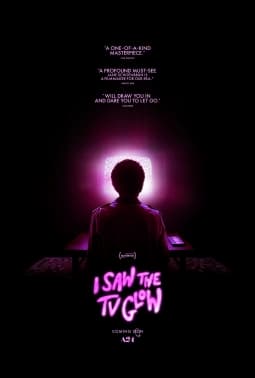
Poster / promotional material via Wikipedia, I Saw the TV Glow. Used under fair use for criticism and review.
I Saw the TV Glow is the film I recommended most often in 2024 and the film whose recommendations most often came back with the same report: I didn’t get it, it was fine, it was slow, I liked it more than I expected to, I was not ready for what it did to me.
A year out, I think the film is one of the most important American debuts, if we can call a sophomore feature a debut, of the decade. Not because it is perfect. It is not. But because it is doing something specific for a specific audience, and doing it without apology.
What the film appears to be
On the surface, I Saw the TV Glow is a 1996-set coming-of-age story about two teenagers, Owen, played by Justice Smith, and Maddy, played by Brigette Lundy-Paine, who bond over a weird young-adult television show called The Pink Opaque. The show, fictional, is broadcast at 10.30pm on Saturdays on a channel only the cool kids watch. The two protagonists tape episodes on VHS and share them at school. The show, in the film’s diegesis, is a kind of Buffy the Vampire Slayer analog, two psychic girls fighting a big bad across monster-of-the-week episodes.
Over the film’s 100 minutes, the relationship between the real-world characters and the in-universe show starts to slip. Maddy disappears, then returns, with a version of reality she is urgently trying to convince Owen of. The film ends in a final sequence whose precise interpretation has been argued about online, at length, for more than a year now.
What the film actually is
I Saw the TV Glow is a trans allegory. Jane Schoenbrun, whose first feature We’re All Going to the World’s Fair established their interest in the specific relationship between adolescent identity and digital media, has said as much in every interview they have given. The film is about the experience of being a trans kid who has not yet realised they are a trans kid, and the specific terror of discovering, too late, that the shape you have been fitted into is not going to fit forever.
This is, I will grant, not a reading the film forces on you. You can watch I Saw the TV Glow and experience it as a creepy media-saturation horror piece, or a Donnie Darko-adjacent suburban strangeness, or a 1990s nostalgia exercise. But the allegorical reading is the one that explains every formal choice in the film, and once you see it you cannot unsee it.
The Justice Smith performance
Justice Smith’s work as Owen is the performance that holds the film together, and it is being asked to do something almost impossible. Owen is, for most of the film, a person who is not fully present in himself. He is watching his own life happen from a slight distance. His relationship to his own voice, his own body, his own desires is muted, as if the volume has been turned down on a channel he cannot change.
Smith plays this across fifteen years of screen time. The Owen of the film’s early scenes, a fourteen-year-old in 1996, is recognisably the same Owen of the film’s late scenes, a forty-year-old in 2020. The continuity is the point. The character has not developed. He has been suspended. Smith plays the suspension with a physical precision that made me rewind the first time I watched it.
The scene that broke me on rewatch was the moment, late in the film, when Owen screams in a chain restaurant. It is one of the most formally terrifying sounds in a horror film of the decade. It is also, structurally, the one moment in the film where the character gets to demand that he be seen. The rest of the film is about that demand being denied or suppressed.
Brigette Lundy-Paine, the other half
Lundy-Paine as Maddy does a different kind of acting, and the two performances work in counterpoint. Where Owen is suspended, Maddy is escaped. She has been somewhere, and the somewhere has changed her, and the film is about her inability to translate what she has learned back into the language of the suburb. The specific performance is of a person who has stopped code-switching for a world that needs her to code-switch.
Maddy’s long monologue, delivered to Owen at a backyard fire pit about two-thirds through the film, is one of the most extraordinary pieces of writing in any American film of 2024. It is also, emotionally, the film’s thesis statement, delivered plainly by a character who has nothing left to lose by delivering it. The film is generous enough to let the monologue land at length without cutting.
The final scene
I will not spoil the ending. I will say that a lot of viewers, including many who liked the film overall, found the final sequence frustrating. The film refuses a satisfying resolution. It declines to tell you, definitively, what happened to Owen. It allows an ambiguity that some audiences read as evasion.
I disagreed with that reading at the time and I disagree more strongly now. The final scene is not ambiguous. It is the film’s most specific moment. The film has been, throughout, staging Owen’s inability to receive the information Maddy is offering him. The final scene shows us the cost of that inability. It is devastating. It is also exact.
What it did in the year
I Saw the TV Glow did not have a huge theatrical run. It made about $5 million worldwide on a $10 million budget. By commercial measures, it under-performed. By cultural measures, it became one of the most discussed American films of the year inside the audiences who needed it. A generation of young trans viewers encountered the film in 2024 and came out of it, in many public and private accounts, changed.
That is not a small achievement. That is what films can still do. Not to everyone, not every time, but when the film is specifically made for a specific audience with real stakes, the film can clarify a life.
Watch it again. Or, if you haven’t: watch it, at night, alone, with nothing else to do afterwards.
Marcus believes good criticism is an argument. He is almost always angry about something, usually for good reason. Horror is his first language.
MORE BY MARCUS VELL →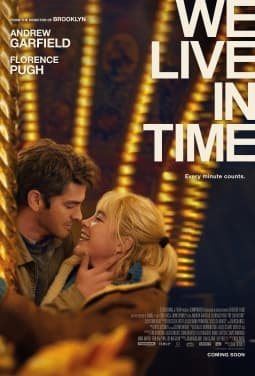
We Live in Time: Crowley's Non-Linear Gamble
John Crowley's third collaboration with A24 runs the ten-year relationship in a non-linear shuffle, and the shuffle is what makes the film survive its cancer-drama premise. Just barely, but it does.

Civil War: Alex Garland's Failure of Nerve
Alex Garland made a film about an American civil war and deliberately stripped out the politics. A year and a half later, the emptiness in the middle of Civil War is not a choice to respect. It is the thing that breaks the film.
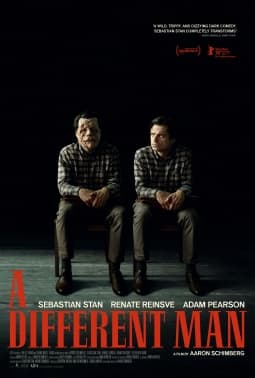
A Different Man: Aaron Schimberg's Face-Swap Comedy
Aaron Schimberg's 2024 comedy about an actor who gets a medical procedure and regrets it is the year's strangest mid-budget indie, and the one whose specific comic machinery I keep returning to.