The Substance and the Body Horror Renaissance
Eighteen months after Coralie Fargeat's prosthetic-heavy fable drew both Oscar nominations and walkouts, the strange alchemy of The Substance has only clarified. The film is less about Hollywood than it looks, and more about what we're allowed to say with bodies on screen.
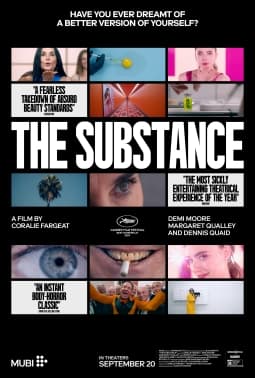
Poster / promotional material via Wikipedia, The Substance. Used under fair use for criticism and review.
The most quoted line in The Substance, at least in the months after its release, was not a line at all but a visual: the bifurcated body on the floor of a bathroom, one half attached to an IV, the other lurching toward the mirror. That image travelled. It was shared, memed, dissected in a dozen think-pieces about Hollywood’s treatment of women over forty, and it threatened, briefly, to become the entire shorthand for what the film was about.
It isn’t what the film is about. Or rather, it isn’t only what the film is about, and a year and a half of distance has made me more certain than ever that we all pattern-matched too fast. The Hollywood-misogyny reading of The Substance is true, unambiguously, but it’s also the reading that makes the film smaller than it needed to be.
What Fargeat actually built
Watch it again, and I did, twice, in preparation for this piece, and what you notice is how uninterested Coralie Fargeat is in anything resembling an industrial critique. There are no producers in the film. There are no directors, no agents, no studio executives in rooms making specific bad decisions. The antagonist, insofar as there is one, is a television programme that barely has internal logic: an aerobics show that operates somewhere between a 1980s fever dream and the way the algorithm keeps showing you the same influencer’s face for six months.
What The Substance is actually about is the thing underneath the industry. The self-image. The private, self-administered violence that a person can do to their own body when they decide, usually in stages, usually imperceptibly, that the body they have is unacceptable to them. The satirical frame is Hollywood. The dramatic frame is a woman alone in an apartment, making a choice, and then another choice, and then a worse one.
Demi Moore, to be blunt about this, does the best work of her career. There’s a scene about forty-five minutes in, she’s getting ready to go out, dressed, looking at herself in the mirror, and she takes the dress off, that is, by itself, the film’s entire thesis. Nothing is said. She does not speak to anyone. She simply re-evaluates, and we watch the re-evaluation take its small domestic shape. That scene is as good as any piece of acting I’ve seen this decade.
The problem with the body horror label
There’s been a rush, in the eighteen months since release, to canonise The Substance as a landmark of the body horror revival, alongside Julia Ducournau’s Titane (2021), the continued critical rehabilitation of Cronenberg père, and the run of smaller American body-conscious films that followed. I understand the impulse. The prosthetic work in The Substance is genuinely extraordinary. Pierre-Olivier Persin’s team built a final-act creature that, in its scale and wetness and weirdness, feels like a deliberate act of transgression against the cleaner, more CG-forward horror imagery the mid-2020s had been producing.
But the genre lineage obscures something. The Substance is not, finally, a horror film about a monster. It is a horror film about a habit. The Substance itself, the mysterious serum that allows Elisabeth to generate a younger body, is administered not in a single demonic pact but over weeks, in careful instalments, with a written regime. The horror is procedural. The horror is that you can, day by day, make yourself smaller.
This is why the comparisons to Cronenberg are true but inadequate. Cronenberg’s bodies, in The Fly or Videodrome, transform because they’ve been compromised, by a disease, a technology, a signal from outside. Fargeat’s bodies transform because they’ve been invited. Elisabeth is not infected. She signs up. And then she signs up again, and again, until the thing she’s building no longer resembles a body at all.
The walkouts, revisited
The Substance became, in its first run, one of those films where the story of audience reaction threatened to overshadow the film itself. Walkouts at Cannes. Reports of hospital visits from faint viewers. A running joke, for a while, about how many minutes the final sequence could be endured. It was, for a stretch, impossible to discuss the film without also discussing the reaction to the film.
Eighteen months on, I’d argue that the walkouts were a kind of critical success. Not because shocking an audience is intrinsically valuable, it isn’t, but because The Substance is a film built specifically to exhaust the viewer’s capacity to aestheticise what they’re watching. Gore, in most horror, functions as spectacle. You flinch, you admire the craft, you absorb it as a beat in a rhythm. Fargeat’s gore works differently. By the final reel, the film has dismantled the viewer’s ability to respond aesthetically at all. The craft is still there, astonishing, in fact, but the viewer is too tired to enjoy it. That tiredness is the point.
What it leaves us with
A year and a half later, the question isn’t whether The Substance is a great horror film. It is. The question is what it represents for a particular kind of mid-budget, director-driven, genre-committed American–European co-production that seemed, five years ago, to be disappearing under the pressure of the streaming economy. Fargeat made it for a reported $17.5 million. It grossed more than four times that. It put Demi Moore back in the Best Actress conversation. It won craft awards. It has, improbably, become one of the films people mean when they talk about 2024 in film.
That is a real achievement. It’s also a slightly fragile achievement, because the economics that allowed The Substance to exist, a director with a vision, a star willing to be brave, a mid-range budget, theatrical release with real campaign support, are not obviously going to hold. The last year has been full of similar films that didn’t find their audience. The Substance is the one that did. It shouldn’t be the last.
Watch it again. It’s better than you remember. It’s meaner, too.
Lena writes long-form essays on the films that will still be talked about in a decade. Previously at a defunct monthly whose name we do not speak.
MORE BY LENA ASHWORTH →
Companion and the Case for the Small Sci-Fi Thriller
Drew Hancock's debut strips its premise to a weekend-house structure and one central idea. The discipline is the film's argument, and the argument lands cleanly.

Nosferatu: Eggers' Gothic Masterwork
Eggers' remake was received with admiration rather than fervour, a proper film from a proper filmmaker. Sixteen months later, it looks like the serious piece the year needed, and the one we were too cool to love properly at the time.

Sinners: Coogler's Vampire Western and the Return of the Studio Auteur Movie
Ten months on, Ryan Coogler's 1930s Mississippi vampire film doesn't just still hold up, it looks like the clearest sign in years that the studio auteur movie is not dead. A field report from inside the juke joint.