Warfare: Mendoza and Garland's Real-Time Iraq
Ray Mendoza and Alex Garland's second collaboration rebuilds a 2006 Ramadi engagement from the memories of the men who survived it, and the film's claim on attention is its specific refusal to shape.
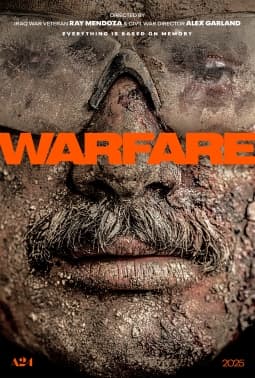
Poster / promotional material via Wikipedia, Warfare (film). Used under fair use for criticism and review.
Alex Garland, coming off the 2024 Civil War, announced his next film would be a co-direction with Ray Mendoza, the former Navy SEAL who had served as military adviser on the previous picture. The premise Garland and Mendoza described in pre-release interviews was specific and unusual: a single SEAL engagement in Ramadi in November 2006, reconstructed in real time, using only the recollections of the men who were there, with no score, no voiceover, and no composite characters. Warfare opened in the US in April 2025 through A24, grossed approximately $24 million domestically against a reported $20 million budget, and has, since, been the subject of the most specific arguments about the ethics of war cinema I can recall in recent memory.
I want to try to describe what the film is and what, specifically, it is refusing, because the refusals are where the film’s claim is made.
What the film is
A platoon of Navy SEALs occupies a residential building in Ramadi as an overwatch position during a larger infantry operation on the streets below. The occupation is the film’s entire premise. The platoon enters the building in the opening sequence. An insurgent engagement follows. A SEAL is gravely wounded. The platoon’s medevac is conducted under fire. The film ends when the evacuation is complete.
This takes ninety-five minutes. The film’s running time is close to the real time of the engagement as the surviving SEALs remember it. There is no before. There is no after. There is no scene showing the wounded soldier’s recovery, no scene showing his family, no scene showing the platoon at home. The film begins inside the building and ends when the last American leaves it.
The ensemble is substantial. Will Poulter plays the platoon’s officer in charge. D’Pharaoh Woon-A-Tai, who was outstanding in Reservation Dogs, plays the communications operator whose specific point of view structures several of the longer sequences. Cosmo Jarvis plays the platoon’s senior NCO. Kit Connor, Joseph Quinn, Michael Gandolfini, Charles Melton, and Noah Centineo round out the squad. The ensemble is very young, which is the first of the film’s specific deliberate choices: the real SEALs, in 2006, were in their early twenties, and Garland and Mendoza have cast the film to that age, not to recognisable leading-man seniority.
The reconstruction method
Mendoza, in press interviews, has been specific about the reconstruction process. He contacted each of the surviving SEALs from the 2006 engagement, recorded their specific recollections of the event, cross-referenced the recollections against declassified after-action reports, and built the film’s shooting script from the overlap between the men’s memories. Where the recollections differed, the film either selects the consensus version or presents both. There are no invented characters. There are no invented events. The film’s script is, in this sense, a documentary artefact reconstructed as fiction.
The formal consequence of this method is that the film has no dramatic shape in the conventional sense. Nothing is foreshadowed. Nothing is paid off. The moments of specific intensity arrive without the preparation that narrative cinema would ordinarily provide, because that is how the men remember them arriving. The wounded soldier’s injury, in particular, is staged without any of the narrative cueing that a war film would conventionally use. One moment the platoon is in position. The next moment, at the edge of a frame, a man has been hit, and the film’s specific emergency has begun.
David Thompson’s camera
David Thompson, who shot Garland’s Men and Civil War, is the cinematographer, and the work here is his best to date. Warfare is almost entirely confined to the interior of the residential building the SEALs have occupied. The cinematography is organised around the specific spatial logic of the building: which rooms are overwatch positions, which rooms are thoroughfares, which rooms are medical triage spaces, which hallways connect to which.
Thompson shoots the spaces with a specific patience that allows the film’s viewer to build an accurate mental map of the building’s geography across the first thirty minutes. This is load-bearing work. When the engagement escalates in the second act, the audience has to understand, without being told, where the SEALs are relative to one another, where the wounded man is, where the medevac vehicles can reach, where the insurgent fire is coming from. The film’s tension depends on spatial comprehension the audience has acquired earlier, and Thompson’s compositions have built it in.
The lighting is, throughout, strictly diegetic or unobtrusively naturalistic. The building has specific windows, specific interior lamps, specific emergency lights when the power is cut. The film refuses the grading conventions of recent war cinema. There is no desaturated steel-and-orange palette. There is no handheld vérité shake beyond what the specific handheld operators were actually generating in the remembered event. The image is specifically ordinary, which is the film’s specific insistence about what the engagement looked like to the men who were inside it.
What the film does not do
Three refusals are worth naming.
The film does not depict the Iraqi family whose home the SEALs occupy with any sustained narrative weight. The family is present, glimpsed at the edges of frames, shown in brief specific moments of interaction, but the film does not shift point of view to them. This is the film’s most contested choice, and one I think requires close attention: the decision is defended in press interviews as an honesty about what the SEALs themselves were in a position to know, which is not much. An alternate film, which included the family’s experience, would be a different film with different ethical claims. This film’s specific claim is that the SEALs’ experience is what it is reconstructing, and that the reconstruction is honest only if it stays inside the SEALs’ knowledge.
The film does not include any context about the larger political situation of the Iraq war, the specific reasons for the American presence in Ramadi, or the specific chain of decisions that put this platoon in this building on this day. The film’s interior-facing frame is strict. You have to bring the larger context with you.
The film does not score the action. There is no music during the engagement. The end credits play over a single country song, chosen by the real soldiers as the piece of music they had been listening to in the weeks before the engagement. The absence of score is specifically felt. The engagement’s intensity is produced by the sound design, by Glenn Freemantle and his team, which reconstructs the acoustic conditions of the engagement with documentary specificity: the specific report of the rifles, the specific frequencies of the radio communications, the specific sound of wounded men breathing through pain.
Where it sits
Warfare will be argued about for years, and the arguments are worth having. The film’s refusal to locate itself politically, to include Iraqi interiority, to provide the shaping that war cinema conventionally offers, are not neutral choices. They are specific ethical decisions that the film is making, and a viewer can reasonably disagree with them without dismissing the film’s achievement.
What the film is, on its own terms, is the most formally disciplined war picture an American studio release has produced in the last decade. Garland and Mendoza’s collaboration has produced an object that is, by design, harder to metabolise than conventional war cinema. The harder register is the point.
Watch it in a cinema if you can, because the sound design requires it. Watch it once. Let the film do its specific strange thing without asking it to be shaped. Then read Mendoza’s interviews, and read the after-action reports that are available, and read the Iraqi accounts of the Ramadi operations that have been published since. The film is a starting point. It is not the whole.
Lena writes long-form essays on the films that will still be talked about in a decade. Previously at a defunct monthly whose name we do not speak.
MORE BY LENA ASHWORTH →
Civil War: Alex Garland's Failure of Nerve
Alex Garland made a film about an American civil war and deliberately stripped out the politics. A year and a half later, the emptiness in the middle of Civil War is not a choice to respect. It is the thing that breaks the film.
Dream Scenario: Borgli's Cage Vehicle as Media Critique
Kristoffer Borgli's A24 feature used Nicolas Cage as the vehicle for a media satire that landed in late 2023 and has aged, through 2024 and into 2025, into a specifically sharper object than the reviews initially registered.
We Live in Time: Crowley's Non-Linear Gamble
John Crowley's third collaboration with A24 runs the ten-year relationship in a non-linear shuffle, and the shuffle is what makes the film survive its cancer-drama premise. Just barely, but it does.