Blitz: Steve McQueen's Crowded Home Front
Steve McQueen's first feature since Small Axe attempts a sprawling wartime mural of London. The mural mostly works. The boy at its centre is the reason it sometimes does not.
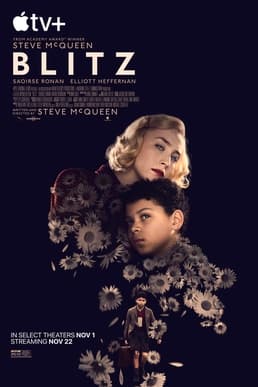
Poster / promotional material via Wikipedia, Blitz (2024 film). Used under fair use for criticism and review.
Blitz arrived in November 2024 on Apple TV+ after a short theatrical run, the first feature Steve McQueen had directed since Widows in 2018, and the first original film he had produced since the Small Axe anthology concluded in 2020. The gap had raised expectations that the film was always going to struggle to meet. McQueen had spent the intervening years making a nonfiction feature about Amsterdam under Nazi occupation, and a television series about Caribbean London, and both projects had informed the thinking that became Blitz. The film arrived carrying a specific argumentative weight that it was asked to discharge inside a two-hour fiction feature.
Six months on, watched again without the release-window noise, Blitz is a more successful film than the early reviews suggested and a more compromised one than the defence-of-McQueen responses have allowed.
The structural ambition
The project McQueen was attempting is visible in the first reel. Blitz wants to give us wartime London across its full class, racial, and geographical spread, refusing the specific monocultural frame that British war cinema has traditionally used. We get the East End and the West End, the Afro-Caribbean communities of the docks, the Indian lascars working the merchant marine, the Jewish refugees sheltering in the Underground, the white working-class mothers putting children on evacuation trains. The film is structured as a mural rather than a drama, and the mural is the point.
This is, at its best, an argument the film can sustain. The extended sequence of a night’s bombing, cut between a Mayfair supper club, a crowded tube platform, and a warden’s shelter in Stepney, is one of the strongest things McQueen has directed. Hans Zimmer’s score holds off until the last minute of the sequence. The cuts are long. The violence, when it arrives, lands on three specific groups of Londoners who have not previously been in the same film. That is the work the mural is doing.
Saoirse Ronan, holding the centre
Saoirse Ronan plays Rita, a munitions-factory worker whose son George is sent on the evacuation train the film is partly named for. Ronan does, across the film’s two hours, what she reliably does, which is to hold a centre the script is asking her to hold without much affirmation. Rita is written sparely. The script gives her few speeches. Ronan plays her through the specific physical discipline of a woman whose exhaustion is not negotiable, whose grief has nowhere to go, and whose tenderness is being continuously rationed against the demands of the day.
There is a sequence roughly forty-five minutes in, Rita’s factory choir performing on a BBC radio broadcast, that is the film’s most economical piece of characterisation. Ronan plays Rita’s stage fright, then her specific surrender into the singing, without ever breaking the line of the performance. The scene does the work of half an hour of dialogue. It also gives us the single best use of Zimmer’s score, which sits underneath the live vocal without competing.
The problem with George
The film’s central decision, and its biggest problem, is to structure the plot around George’s journey back to London after he jumps the evacuation train. Elliott Heffernan, cast from an open call, carries the film’s single most emotionally central role. Heffernan is a genuine discovery. He has a face that reads on screen. He plays the specific exhaustion of a nine-year-old who has been travelling through a burning city for days. When the film trusts his stillness, he is remarkable.
The problem is not the performance. The problem is that McQueen’s script has asked the child to carry a series of set-piece encounters, each of which is designed to introduce us to a different part of wartime London, and the cumulative effect is to make George a kind of ambulatory introduction. He meets a kindly Nigerian ARP warden. He is taken in by a criminal gang looting bombed shops. He encounters a young woman who helps him hide. Each encounter, on its own, is competently staged. Collectively, they begin to feel like a Dickensian tour rather than a journey with its own shape.
What the set pieces do best
The specific set pieces are where McQueen’s cinema is always most visible, and Blitz has two that are among the best things he has made. The first is the flooding of the tube station, a long sequence that combines practical water effects with specific staged performances from a cast of extras held in the water for real. The sequence is not sentimentalised. Bodies are not recovered with choreographed grief. The camera holds on faces that have understood, in a specific instant, that nothing is coming.
The second is the supper-club sequence late in the film. McQueen stages the interior of a West End nightclub during an air raid, the specific class and racial mixing that the film has been building toward, and then introduces the violence at a point the audience has been lulled into not expecting. Ira Khan’s appearance as a jazz trumpeter, playing live on set, is one of the film’s few moments of pure pleasure. When the sequence ends, the pleasure is what the film has taken away.
The Ronan-Heffernan problem
The mother-son relationship is the film’s emotional promise, and Blitz struggles to deliver it for a specific structural reason. Rita and George are on screen together for approximately the first twenty minutes and the last fifteen. The middle seventy-five minutes of the film, which is the material doing the most work in terms of both set-piece cinema and thematic argument, is a parallel structure. Rita is searching London while George is crossing it.
This is a defensible structure, but it means the final reunion has to do an enormous amount of dramatic work. McQueen gives the reunion a specific deliberate restraint. No soaring music. No extended embrace. The performances are held at a low register. I found this, on first viewing, unsatisfying. On rewatch, I am more persuaded. The muted reunion is consistent with the film’s broader argument, which is that the war’s effects are cumulative and private rather than cathartic and public. The reunion is not the end of the trauma. It is the start of a different phase of it.
The production
Yorick Le Saux’s cinematography gives the film a specific painterly register that I found among its pleasures. The streets of East London have been built or redressed at working-backlot scale. Specific period interiors (a pub, a factory floor, the underground platforms) have been recreated rather than digitally manipulated. The choice is expensive, it is obvious on screen, and it is the reason the film’s larger claims can land.
Adam Stockhausen’s production design and Jacqueline Durran’s costume work both deserve specific attention. The muted palette of wartime utility clothing has been pushed, in Durran’s scheme, toward a specific grey-green and dusty-pink range that gives the film a colour identity that is not either Technicolor-bright or grimdark-desaturated. It is the colour of an actual winter in a bombed city, and the precision registers.
What Blitz achieves
The film’s argument, finally, is that the memory of the Blitz belongs to a wider London than British cinema has conventionally granted. The Afro-Caribbean presence, the Indian maritime labour, the refugee communities sheltering alongside the white working class, are all part of the historical record and all under-represented in the cinema that has mythologised the period. Blitz corrects the record. It does so at the cost of a slightly overloaded dramatic structure, but the correction is worth the cost.
McQueen is, across his feature work and Small Axe, the British director most capable of making historical argument at theatrical scale. Blitz is not his best film. It is his most ambitious, and the ambition is visible in both the successes and the strain.
Watch the factory choir sequence. Watch the supper-club raid. The film is at its strongest when it trusts its ensemble work over its child protagonist, and its best scenes belong to a London that British cinema has been slow to see.
Lena writes long-form essays on the films that will still be talked about in a decade. Previously at a defunct monthly whose name we do not speak.
MORE BY LENA ASHWORTH →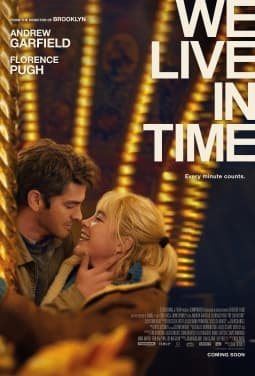
We Live in Time: Crowley's Non-Linear Gamble
John Crowley's third collaboration with A24 runs the ten-year relationship in a non-linear shuffle, and the shuffle is what makes the film survive its cancer-drama premise. Just barely, but it does.
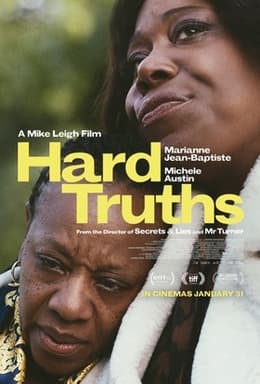
Hard Truths: Leigh's Return to Pansy
Mike Leigh's first film since 2018 reunited him with Marianne Jean-Baptiste for a character study of sustained anger. The argument is that the film is one of his best, and the conditions that produced it are the ones his method has been waiting to find.
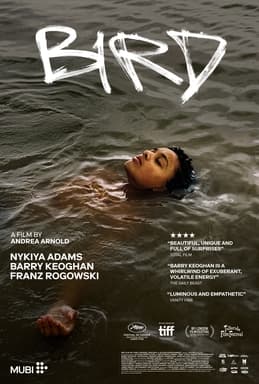
Bird: Arnold's Kent Fable
Andrea Arnold's fifth feature split the reviews, and the split was real. The retrospective argument is that the film's unexpected magical turn is not a failure of the social-realist grammar, it's what the grammar was always walking toward.