American Fiction: Cord Jefferson's Double Movie
Cord Jefferson's debut feature is two films trying to be one. The surprise, two months into its run, is that both films work.
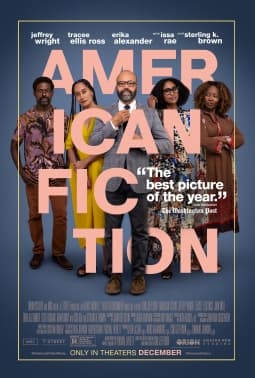
Poster / promotional material via Wikipedia, American Fiction (film). Used under fair use for criticism and review.
American Fiction, which opened wide in the US in January and has been slowly rolling out internationally since, is Cord Jefferson’s debut feature, adapted from Percival Everett’s 2001 novel Erasure. It was nominated for five Oscars and won one, for Jefferson’s adapted screenplay. I have been trying, across several weeks, to articulate why it works, because, structurally, it shouldn’t.
The structural problem, stated
American Fiction is two films. The first film is a sharp, specific satire about the publishing industry’s appetite for “authentic” Black suffering, and the career collapse of a Black literary novelist whose serious work does not sell while a deliberately stereotype-heavy pseudonymous novel he writes as a joke becomes a runaway bestseller. The second film is a family drama about the same novelist, Thelonious “Monk” Ellison, played by Jeffrey Wright, reckoning with his ageing mother, his recently-widowed sister, his recovering-addict brother, and the long-deferred work of being a son.
These are genuinely different films. The satire has one register (dry, angry, literary). The family drama has another (warm, quiet, intimate). The structural risk of switching between them across a 117-minute running time is real. Either the satire keeps breaking the family drama’s mood, or the family drama keeps softening the satire’s edge.
Jefferson’s achievement, which I did not fully register on first watch, is that he does not try to resolve the mismatch. He lets the two films coexist, and the coexistence is the point.
The satire, briefly
The satire half is propulsive, particularly in its first act. Monk, frustrated at being told his serious novels are “not Black enough,” writes under a pseudonym the most stereotype-dense crime novel he can imagine, “My Pafology,” later retitled “Fuck.” Every major publishing figure in the film loves it. They fight over it. It is longlisted for a major prize. He is now, simultaneously, the distinguished literary novelist nobody wants and the sensational crime writer everybody does.
This is a real set of conditions in the American literary economy, and Jefferson’s script is sharpest when it is documenting the specific rhetorical moves editors and critics use to signal respect for Black writing while requiring Black writers to stay inside a narrow thematic lane. The agent (played by John Ortiz), the publishing executive (Miriam Shor), the Pulitzer juror (the single best scene in the film, with Erika Alexander and Issa Rae): these are the sharp implements.
The family drama, quietly
Meanwhile, the other film. Monk’s sister Lisa, played by Tracee Ellis Ross, dies early. His brother Cliff, played by Sterling K. Brown, arrives for the funeral and stays. His mother, played by Leslie Uggams, is entering dementia. Monk, across the running time, moves from being the distant sibling to being the primary caretaker, and the film pays attention to the specific domestic labour that involves.
What Jefferson does, which is deeply generous and which the film’s awards-campaign coverage largely missed, is give the family drama the same respect the satire gets. He does not ironise it. He does not under-cut it. When Monk sits with his mother and realises she no longer knows who he is, the film does not cut away to a satirical jab at the publishing industry. It sits with the scene.
Jeffrey Wright, finally foregrounded
Jeffrey Wright has been one of the most reliable American character actors of the last twenty-five years (Basquiat, Angels in America, The Hunger Games, Westworld) and American Fiction is, shockingly, his first leading role in a major feature. That the lead came this late in his career is an indictment of how American cinema has historically allocated leading-man roles.
He is, unsurprisingly, excellent. Wright plays Monk as a man whose intellect is his primary defence and whose primary liability is that his intellect is not actually sufficient to manage his emotional life. The scenes where Monk’s intellectual armor cracks, during his mother’s decline, during the romance with Coraline (Erika Alexander), during the Pulitzer juror confrontation, are where the performance does its specific work.
Sterling K. Brown, stealing
Sterling K. Brown’s Cliff is the film’s largest comic achievement and, probably, the strongest supporting performance in any film of the winter. Cliff is a plastic surgeon who has recently come out, has recently divorced his wife, and is recently addicted to cocaine, and who nevertheless is, by some margin, the most emotionally available person in the Ellison household. Brown plays the chaos of the role with a precise sense of comic timing that never tips into caricature.
The scene in which Cliff finally talks to Monk about their dead father’s affair, which Monk has been avoiding discussing for twenty years, is the family drama’s emotional spine, and Brown carries it.
Where the film’s argument lands
American Fiction, underneath both of its halves, is arguing that Black artistic life in America is still, in 2024, coerced into narrow commercial shapes that do not match the fullness of actual Black lives. The satire makes this argument explicitly. The family drama makes it implicitly, by simply showing a Black literary-class family living a full middle-class American life, with the specific concerns of such a life, and refusing to translate those concerns into the publishing industry’s preferred genre categories.
The film’s best move is that it does not let either half win. The satire cannot annihilate the family drama. The family drama cannot humanise the satire into irrelevance. Both films are, in their way, true.
Where it sits
American Fiction has been on awards-list-safe status for about three months now. The Oscar win for Adapted Screenplay was correct. Jeffrey Wright’s Best Actor nomination was overdue. The film’s longer-term importance will depend on whether Jefferson sustains the project in his second feature.
Watch it when you can get to it. Stay for both films.
Lena writes long-form essays on the films that will still be talked about in a decade. Previously at a defunct monthly whose name we do not speak.
MORE BY LENA ASHWORTH →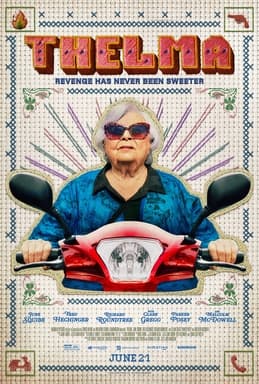
Thelma: June Squibb's Late-Career Lead
Josh Margolin's debut feature gave June Squibb her first leading role at 94. It was not a stunt. It was a film.
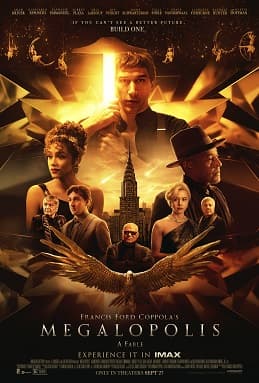
Megalopolis: Coppola's $120 Million Argument With Himself
Francis Ford Coppola self-funded his first film in thirteen years. It is nearly unwatchable in specific places and almost-great in others. The project is the point.
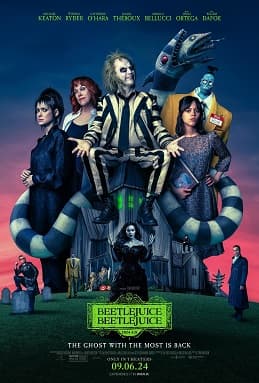
Beetlejuice Beetlejuice: The Rare Legacy Sequel That Remembers What the Original Was
Tim Burton returns to Beetlejuice after 36 years and makes a legacy sequel that actually works, mostly because he refused to make a serious one.