All We Imagine as Light: Kapadia's Bombay Nocturne
Payal Kapadia's Cannes Grand Prix winner was received, on its US release, as the decade's strongest import from Indian indie cinema. The re-reading is that the film is even stranger, and more formally considered, than the initial reception allowed.
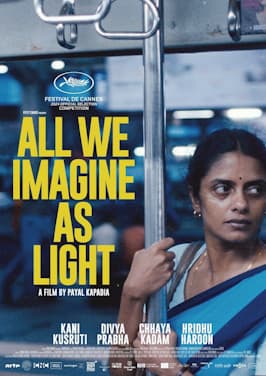
Poster / promotional material via Wikipedia, All We Imagine as Light. Used under fair use for criticism and review.
Payal Kapadia arrived at Cannes 2024 with her first narrative feature, having previously made the documentary A Night of Knowing Nothing (2021), and left with the Grand Prix, the festival’s second-highest honour and the first such prize for an Indian film in thirty years. Sideshow and Janus Films acquired All We Imagine as Light for US distribution; the theatrical run opened in November 2024 and expanded gently through early 2025, grossing around $1.9 million in North America, a modest but meaningful figure for a Malayalam-and-Hindi-language drama with no stars known to an Anglophone audience.
The initial US reception, in the specialty press, was uniformly warm. The re-reading, with a year’s distance, is that the warmth was slightly insufficient to what Kapadia actually accomplishes.
What the film is
Prabha (Kani Kusruti), a nurse at a busy Mumbai hospital, lives in a small flat she shares with a younger colleague, Anu (Divya Prabha). Prabha has been separated for years from a husband who left India for Germany and has since stopped writing. Anu is secretly in love with a young Muslim man, Shiaz (Hridhu Haroon), a relationship her Hindu family would not accept. Their older friend Parvaty (Chhaya Kadam), a cook at the hospital, is facing eviction from the tenement where she has lived for decades, the block about to be demolished for luxury redevelopment.
The first hour of the film stays in Bombay. The second hour moves to a coastal village where Parvaty returns to her late husband’s house and where Anu and Shiaz find a brief pocket of privacy. The film ends at a beachside tea stall at dusk.
That is roughly the shape of it. The shape is not the film.
What Kapadia is doing
The film opens with a long sequence of documentary footage: migrant workers in Bombay, voice-over fragments in several languages describing the city’s relationship to labour, to sleep, to arrival. The footage is quasi-ethnographic; the voices are uncredited. Kapadia holds this register for perhaps eight minutes before the narrative proper begins.
That opening matters. It establishes, before the viewer meets Prabha or Anu, that the film is situated inside a larger city, a city whose texture will keep surfacing through the personal story the film then tells. Kapadia’s background in the documentary form is not a prologue she abandons. It is the ground the fiction is built on.
Ranabir Das, who shot the film on 35mm, gives Bombay a specific nocturnal palette: fluorescents, sodium streetlights, the blue wash of TVs behind windows. The cutting (by Kapadia herself, with Clément Pinteaux) is patient; scenes are allowed to run past their narrative function. The result is a film that feels, in its first half, more like a dream the city is having about its inhabitants than a character drama about three women.
The structural pivot
The move to the coast, roughly an hour in, is the film’s formal gamble. Kapadia is asking the viewer to leave the city and its accumulated texture behind, and to trust that the village sequence will do work the city sequence has set up. For viewers who read the film as a Bombay film, this pivot can feel like a loss. For viewers who read the city sequence as preparation rather than subject, the coast is where the film’s thesis finally lands.
The thesis, if it can be stated, is about the conditions under which women in this society are allowed to want anything for themselves. The city denies them the space. The coast, briefly, offers it. The film is careful not to sentimentalise the coast or to imply that the offer is permanent. It offers a pocket. The pocket closes. The women return.
The Kusruti and Prabha performances
Kani Kusruti, one of the more interesting working actors in Malayalam cinema (Biriyaani, Declaration), plays Prabha with a specific withheld quality. Prabha is not depressive; she is professionally competent, affectionately connected to her colleagues, physically comfortable in her routines. What she has lost is permission to want something new. Kusruti plays that loss as a small physical compression, visible in the shoulders, in the way Prabha holds a phone, in the slight lag between a question being asked and her answering it.
Divya Prabha as Anu is the film’s open-hearted counterweight. Anu still wants. She is risking her family for the wanting. The performance is specifically bright without being naive; Anu knows the risk, and is running it anyway. The two registers, Kusruti’s compression and Prabha’s openness, define the film’s emotional range.
Chhaya Kadam, as Parvaty, carries the film’s most socially legible material: a widow displaced by a city that no longer has a place for her. Kadam plays it without pathos. The eviction is a problem to solve. The village house is a place to go. The performance refuses the sentimental register the subject would ordinarily invite.
The coastal sequence
The film’s best passage is a late sequence on the beach, filmed in what appears to be available light at dusk. Anu and Shiaz, briefly alone, walk along the waterline. The scene is almost wordless. Kapadia holds on their feet, on the shallow water, on the specific quality of the light as the day ends. There is no plot in the sequence. There is only the brief fact of their being able to be together outdoors, in a country where they cannot be together outdoors, for the length of a walk along a specific beach.
The emotional impact of the sequence depends on everything that has preceded it. The compression of the city, the secret of Anu’s relationship, the structural constraints the film has been documenting: all of them make this small beach walk carry more than the visuals would otherwise support. This is Kapadia’s formal trick. She loads the small gesture by refusing to dramatise the larger ones.
Where it sits
All We Imagine as Light is the kind of film whose long commercial life will be on the Criterion Channel, on Mubi, on whatever art-house streaming ecosystem survives the next five years. Janus is the right steward for that long life. The film will continue to accumulate the audience it deserves across the next decade.
The larger point is what Kapadia’s arrival signals about Indian film. The dominant international image of Indian cinema is the Bombay mainstream, the star-driven commercial vehicle. All We Imagine as Light proposes an alternative: a patient, observational, formally serious Indian cinema that is aware of the mainstream and deliberately works alongside it. Kapadia is now part of a small cohort (Rohena Gera, Payal Sethi, the Malayalam arthouse circuit) whose work the festival circuit is paying attention to.
Watch it on the largest screen you can find, at night, with the subtitles on. Let the opening documentary passage do its work. The film earns every minute of its 118-minute runtime.
Lena writes long-form essays on the films that will still be talked about in a decade. Previously at a defunct monthly whose name we do not speak.
MORE BY LENA ASHWORTH →
Flow: Zilbalodis and the Wordless Feature
Gints Zilbalodis made a dialogue-free animated feature in Blender with a team of a dozen, won the Oscar, and put the Latvian film industry on the global animation map. The patient argument is that the form, not the novelty, is the achievement.
We Live in Time: Crowley's Non-Linear Gamble
John Crowley's third collaboration with A24 runs the ten-year relationship in a non-linear shuffle, and the shuffle is what makes the film survive its cancer-drama premise. Just barely, but it does.

Small Things Like These: Murphy's Quiet Indictment
Tim Mielants's adaptation of the Claire Keegan novella was reviewed as a modest Cillian Murphy vehicle. The careful reading is that the film's restraint is the indictment, and the restraint is harder to film than the indictment would have been.