Flow: Zilbalodis and the Wordless Feature
Gints Zilbalodis made a dialogue-free animated feature in Blender with a team of a dozen, won the Oscar, and put the Latvian film industry on the global animation map. The patient argument is that the form, not the novelty, is the achievement.
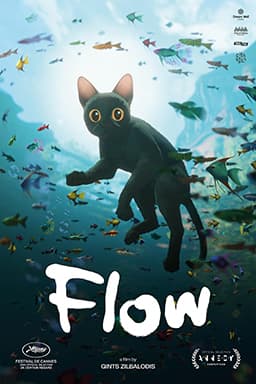
Poster / promotional material via Wikipedia, Flow (2024 film). Used under fair use for criticism and review.
Gints Zilbalodis’s Flow is a dialogue-free animated feature from Latvia, made for a reported budget of 3.7 million euros by a team of around a dozen people, and rendered entirely in Blender, the open-source 3D software. It premiered at Cannes in the Un Certain Regard sidebar in May 2024, received US distribution from Janus Films and Sideshow in November 2024, won the Golden Globe for Best Animated Feature, and then, in March 2025, won the Oscar in the same category, beating The Wild Robot, Inside Out 2, and Memoir of a Snail. It is the first Latvian film to win the Academy Award in any category.
I want to write about it patiently, because the reception fell into two reductive shapes: the Blender-miracle shape (small team, open-source tools, big outcome) and the Oscar-upset shape (independent beats the studios). Both are true. Neither gets at what the film actually does.
What the film is
A flood is coming. A small black cat, whose habitat is the upper branches of a forest, finds itself in rising water. It encounters, in succession, a capybara sheltering on a floating boat, a secretary bird wounded and grounded, a golden retriever abandoned by its human owner, and a lemur hoarding objects that no longer belong to anyone. The animals make an uneasy crew. The flood rises. The boat drifts. The film, over 84 minutes, follows their journey across a world in which the human population appears to have already left.
There is no dialogue. The animals communicate through vocalisations that are those of their actual species (a team of sound recordists captured real animal vocalisations for each character). There is no narration. There are no title cards. The film is entirely visual and diegetic-sound.
What Zilbalodis is doing
The formal choice that defines Flow is the refusal of anthropomorphism in the character design. The animals do not wear clothes, do not stand on two legs, do not have human facial features grafted onto animal bodies. They are rendered as animals, with animal movement, animal posture, animal proportions. Their emotional states are communicated through body language that is consistent with their species.
This is harder than it sounds. The dominant animation tradition (Pixar, Disney, Dreamworks) has spent three decades refining an anthropomorphism grammar in which an animal’s face is essentially a human face displaced onto an animal body. Zilbalodis does not use that grammar. His cat moves like a cat. His lemur moves like a lemur. The viewer has to read emotional content from posture, tail movement, the direction of a gaze. The film trusts the viewer to do this work, and the trust is the film’s primary formal move.
The camera
The second formal element is the camera. Zilbalodis, who also edited, composed the score, and wrote the film, treats the virtual camera as a physical presence. The camera swims. It climbs. It follows the cat along branches, then pulls back to reveal landscapes. Long unbroken takes are common. The camera operates with the kinetic logic of a drone that is also aware of animal scale.
This kinetic camera style was already present in Zilbalodis’s previous feature, Away (2019), which he made entirely by himself. Flow extends the camera grammar to a project with a team, which allows for richer environments and more animal characters, but the camera logic is continuous. The film feels inhabited by a specific sensibility, and the sensibility is legible across the director’s earlier work.
The world
The world of Flow is not explained. Why is the flood happening? Where have the humans gone? What caused the ruin? The film does not answer any of these questions, and the refusal is part of what makes it operate at the register it does. The viewer is given a set of landscapes (a forest, a ruined city, a set of mountain passes, an ocean) that are post-human in a specific way: human objects persist, human structures persist, but humans are absent.
The absence is not post-apocalyptic in the way that live-action cinema usually stages post-apocalypse. There is no wreckage of conflict. There is no implication of recent human death. The humans have simply not been here for a long time, and the landscapes have been reshaped by water and growth. The tone is melancholic rather than horrific. The film is interested in what continues, not in what has ended.
The sound
Rihards Zalupe, who scored the film with Zilbalodis, built an orchestral soundtrack that is specifically restrained. Long passages have only ambient sound: water, wind, animal calls. When the score enters, it is usually to carry an emotional climax rather than to underline continuous action. The restraint allows the diegetic sound to carry the film’s sensory load. Water moves throughout the film, and the water is acoustically specific: how it laps a hull, how it resonates in a flooded room, how it sounds when the camera goes underneath.
The animal vocalisations are the film’s emotional vocabulary. The cat’s meows, the capybara’s specific soft clicks, the retriever’s whines are recorded from real animals and edited with specific care. This is not a film in which the score does the emotional work. The emotional work is in the sounds that the characters themselves make.
The production story
The production ran for around five years. Zilbalodis and his team worked primarily in Latvia, with additional collaborators in France and Belgium. Blender was used for modelling, animation, and rendering, which allowed the team to operate at a scale their budget otherwise would not have permitted. The open-source choice was pragmatic (licence costs for commercial tools at the required scale would have been prohibitive) but it is also specifically visible in the film’s look. The rendering has a particular quality that reads as neither the Pixar register nor the European stop-motion register. It is a specific middle space, digital but handmade.
Where it sits
Flow has already reshaped the conversation about what small European animation studios can accomplish. The Latvian film industry has received specific international attention in the film’s wake. Zilbalodis has indicated his next project will continue in a similar register.
The broader point is about the animated-feature category as a whole. The Oscar win over three American studio films with budgets several hundred times larger was not a fluke; it reflected a recognition, by a specific voting body, that Flow is doing work the studio animation tradition has stopped doing. The major studios animate stories in which animals talk. Zilbalodis animated a story in which animals are animals, and the limitation forced the film into a formal register that the talking-animal tradition cannot access.
Watch Flow with the sound loud and the screen dark. Let the long silences run. The film earns its 84 minutes.
Priya came to criticism sideways from theatre. She is patient with slow shows, short with bloated ones, and cheerfully vicious about lazy writing.
MORE BY PRIYA NAIR →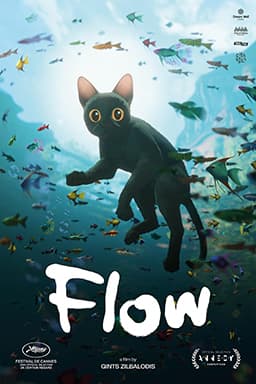
Flow and the Case Against Animated Dialogue
A Latvian animated feature made on Blender with a team of fifteen people won the Oscar and beat DreamWorks, Pixar, and Netflix. The reason is not budget. It is silence.
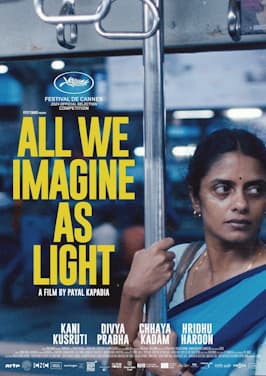
All We Imagine as Light: Kapadia's Bombay Nocturne
Payal Kapadia's Cannes Grand Prix winner was received, on its US release, as the decade's strongest import from Indian indie cinema. The re-reading is that the film is even stranger, and more formally considered, than the initial reception allowed.
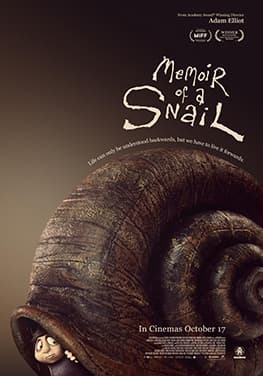
Memoir of a Snail: Elliot's Claymation Grief
Adam Elliot's second stop-motion feature took eight years to make and collected festival prizes from Annecy to Annapurna. The Australian argument is that his particular strain of misery-claymation is one of the country's more unusual exports.