A Real Pain: Jesse Eisenberg's Two-Handed Script
Jesse Eisenberg's second film as director is a tightly written cousins-on-a-trip movie that uses its ninety minutes to say something particular about inheritance, grief, and the specific tolerances of family.
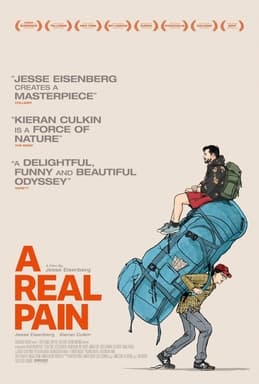
Poster / promotional material via Wikipedia, A Real Pain. Used under fair use for criticism and review.
Jesse Eisenberg’s A Real Pain is ninety minutes long. This seems worth mentioning because the film is, in most other respects, remarkable for what it declines to do rather than for what it does. It does not have a second plot. It does not have a subplot. It does not have an ensemble beyond the two leads. It does not have set pieces or action or production spectacle or an eleventh-hour revelation. It has two cousins, a week-long Jewish heritage tour of Poland, and ninety minutes of closely-watched behaviour.
The specific question for a retrospective is whether what Eisenberg has constructed holds up outside the awards-season climate in which it was initially received. A year on, it does, and in ways that the initial reception did not fully register.
What the film is
David Kaplan (Jesse Eisenberg) and Benji Kaplan (Kieran Culkin) are cousins in their mid-thirties. Their grandmother, a Holocaust survivor who emigrated to the United States after the war, has recently died. David and Benji have inherited enough money from her estate to travel to Poland together as part of a small-group heritage tour organised around visiting the sites of Polish Jewish history, ending at their grandmother’s childhood home.
The cousins are specific opposites. David is married, has a young child, works in digital advertising, takes prescription medication for anxiety, and has the affect of a specifically contained Jewish professional who is quietly unhappy with most of his adult life. Benji is unmarried, unemployed, lives with his mother, has recently survived a suicide attempt, and has the affect of a specifically unfiltered Jewish bohemian who is specifically loved by everyone who meets him for about forty-eight hours before the loving becomes exhausting.
The film watches them travel together. That is the plot.
What Culkin does
Kieran Culkin’s Benji is the performance that carried the film through awards season, and the performance that the film’s structural design requires. Culkin won Best Supporting Actor at the 2025 Oscars. The win was deserved, but the framing of the performance as “supporting” is worth questioning. Benji is, in terms of screen time and dramatic function, a co-lead. The supporting category is, in his case, a specific commercial decision rather than a structural truth about the film.
What Culkin does with Benji is the thing most worth watching. Benji is, on the page, a character who could easily have read as a quirky-friend caricature: the magnetic depressive, the wounded charmer. Culkin plays him with a specific refusal of the charm. Benji’s charisma is not softened. It is shown as a specific thing that creates specific costs for the people around him, and Culkin lets those costs register.
The scene that best demonstrates this is the second-act group dinner at a Warsaw hotel. Benji has, across the first half of the trip, charmed every member of the small tour group. At dinner, the charm tips. He monopolises the conversation. He deflects questions back at the other travellers in ways that feel aggressive rather than generous. He makes a specific joke at David’s expense that lands as cruelty. Culkin plays the moment as a specific loss of control, and the camera, close on his face as he registers the loss, lets the viewer see him see it.
Eisenberg as director
This is Eisenberg’s second directorial feature after When You Finish Saving the World (2022). The earlier film was less confident. A Real Pain is a specific technical improvement, and the improvement is most visible in Eisenberg’s comfort with stillness. The film is willing to hold on faces. It is willing to stay in silence. It is willing to let a scene play out at the pace of the performance rather than the pace of the edit.
Michał Dymek, the Polish cinematographer who shot the film, deserves specific mention. His work (previously on Jerzy Skolimowski’s EO, 2022) has a particular attention to ambient light that suits the film’s heritage-tourism register. Warsaw, Lublin, and the Majdanek concentration camp are shot without the specific aesthetic softening that American films about European Holocaust sites often default to. The light in the Majdanek sequence is cold and particular. The film is not looking for the beautiful shot. It is looking for the accurate one.
The heritage tour, as structure
One formal choice worth naming: the film organises itself around the itinerary of the tour rather than around a dramatic arc. Each location is a station, and each station produces a specific interaction between David, Benji, and the other tour members. The film trusts the itinerary to produce the dramatic material, rather than imposing dramatic material on the itinerary.
This trust is what makes the film’s emotional register work. The Majdanek sequence, which is the film’s most sensitive piece of construction, does not structure itself around a catharsis. The cousins visit the camp, silently. They walk the specific paths, look at the specific barracks, sit in the specific grass. Nothing is said by either of them during the visit itself. The emotional weight lands afterwards, in a quieter scene on a train, when Benji mentions, offhand, that he does not know what he felt at Majdanek, and David admits he did not know what he felt either. The film does not require the cousins to produce a specific emotional response to the Holocaust. It is willing to let them be uncertain.
The supporting tour group
Jennifer Grey, playing Marcia, a divorced American woman on the tour, gives a specifically compact performance that deserves more attention than the awards conversation allowed. Marcia is, in her handful of scenes, the specific adult presence the film requires: someone who has enough life behind her to register what she is seeing in Poland with a specific weight the cousins cannot yet muster. Grey plays this without dramatising it. Her scenes are the specific ballast that keeps the cousins’ dynamic from floating free of adult stakes.
The other tour members, including Will Sharpe’s British-Rwandan convert to Judaism, function less as individuals and more as specific reactions against whom the cousins’ behaviour is measured. This is an economical piece of construction. The tour is the ensemble. The cousins are the film.
What the film is actually about
The film’s most frequently-cited thematic reading is that it is about generational inheritance: the specific weight of Holocaust memory on the grandchildren of survivors, the specific question of how to hold that memory without being crushed by it or trivialising it. This reading is correct. The film does carry that weight.
But the more specific reading, the one that the second viewing clarifies, is that the film is about the specific ethical problem of loving someone whose suffering is more spectacular than yours. David loves Benji. David also sometimes wishes Benji were easier to love. The film’s deepest honesty is about this specific second feeling, and about the guilt that attends it. The closing scene, in which David returns home to his wife and child, and Benji, alone, sits in an airport, articulates this without ever stating it.
Where it sits
A Real Pain grossed approximately $20 million on a reported $3 million production budget, which makes it one of the most commercially efficient awards-season releases of 2024. It is the kind of small, specifically accomplished film that studios used to make more frequently and now mostly do not. Searchlight’s backing of it is, in retrospect, the specific gesture of curatorial confidence the industry needs more of.
Eisenberg, whose next project has been announced as a lower-budget American film, is developing into a specifically interesting mid-career director. The writing is the thing. Watch A Real Pain for the cousins dynamic, and for the specific discipline of its ninety-minute running time. The discipline is what makes the emotional weight land.
Priya came to criticism sideways from theatre. She is patient with slow shows, short with bloated ones, and cheerfully vicious about lazy writing.
MORE BY PRIYA NAIR →
A Real Pain: Eisenberg's Cousins Movie
Jesse Eisenberg's second feature as director-writer is a specifically small, specifically patient Polish heritage-tour film, and the film it most resembles is a Broadway play that someone has somehow filmed correctly.

Anora's Best Picture Win, Defended
A year after Sean Baker's fourth feature took five Oscars including Best Picture, the predictable backlash has arrived on schedule. Here's why the Academy, improbably, got it right.
Between the Temples: Nathan Silver's Cantor
Nathan Silver's improvisational comedy about a grieving cantor and his retired music teacher is the specifically strangest American indie comedy in years. I keep coming back to it.