A Real Pain: Eisenberg's Cousins Movie
Jesse Eisenberg's second feature as director-writer is a specifically small, specifically patient Polish heritage-tour film, and the film it most resembles is a Broadway play that someone has somehow filmed correctly.
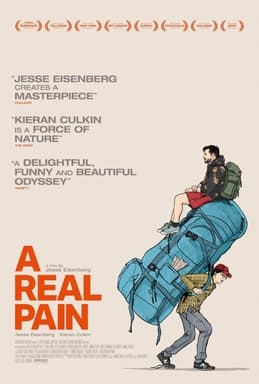
Poster / promotional material via Wikipedia, A Real Pain. Used under fair use for criticism and review.
I did not expect to care about A Real Pain. I had not been impressed by Jesse Eisenberg’s first feature as director, When You Finish Saving the World (2022), which seemed to me a specifically thin Julianne Moore vehicle that kept trying to be about something it could not quite articulate. Eisenberg’s career as a screenwriter had included an off-Broadway play (The Revisionist, 2013) that I had specifically liked. His career as a performer has been specifically uneven. His first feature suggested the directing turn wasn’t his mode.
A Real Pain is his mode. It grossed around $10 million in the US after its Sundance premiere and its October 2024 Searchlight release, won Kieran Culkin the supporting actor Oscar in March 2025, and is, for my money, the specifically best two-handed American indie of the 2024 slate.
What the film is
David (Jesse Eisenberg) and Benji (Kieran Culkin) are first cousins in their early thirties. Their grandmother, a Polish-Jewish Holocaust survivor, has recently died, and has left them money to go to Poland together on a Holocaust-heritage tour. They have not been close for several years. Benji has been struggling with specific mental-health and substance issues. David is a married-with-kid digital-ads professional in New York who feels specifically responsible for Benji but also specifically at a loss about what to do with him.
The film is the cousins on the tour. They fly into Warsaw. They join a small specifically organised heritage group led by an English guide named James (Will Sharpe). They visit specific sites: the Warsaw Jewish cemetery, a former concentration camp, the specific small town their grandmother came from. They fight. They reconcile. They fight again. The tour ends. They part.
What Eisenberg is doing
The film is approximately ninety minutes. Eisenberg directs at a specifically patient tempo that the small plot would seem to resist. What he is interested in is the specific texture of being cousins across a ten-day trip. The tour group becomes the specific social geography through which the cousins’ dynamic surfaces. The specific other group members (an older American Jewish couple, a recent convert to Judaism, a middle-aged Rwandan genocide survivor) function as the specific chorus that the cousins’ dynamic plays against.
The film’s formal achievement is its specific restraint about the heritage material. A Real Pain is a Holocaust film. The cousins are visiting the specific sites of historical atrocity. The film does not attempt to represent the atrocity. It does not attempt to dramatise the survivors’ lives. It stays, specifically, with the present-day cousins and the present-day tour, and the specific difficulty of being at these sites as grandchildren of the people who survived them.
This is the correct register, and it is specifically difficult to maintain. The temptation in a Holocaust-heritage narrative is to reach for significance. Eisenberg refuses. The film’s specific claim is that the present-day grandchildren are, by virtue of being grandchildren, structurally unable to fully access what happened at these sites, and that the inability is the specific subject. The film’s most formal sequences are the ones in which the cousins simply walk through spaces and do not know how to feel.
The Culkin performance
Kieran Culkin won the supporting actor Oscar and deserved it. Benji is the film’s engine. The performance is specifically generous, specifically unpredictable, specifically allowed to slide between registers that most actors at Culkin’s career stage would either commit to or avoid. Benji is funny. Benji is cruel. Benji is loving. Benji is specifically self-destructive in ways that the film does not moralise about.
What Culkin does specifically well is play Benji as a person whose specific charm is continuous with his specific damage. The charm is not a mask. It is not compensating. It is the same quality as the damage, expressing itself at different pressures. This is harder to play than it sounds, because most actors split the register: the charming surface and the damaged interior. Culkin refuses the split. Benji is, specifically, a whole person whose whole person includes the specific instability.
The film’s central extended sequence, in which Benji has a specifically painful emotional breakdown in a hotel bar in front of the other tour members, is the performance’s specific showcase. Culkin plays the breakdown without any of the conventional acting-class cues for breakdown. He is not pushing for tears. He is not straining. He is specifically present to the breakdown as it is happening to the character, and the presence is the performance.
The Eisenberg performance
Eisenberg, as David, has given himself the harder and less-noticed assignment. David is the film’s audience surrogate: the specifically responsible cousin who is trying to take the tour seriously, trying to take Benji seriously, trying to take his own feelings seriously across all of the above. Eisenberg plays David as specifically watchful rather than reactive. David is, across the running time, doing the specific work of keeping the tour going despite Benji’s continual undermining of its tonal register.
What Eisenberg plays specifically well is David’s specific low-grade continuous irritation with Benji, coexisting with his specific underlying love. The irritation is not performed. The love is not performed. They both simply surface across the running time at different intensities. Eisenberg’s specific on-camera register (the clipped speech, the specifically defensive body language) is put to work here in a way his performances elsewhere have not always been.
The Warsaw and camp sequences
The film’s specific visual achievement is its cinematography of Warsaw and the concentration-camp site. Michal Dymek, the Polish cinematographer, shoots the locations with a specifically restrained observational register. The Warsaw scenes are specifically lit for the actual light of Polish autumn; the camp scenes are specifically lit for the actual light of a specifically grey day. The film does not stylise the heritage locations. It does not photograph them for sombre effect. It records them at the register of what a tour group would actually see, and the restraint is specifically powerful.
The Chopin music that scores the film (the nocturnes, specifically the Op. 9 pieces) is the film’s specific emotional register. Eisenberg has chosen a specifically Polish-national musical tradition to score the film’s specific Polish-diaspora cousin dynamic, and the choice produces a specific cultural-historical resonance that a composed-for-film score could not have achieved.
Where it sits
A Real Pain is, I want to argue, the specific indie drama of the 2024 awards season that will keep holding up. Searchlight distributed it with specific care. The Oscar for Culkin has further secured its long afterlife. The film is specifically small in a way that most awards-season indies no longer are.
Eisenberg’s next project, which is reportedly going to be another small two-hander, is worth waiting for. He has become, specifically quietly, one of the more specifically interesting directors of American indie drama at this budget tier. Watch A Real Pain on an aeroplane, or on a train, or in any specifically transitional setting. The film was made for that specific register of attention.
Jules writes the kind of pieces that come from wandering somewhere and overhearing something. On Frame Junkie's masthead since the beginning.
MORE BY JULES OKONKWO →
A Real Pain: Jesse Eisenberg's Two-Handed Script
Jesse Eisenberg's second film as director is a tightly written cousins-on-a-trip movie that uses its ninety minutes to say something particular about inheritance, grief, and the specific tolerances of family.
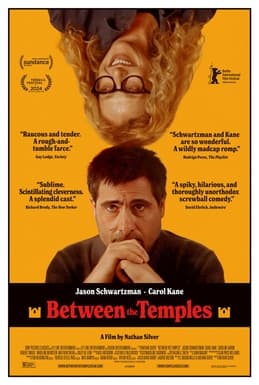
Between the Temples: Nathan Silver's Cantor
Nathan Silver's improvisational comedy about a grieving cantor and his retired music teacher is the specifically strangest American indie comedy in years. I keep coming back to it.
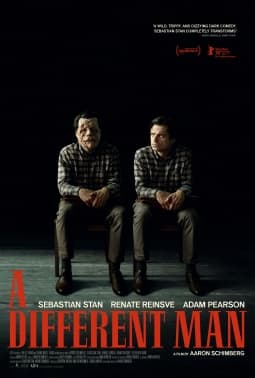
A Different Man: Aaron Schimberg's Face-Swap Comedy
Aaron Schimberg's 2024 comedy about an actor who gets a medical procedure and regrets it is the year's strangest mid-budget indie, and the one whose specific comic machinery I keep returning to.