Wolf Man, Leigh Whannell, and the Universal Monster Problem
Leigh Whannell's January 2025 Wolf Man cost about $25 million and grossed about $36 million globally. The film is not the disaster the numbers suggest. The strategy around it is.
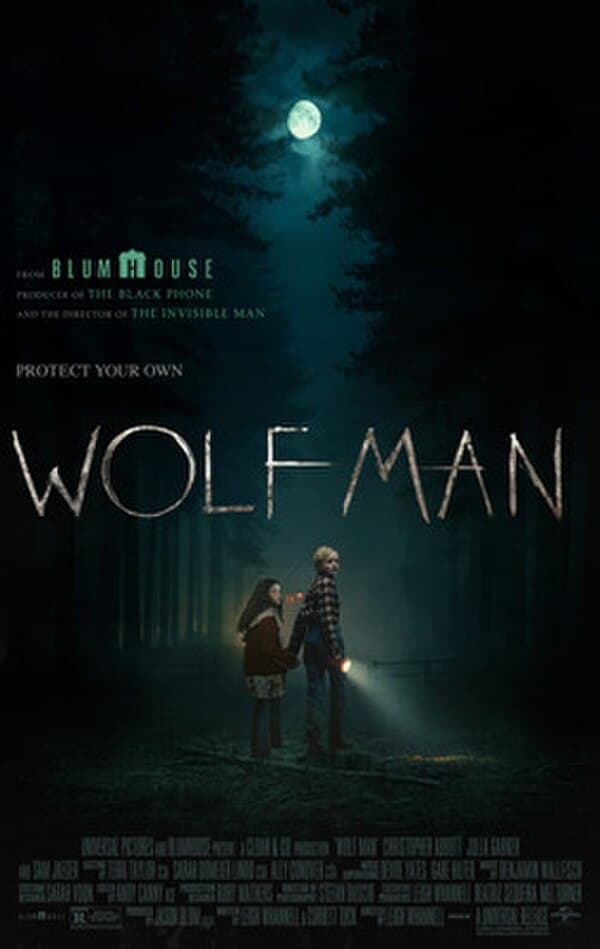
Poster via Wikipedia, Wolf Man (2025). Used under fair use for criticism and review.
Let me get one thing out of the way. Wolf Man, directed by Leigh Whannell and released in January 2025, is not a bad film. It is not the film I wanted Whannell to make six years after The Invisible Man, and the marketing did it no favours, and the second act is a structural mess that the third act does not solve. But the camera work is precise, Christopher Abbott is doing the best work of his career, and the prosthetic design by the Weta workshop is the most specific monster makeup the studio has put on screen since Rick Baker’s American Werewolf in London prosthetics in 1981. The film is not a disaster.
What is a disaster is the strategy that put it on January screens, the second January slot in five years for a Whannell-directed Universal Monsters update, and the institutional failure to learn anything from the Invisible Man result. Wolf Man opened on 17 January 2025 against One of Them Days (Sony) and the second week of Mufasa: The Lion King (Disney). It posted a $10.8 million domestic opening on a reported $25 million production budget and finished its theatrical run with about $36 million worldwide. Universal does not lose money on a Blumhouse co-production at that scale, but the sequel pipeline that the Invisible Man numbers were supposed to underwrite is now functionally dead, and the studio’s monster strategy is back where it was in 2017 after Tom Cruise’s Mummy.
Why The Invisible Man worked
I want to revisit the 2020 Invisible Man numbers, because the studio’s read of those numbers is the source of the current problem. The Invisible Man opened at the end of February 2020, three weeks before the United States locked down for COVID. It cost about $7 million. It earned about $144 million worldwide before theatres closed and another $20 million through pandemic-era streaming and home rental. The cost-to-return ratio was a generational outlier. Universal saw the result and read it as a model.
The model was: small budget, contemporary domestic-thriller framing, a single recognisable monster, no cinematic-universe scaffolding, a director with horror credibility and final cut. The model was correct. The execution problem was that Universal did not commission the next monster picture immediately. They commissioned a remake of The Wolf Man in 2020 with Ryan Gosling attached, lost it in development hell for three years while Gosling left for Barbie, and rebooted the project around Whannell’s pitch in 2023. The version that arrived in January 2025 was not the Invisible Man model executed cleanly. It was the Invisible Man model executed five years late, with a different script, in a market that had moved on.
What the film does well
Whannell shoots Wolf Man in a tight, claustrophobic chamber-horror register. Stefan Duscio is back as cinematographer (he shot The Invisible Man and Whannell’s Upgrade), and the visual logic of the film is that we never leave the family house in Oregon for the second hour. Abbott, as Blake, is bitten in the cold open, and the rest of the picture is a slow-motion infection scored against a marriage already in collapse. Julia Garner plays the wife. The daughter is played by Matilda Firth.
The single best sequence in the film is roughly twenty minutes in, when Blake’s perception begins to shift. Whannell and Duscio render the wolf-vision in a desaturated grey-blue palette while keeping his wife and daughter in normal colour, which on its own is not new (Cronenberg did versions of this in The Fly in 1986; del Toro does versions in Crimson Peak), but the specific sound design is the part that lands. Composer Benjamin Wallfisch and the sound team build a register of mid-range frequencies that humans hear as a low hum and that Blake hears as words. Garner shouts at her husband in plain English. Blake hears barking. The audience hears both. The technical execution of that audio split is the film’s craft argument.
What the film does badly
The script, credited to Whannell and Corbett Tuck, does not commit to any of its three available themes. It is partly a film about generational masculinity (Blake’s father is a survivalist who raised him in the Oregon woods, played in flashback). It is partly a film about marriage at the point of dissolution. It is partly a film about a man becoming an animal in front of his daughter. Each of these is a film. None of them is the film that exists. The second act stalls because the script is trying to keep all three balls in the air, and the third act resolves only one of them, in the wrong order.
The other failure is structural and not Whannell’s fault. The film has no antagonist. Blake is the antagonist. Garner’s character has nothing to do but be afraid. Firth’s daughter has nothing to do but witness. The picture’s energy is one-directional, all body-horror inflicted on a single character, and the supporting cast is reduced to bystanders. The Invisible Man worked partly because Elisabeth Moss was the antagonist’s victim and partly because the antagonist was an absence, which gave Moss something specific to act against. Wolf Man gives Garner nothing to act against because the absence is not absence; it is her husband, in the next room, in the basement, in the bedroom, becoming something he cannot be reasoned with.
The strategy problem
Universal’s monster strategy is, at this point, exhausted. The 2017 Dark Universe collapsed before it began. The 2020 Invisible Man model produced one film. The 2025 Wolf Man result has killed the model itself. There is reportedly a Frankenstein picture in pre-production with Maggie Gyllenhaal directing, which is a credible commission, but everything that was meant to follow the Invisible Man numbers has been quietly shelved.
The mistake is not that Wolf Man underperformed. The mistake is that the studio waited five years to make it. The mistake is that Universal does not run its monster IP the way Blumhouse runs its franchises, with low budgets, high cadence, and the willingness to underwrite the third or fourth film at the same scale even after the second one disappoints. Jason Blum’s model is the one that produced The Black Phone, M3gan, and the steady Five Nights at Freddy’s return. The model requires that the studio not panic when an instalment loses money, because the next instalment is already in production at the same budget. Universal does not run their monsters on that cadence. They run them as one-shots, then read the result, then delay the follow-up by years, and the delay is what kills the strategy.
What I want next
I want Whannell to make a film without monster-IP attached to it. Upgrade is six years old now (December 2018), and the original genre work he did there with Logan Marshall-Green and the same Stefan Duscio cinematography is the work the Universal monster pictures have not let him do. The Whannell film of 2026 should not be a re-up of a 1941 property. It should be the Upgrade sequel that has been in script for two years and that nobody is announcing because Wolf Man did not earn its multiplier.
The career-management question for Whannell is whether he can leave Universal’s monster shelf and return to the genre territory he built his name on. The studio question is whether the Wolf Man result actually killed the cycle, or whether Maggie Gyllenhaal’s Frankenstein, due in 2026, is going to be required to carry the weight of the entire Dark Universe rebuild on a single opening weekend. If the studio cannot answer that question with anything more than another five-year delay, the cycle is over. The actual film is not the problem. The strategy is.
Marcus believes good criticism is an argument. He is almost always angry about something, usually for good reason. Horror is his first language.
MORE BY MARCUS VELL →
Wolf Man, Whannell's Domestic Horror Bet
Leigh Whannell's follow-up to The Invisible Man arrived in January through Blumhouse and Universal. It is a smaller, stranger film than the one the marketing sold, and the smaller film is the better film.
Wicked: What Jon M. Chu's Part One Gets Right About Musicals
Jon M. Chu's Wicked was the studio musical that worked, and the reasons it worked are specific to the form. A year on, its choices look like a template.
Weapons Is a Comedy Structure With the Laughs Taken Out
Zach Cregger spent a decade writing sketch comedy and then applied the sketch runner's structure to a film about seventeen missing children. It made $270 million on $38 million.