What Anora's Ending Pays For
Sean Baker's Brooklyn fairytale won five Academy Awards on the strength of two minutes of silence in a parked car. The film is more interested in what that silence costs.
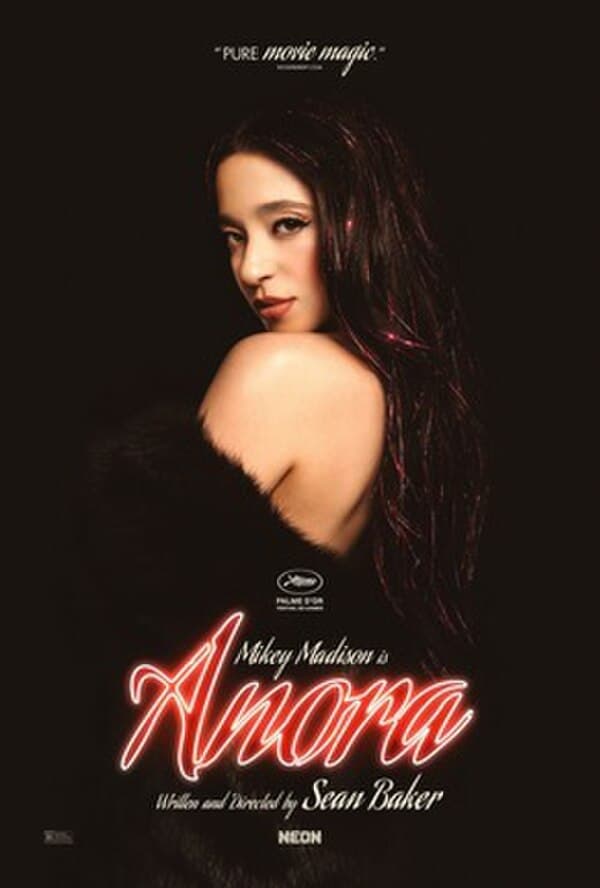
Poster via Wikipedia, Anora. Used under fair use for criticism and review.
The most quoted moment in Sean Baker’s Anora is not a line of dialogue. It is a shot of roughly two minutes near the end of the film, a parked car in a Brooklyn snowfall, two people who are not in love behaving as though they are, and a long held silence the audience is asked to read. Most reviewers in October 2024 read the shot as a moment of tenderness. By the time the film took the Palme d’Or at Cannes that May (the festival jury under Greta Gerwig had announced the prize on 25 May 2024), the reading had calcified into critical consensus. By the time Baker won five Academy Awards on 2 March 2025 (Best Picture, Best Director, Best Original Screenplay, Best Film Editing, and Best Actress for Mikey Madison), the consensus had hardened into something close to hagiography.
I want to make a careful argument about that ending, because it is the place where the film’s politics live, and the awards-season reception has a way of flattening politics into mood.
What the film actually is
Anora is, structurally, the most conventional picture Baker has made. Eight features deep, the director has built a career on workers refused by the camera elsewhere (the Florida motel kids of The Florida Project, the trans sex workers of Tangerine, the porn-industry losers of Red Rocket), and on endings that refuse the audience the consolation those workers are otherwise refused. Anora is no exception. It is the consolation that gets refused; the structure underneath it is a Cinderella.
Ani Mikheeva, played by Madison, is a Brighton Beach lap dancer who marries the son of a Russian oligarch in a Las Vegas chapel after roughly a week of acquaintance. Drew Daniels, the cinematographer, photographs the first hour in a widescreen 35mm warmth that the script refuses to underwrite, the visual register of the film flirting with the romantic comedy it is structurally pretending to be. Then the parents arrive, the marriage is dismantled, the dream is reclaimed by the family that paid for it, and the film’s last act follows the henchmen tasked with reclaiming it. Yura Borisov plays the most reluctant of the three, a Russian-Armenian named Igor who watches Ani lose everything and does not know what to do about it.
The film’s last twenty minutes are Igor and Ani together, alone, after the marriage has been annulled. They drive across Brooklyn in his car. He returns her wedding ring, which his employer instructed him to seize and which he secretly kept. They park outside her apartment building. She climbs onto his lap and initiates sex. He freezes. He tries to kiss her. She refuses. She breaks down and cries against his chest. The camera holds. The film ends.
The reading the awards rewarded
The festival reception treated the parked-car scene as the film’s emotional payoff: two damaged people who could not have made it work in any other configuration finding a fragment of grace at the moment of total loss. The Cannes jury cited the performances. The Academy, more bluntly, voted it the Best Picture of the year on a ballot dominated by an Edward Berger period romance and a Brady Corbet immigrant epic, both of which carried more conventional prestige signifiers and neither of which closed on the ambiguity Anora closes on.
The rewardable reading is real. Baker and his editor (himself, working under the editorial credit that won him an Oscar over Sean Bobbitt’s work on Nickel Boys) hold the final scene long enough that the consoling reading has time to build. Two minutes is enough time for an audience to construct a meaning the film does not need to announce. The silence is generous. It permits tenderness as a possible reading.
The reading the film actually allows
What the film does not do, and what the consoling reading misses, is offer Igor any version of dignity that is not contingent on Ani’s collapse. The scene is built around her body’s exhaustion and his body’s refusal. He cannot kiss her. He cannot, more precisely, kiss her without doing the same thing his employer did to her, the same thing the marriage did to her, the same thing the entire week has done to her. The kiss would be a transaction even when he means it as something else, because Igor exists, in the structure of the film, as an arm of the family that bought and unbought her marriage.
What the film is interested in is the discipline of his refusal. Borisov’s performance does not let the audience read him as a saviour. He does not stop the violence earlier in the film. He participates in the abduction. He flinches. He comes back. The flinch is not redemption. The flinch is the budget of a man who works for an oligarch and has, for the length of the journey from the chapel to the parked car, nowhere else to go.
The craft underneath
I want to be specific about the craft, because the awards conversation flattened it. Daniels shot the film on Kodak 35mm anamorphic in a 2.39:1 frame that sits closer to the romantic comedies of the 1990s than to the contemporary realist register. Production designer Stephen Phelps built the Las Vegas chapel and the Mikheev mansion as architectural fantasies the script then proceeds to demolish. The score, by composer Stephen Lewandowski (under the credit “Stephen”, which sits on the closing crawl with the modesty of a non-presence), is barely audible across most of the film and lands only at the close. None of this is accidental. The film is calibrated to look like a fairytale until it is calibrated to stop. The calibration is the politics.
The famous wedding sequence, fifteen minutes from the closing, is shot in a kind of slowed-down giddy choreography that Daniels stages with handheld in long takes. The annulment, by contrast, is staged in a New York judge’s chambers as flat, daytime, fluorescent procedural. The visual logic is that the marriage was the dream and the procedure was the reality. The visual logic is also that the dream was always shot to be reclaimed.
What the ending pays for
The awards conversation around Anora settled on Madison’s performance, and she is genuinely doing the most demanding work in the film. But the ending the film closes on is not Madison’s. It is Borisov’s. The shot holds because his face, after she has folded into him and begun to cry, is the surface the film is asking the audience to read. He looks at the dashboard. He looks at the windscreen. He does not look at her. The film ends before he decides what to do.
What Baker has done in the last twenty minutes of his most decorated film is construct a scene in which a man who cannot offer love and a woman who cannot accept it occupy the same parked car. The scene is not asking whether Igor can love Ani. It is asking whether he can be permitted to want to. The answer the film withholds is the answer that lets the audience do the work.
The Palme d’Or, the five Oscars, and the eighteen months of criticism that followed all metabolised the ending into something gentler than it is. The film is not gentle. The film is the most disciplined refusal of an ending Baker has yet shot, which is saying something for a director whose endings have always done the heavy structural work. The last twenty minutes are not the lift. They are the price.
Lena writes long-form essays on the films that will still be talked about in a decade. Previously at a defunct monthly whose name we do not speak.
MORE BY LENA ASHWORTH →
Anora's Best Picture Win, Defended
A year after Sean Baker's fourth feature took five Oscars including Best Picture, the predictable backlash has arrived on schedule. Here's why the Academy, improbably, got it right.

Frankenstein Cost $120 Million and Played Like a Secret
Del Toro's Frankenstein is built in two halves that only work if you sit through both in one go. Netflix released it as something you can pause.

It Was Just an Accident and the Weight of Not Knowing
Jafar Panahi's Palme d'Or winner is a revenge thriller built on a doubt that can never be cleared, and the doubt is the point.