Wolf Man, Whannell's Domestic Horror Bet
Leigh Whannell's follow-up to The Invisible Man arrived in January through Blumhouse and Universal. It is a smaller, stranger film than the one the marketing sold, and the smaller film is the better film.
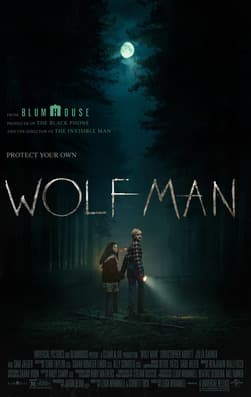
Poster / promotional material via Wikipedia, Wolf Man (2025 film). Used under fair use for criticism and review.
Leigh Whannell’s Wolf Man, which opened on 17 January 2025 through Blumhouse and Universal, did the numbers nobody wanted and then did something more interesting with the material than the numbers suggested. The film took around $11 million domestic on opening weekend against a reported $25 million production budget, closed at roughly $34 million worldwide, and was quickly framed as a disappointment against the 2020 Invisible Man, which Whannell directed for the same label and which took around $143 million worldwide on a $7 million budget.
The framing is fair on ledger. It is less fair on craft. Two months on, with the film available for rental and the discourse having moved on, the piece has clarified itself as the strangest domestic-horror feature a major studio has put out in at least three years. It is also the clearest statement Whannell has made about what he is actually interested in, which is not monster movies.
The premise, and what it concedes
Christopher Abbott plays Blake, a freelance writer living in San Francisco with his wife Charlotte, played by Julia Garner, and their young daughter Ginger, played by Matilda Firth. Blake receives notice that his estranged father, who disappeared into the Oregon backwoods thirty years earlier, has been legally declared dead. The family travels north to empty out the father’s cabin. On the road they are attacked by something on four legs. Blake is scratched. The family makes it to the cabin. The scratch begins to do what scratches do in this genre. The film unfolds across a single night.
The setup is as stock as monster horror gets. Whannell’s interest is not the setup. His interest is the specific conceit of a father, in a cabin, slowly becoming unable to communicate with his wife and child while they watch. The film is structured, deliberately, around the progressive loss of Blake’s senses and his language. Whannell shoots sequences from inside the transformation. Abbott’s hearing warps. The family’s speech becomes a low rumble. The cabin’s lights begin to read as too bright. The visual register of the film is, increasingly, a subjective approximation of someone ceasing to be able to hold a family conversation.
The register is not the genre
The film’s marketing promised a Whannell monster movie. What it delivered is a slow, specific piece of domestic horror in which the monster transformation is the vehicle for something else. Blake’s arc, which starts with him as a careful, somewhat anxious father trying to hold his marriage together, becomes an arc about a man losing his capacity to be present for his wife and daughter at the exact moment they need him most. The werewolf material is the mechanism. The material itself is about a specific kind of male dissociation.
This is Whannell’s consistent interest. The Invisible Man used the monster-movie frame to make a film about domestic violence and coercive control. Upgrade used transhumanist body horror to make a film about grief and loss of agency. Wolf Man continues the pattern. The monster is the structural device. The film is about the thing the monster allows the film to look at.
Abbott, carrying the interior work
Christopher Abbott has been one of American independent film’s most reliable interior performers for a decade, and Wolf Man uses that reliability as its lead structural asset. Abbott plays Blake as someone whose emotional register is already narrowed before the scratch. He does not shout. He does not panic visibly. The transformation, across the runtime, is visible in Abbott’s face and body in a sequence of small calibrations: his jaw tightening, his pupils dilating, the specific moment he stops being able to follow what Garner is saying to him. Abbott plays the loss of comprehension as the grief it is.
Garner, who takes on the structural role the 2020 film gave Elisabeth Moss, is working with less obvious material. Charlotte’s arc, across the night, is the arc of a wife who understands before her husband does what is happening and who has to protect her daughter while also trying to save the man she is losing. Garner plays it mostly in close-up. Her scenes with Abbott in the back half of the film, where verbal communication has broken down entirely, are the best work in the film.
Matilda Firth as Ginger is used carefully. Whannell has said in press that he wanted the daughter to be a specific presence rather than a narrative device, and the script does give Ginger a specific emotional centre the film honours. A scene midway through, where Ginger sits with her father and tries to coax him to eat a meal he can no longer understand as food, is the film’s quiet centre.
What the craft is doing
Stefan Duscio, who shot Upgrade and The Invisible Man for Whannell, returns as DP. The cabin interior is lit, across the transformation, in a deliberately shifting register. The first cabin scenes are shot in a warm, ordinary domestic palette. As Blake’s subjective experience distorts, Duscio introduces specific temperature shifts, high-key cool in the perception sequences, softer warm tones in the family scenes Blake is still inside. The visual argument is specific and tracked.
The sound design is where the film does its most aggressive work. Whannell and his team, with supervising sound editor Will Files, built a two-track register where Blake’s subjective hearing and the family’s objective hearing are separated and interleaved. The shift between the two registers is the film’s principal formal device. It works because it is disciplined. When the film is in Blake’s register, the family’s speech is unintelligible rumble and environmental noise is painfully sharp. When it cuts to Charlotte or Ginger, speech returns. The audience is positioned, structurally, as the wife and daughter watching a husband drift.
The creature design is deliberately restrained. Whannell has said he wanted to avoid a full-prosthetic reveal, and the film largely delivers on that. The transformation is suggested through posture, silhouette, and specific body-horror beats that register as physical distress rather than monster spectacle. Some viewers, including the ones who wanted a Rick Baker callback, read the restraint as failure. I read it as the correct choice for the film Whannell is actually making.
The commercial framing
The box-office numbers do not lie, but they also do not finish the conversation. Blumhouse and Universal released the film on the same mid-January slot that had previously housed Glass and M3GAN. January horror is the studio’s counter-programming zone. The 2020 Invisible Man had a specific cultural moment (pre-pandemic, Moss attached, a concept legible in a poster) that Wolf Man did not reproduce. The werewolf is not a current horror monster in the way the invisible-stalker conceit was. The marketing struggled to communicate what the film actually was.
Blumhouse and Universal’s recent mid-budget horror track record has been choppy. M3GAN 2.0 is being reworked. The Exorcist: Believer underperformed. Five Nights at Freddy’s worked on specific IP terms but did not scale. Wolf Man is part of the pattern. The pattern is not the craft. The craft is the reason to go back to the film.
What stays
Wolf Man will not be Whannell’s commercial high point. It is, I think, his most disciplined film to date and the clearest expression of his interest in monster horror as a domestic register rather than a spectacle register. The film works. It is not designed to satisfy the audience that showed up for the poster.
Rent it. Watch it in one sitting, on a dark night, with the volume up enough to register the sound design. The film is smaller than it was sold as. The smaller film is the better film, and the better film is the argument for Whannell staying inside the budget bracket he is working in. The next one will land somewhere new.
Marcus believes good criticism is an argument. He is almost always angry about something, usually for good reason. Horror is his first language.
MORE BY MARCUS VELL →
Wolf Man, Leigh Whannell, and the Universal Monster Problem
Leigh Whannell's January 2025 Wolf Man cost about $25 million and grossed about $36 million globally. The film is not the disaster the numbers suggest. The strategy around it is.
Wicked: What Jon M. Chu's Part One Gets Right About Musicals
Jon M. Chu's Wicked was the studio musical that worked, and the reasons it worked are specific to the form. A year on, its choices look like a template.

Frankenstein Cost $120 Million and Played Like a Secret
Del Toro's Frankenstein is built in two halves that only work if you sit through both in one go. Netflix released it as something you can pause.