Wicked: What Jon M. Chu's Part One Gets Right About Musicals
Jon M. Chu's Wicked was the studio musical that worked, and the reasons it worked are specific to the form. A year on, its choices look like a template.
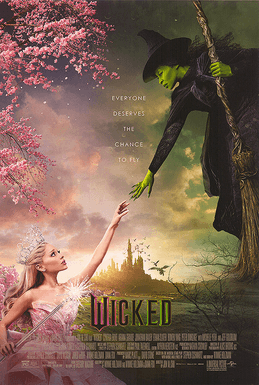
Poster / promotional material via Wikipedia, Wicked (2024 film). Used under fair use for criticism and review.
The received wisdom about Wicked, in the months after its November 2024 release, was that the film succeeded despite the decision to split Stephen Schwartz’s stage musical into two theatrical features. I want to argue the opposite. The split is the reason the film works. Everything that makes Jon M. Chu’s Wicked a functioning musical, as opposed to an expensive filmed cast album, follows from the decision to let the first half of the show breathe at feature length.
A year on, this is the thing worth remembering.
What the critics said at the time
Wicked opened to reviews that praised the performances (Cynthia Erivo as Elphaba, Ariana Grande as Glinda), questioned the colour grading (Alice Brooks’s cinematography was frequently called muddy in early reactions), and treated the bifurcation into Part One and Wicked: For Good as a commercial imposition that the film was gamely surviving. The $150 million budget and roughly $728 million worldwide gross settled the commercial question. The aesthetic question, whether the length was a feature or a bug, got left unresolved.
It was a feature.
Why the stage show needed this
Schwartz and Winnie Holzman’s 2003 musical is, structurally, a compression. The first act of the stage show runs roughly ninety minutes and carries the entire arc from Elphaba’s arrival at Shiz to her decision to defy the Wizard. On stage this is workable, because the audience reads the shorthand of musical-theatre convention: a single song establishes a friendship, a dance number establishes a romance, a key change signals a moral crisis. The form does your compression for you.
A film cannot rely on this shorthand. A film audience, even a musical-literate one, needs screen time to register the specific human weight of Elphaba’s relationship with Glinda, with Nessarose, with Fiyero. Chu’s version allocates that time. The “Popular” sequence, for example, runs roughly seven minutes on film against three on stage, and the extra time is spent watching Grande discover, in close-up, the specific pleasure Glinda takes in her own benevolence. That discovery is the character.
The Erivo performance
Cynthia Erivo’s Elphaba is the performance the film builds itself around, and it is the kind of musical-theatre lead performance that very rarely makes it to a film adaptation intact. Erivo has a specific technical discipline, she is, in classical terms, a soprano with a mezzo’s colour, which allows her to sing “Defying Gravity” in the key the stage show uses without either thinning the sound at the top or losing the chest voice at the bottom. Most film adaptations lower the key and sand the song. Chu lets Erivo sing it.
The filmed “Defying Gravity” sequence is the closing number of the first film, and it is structured around Erivo’s technical capacity. The camera stays close for the first verse, pulls back at the bridge, and holds wide on the final sustained note. The staging is disciplined enough to let the voice do the work. Nathan Crowley’s production design (the Emerald City, the Wizard’s mechanical contraptions, the specific brass-and-glass aesthetic of Shiz) gives the number a visual register without competing with it.
The colour problem, reconsidered
The complaint about the film’s colour, which dominated early critical conversation, is worth revisiting. Chu and Brooks made a specific choice to desaturate the Ozian palette. The greens are muted. The pinks are dusty. The emerald is, throughout, pulled toward olive rather than jewel. On a theatrical screen this registered, to some, as a production design failure. On home viewing, it is obviously deliberate.
The choice is consistent with the film’s broader argument: this is a version of Oz that sits closer to pre-war Europe than to Technicolor Kansas. The muted palette places the film in the lineage of The Wizard of Oz’s source material (L. Frank Baum’s books are darker than the 1939 film), and it gives the second film’s political content (the persecution of the Animals, the Wizard’s propaganda apparatus) a visual register that would not have worked against MGM-bright colour. The greens get to bloom in For Good, where they function as relief rather than default.
The Fiyero problem
One genuine difficulty. Jonathan Bailey’s Fiyero, who inherits a role that has always been the stage show’s weakest written character, is given more screen time than the stage version allows, and the extra time does not entirely serve him. Fiyero, as written, is a caricature of the handsome-but-shallow love interest, and the film’s expansions (a longer “Dancing Through Life” sequence, additional Shiz-campus material) amplify the caricature rather than deepen the character.
Bailey does what he can with the material. His specific charm, which was the whole point of casting him, carries the weaker scenes. But the character is where Holzman’s 2003 book shows its age most clearly, and no amount of extended screen time can fix the structural problem. The film would be better if Fiyero were written with a specific interiority that the stage show never gave him.
What the split lets the film do
The specific pleasure of Part One, watched against the stage show, is the time it spends on the material that the musical had to compress. The Shiz sequences, the specific friendship arc between Glinda and Elphaba, the slow build of the Wizard’s ideological project, all of these get the screen time required to register at film-length emotional weight. Myron Kerstein’s editing holds the pace without ever feeling stretched, and Schwartz (who oversaw the musical adaptations personally) has rearranged the songs to sit inside the longer scene work without losing their shape.
The result is a film that is, at 160 minutes, not a single frame too long. Compare to the mishandled compression of Cats (2019) or the reverent-but-airless West Side Story (2021) and the specific achievement becomes clear. Chu has figured out what the stage-to-film transition actually requires: not fidelity, but expansion.
Where it sits
Wicked won two Academy Awards (Production Design and Costume Design) and was nominated for ten. It sits, at this distance, as the most confident studio musical since Bill Condon’s Dreamgirls (2006), and the first large-scale musical in a decade to justify its own budget on aesthetic grounds as well as commercial ones. Wicked: For Good, released November 2025, has inherited the audience and the template.
The retrospective question is whether the two-film structure will become the default for large stage adaptations. I suspect it will, at least for through-sung shows whose specific pleasures live in the time between numbers. The split is no longer a commercial compromise. On the evidence of Wicked it is a structural opportunity, and Chu has shown how to use it.
Lena writes long-form essays on the films that will still be talked about in a decade. Previously at a defunct monthly whose name we do not speak.
MORE BY LENA ASHWORTH →
Wolf Man, Leigh Whannell, and the Universal Monster Problem
Leigh Whannell's January 2025 Wolf Man cost about $25 million and grossed about $36 million globally. The film is not the disaster the numbers suggest. The strategy around it is.
Anatomy of a $200M Musical Flop: What Killed Folie à Deux
Eighteen months after Todd Phillips' much-hated sequel opened to a $37 million weekend and a 30% audience score, it is time to autopsy the corpse. The film isn't good. It also isn't quite what you've been told.
Nickel Boys: Ross's First-Person Adaptation
RaMell Ross adapted Colson Whitehead's Pulitzer-winning novel through a first-person camera almost continuously across two hours. The argument is that the formal gamble is the adaptation, and the adaptation is, so far, the film of the awards year.