Twisters: The Legacy Reboot That Weirdly Works
Lee Isaac Chung's Twisters sequel-slash-reboot should not have been any good. It is, instead, one of the strongest American genre films of the summer.
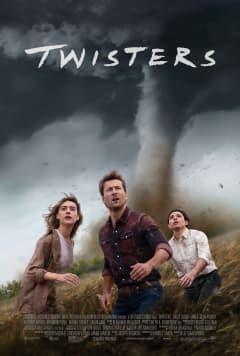
Poster / promotional material via Wikipedia, Twisters (film). Used under fair use for criticism and review.
Twisters, the 2024 pseudo-sequel to the 1996 Jan de Bont film Twister, arrived in July with a specific set of commercial-pedigree warnings attached. Legacy-IP reboot. Director (Lee Isaac Chung) most recently known for a small-scale indie drama (Minari). Summer release into a crowded disaster-movie calendar. Original film’s star cast mostly absent. No Bill Paxton (the actor died in 2017). No Helen Hunt (who declined to return). The film had every structural reason to be a contractual product.
It is, instead, one of the better American genre films of the summer. I want to say why.
What the film is
Kate Cooper (Daisy Edgar-Jones) is a former storm-chasing researcher who, after a PhD-level project went fatally wrong years earlier, has retreated into a desk job studying weather patterns remotely. She is pulled back into active field research by Javi (Anthony Ramos), a former colleague running a new corporate-funded storm-mapping project, and reluctantly returns to Oklahoma to chase tornadoes. In the field, she runs into Tyler Owens (Glen Powell), a YouTube-famous renegade storm chaser whose specific commercial-populist approach to tornado chasing is the film’s specific comic-ideological counterweight.
The film follows the three of them, and their respective teams, across an Oklahoma tornado season that escalates toward a third-act super-storm that threatens a small town.
What Chung is doing
Lee Isaac Chung, whose Minari (2020) was a quiet Korean-American family drama, is a specifically surprising choice of director for a summer tentpole about tornadoes. The choice turns out to have been the right one. What Chung brings to the material is something the original Twister did not fully have, which is a specific regional-sensitivity to the Oklahoma setting and a specific interest in the human communities that live under the weather the film is depicting.
Twisters is, in its quieter moments, a film about rural Oklahoma as a place and as a culture. The film’s scenes set in small towns, at rodeos, in home kitchens, have a specific documentary attention that summer-tentpole cinema usually does not bother with. The tornadoes are the marketing hook. The regional specificity is the film’s actual argument.
The Powell breakthrough, continued
Twisters arrived about a month after Hit Man established Glen Powell as a potential movie star. Twisters is the film that confirmed the potential. Powell’s Tyler Owens is a specific kind of character (populist Oklahoma storm-chaser-influencer) that could, in a lesser actor’s hands, have been a one-note country-boy cartoon. Powell plays him with a specific charm that reads as genuine regional affection rather than as satire.
The chemistry between Powell and Daisy Edgar-Jones is the film’s romantic engine, and it works because both actors are committed to a specific restrained register. The film resists the temptation to resolve their romance too quickly or too explicitly. The pacing of their mutual respect, across the running time, is the film’s most disciplined element.
Daisy Edgar-Jones, the emotional anchor
Daisy Edgar-Jones’ Kate is the performance that most clearly separates Twisters from conventional disaster-film fare. Kate carries specific grief from her earlier failed project (which killed her partner and several friends), and Edgar-Jones plays the grief without dramatic underlining. Kate is functional. Kate is competent. Kate is, also, quietly compromised in specific ways the film allows her to slowly work through.
The scene in which Kate confronts the specific site of her earlier tragedy, which I will not spoil, is the film’s emotional centre and Edgar-Jones’ best work in it. She plays the confrontation without tears, without voice-raising, without any of the standard markers of cinematic grief. The restraint is the register the film has earned.
The tornado sequences
Let me say the obvious thing. The tornado sequences in Twisters are as good as any tornado sequences ever put on film. The 1996 Twister had a specific practical-effects charm that the 2024 version cannot and does not try to replicate. What Twisters has instead is contemporary VFX at the top of its form, deployed with Chung’s specific attention to the human scale of the tornadoes.
The film’s best action sequence, a rodeo scene in which a tornado touches down at the edge of a crowded event, is staged with specific geography and character clarity. You always know where the tornado is. You always know where the characters are. You always know which buildings are in the path. This is proper disaster-film staging, and it is increasingly rare.
Where the film is weakest
The film’s third act contains a specific plot mechanic (Kate’s theoretical research on tornado disruption turns out, conveniently, to be deployable as an in-the-field technique) that the rest of the film has not adequately set up. The mechanic is required to give the climax its heroic shape, but it reads as a narrative convenience rather than as earned plot structure.
This is a minor complaint. Summer tentpole films of this ambition level almost always have one third-act convenience. Twisters’ version is smaller than most.
What the film signals
Twisters made about $370 million worldwide on a reported $155 million budget, which is a solid commercial performance for an IP extension of a twenty-eight-year-old property. The financial signal to the industry is that legacy-reboot films can succeed if they are given to directors with specific regional and human-scale sensibilities rather than to generic studio craftspeople.
Whether the industry will absorb this lesson is a separate question. I am not optimistic. But the film itself is an argument for the specific method.
Watch it in a cinema with big speakers. Pay attention to the rodeo sequence. Notice how Chung films Oklahoma between the tornadoes. That is what makes the film work.
Marcus believes good criticism is an argument. He is almost always angry about something, usually for good reason. Horror is his first language.
MORE BY MARCUS VELL →
The Crow: How Not to Remake a Movie
The Crow remake, after two decades of failed attempts, finally arrived in August and confirmed every reason the attempts should have stayed failed.
Deadpool & Wolverine: The Last MCU Win
A year after Deadpool & Wolverine made $1.3 billion and saved a bad year for the MCU, the film looks less like a triumph and more like the last thing Marvel is going to get away with.
Hit Man: Richard Linklater's Star Vehicle for a Non-Star
A year on from Hit Man's Netflix release, the film is a quieter argument than it first appeared. Richard Linklater made a star-launcher for someone he knew would not, in the end, need launching.