The Crow: How Not to Remake a Movie
The Crow remake, after two decades of failed attempts, finally arrived in August and confirmed every reason the attempts should have stayed failed.
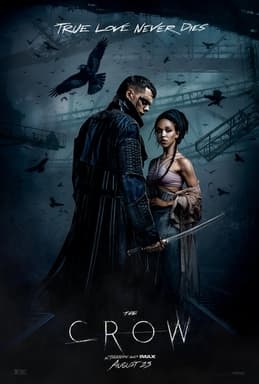
Poster / promotional material via Wikipedia, The Crow (2024 film). Used under fair use for criticism and review.
The Crow, Rupert Sanders’ remake of the 1994 Alex Proyas film, arrived in American theatres in August and did approximately the commercial business that the two decades of failed pre-production pointed toward. It made $18 million worldwide on a $50 million budget. The reviews, with two or three exceptions, were brutal. Audiences, such as they were, mostly left unimpressed.
I am not here to pile on. The film is, indeed, bad. What I want to do instead is articulate specifically why it is bad, because The Crow (2024) is a clarifying example of a very specific kind of contemporary remake failure, and the specifics are worth naming.
What the 1994 film was
The Alex Proyas Crow (1994), which starred Brandon Lee in a role that became famously posthumous after Lee’s accidental on-set death, is a specific kind of mid-90s gothic-rock artifact. The film is an adaptation of James O’Barr’s 1989 comic series, a grief piece about a musician murdered alongside his fiancée who returns from the dead to avenge both of them.
The 1994 film works not primarily because of its plot, which is thin, or its dialogue, which is serviceable, but because of its specific atmospheric register. The film has a specific visual weather: rain-soaked American industrial decay, Detroit-coded cityscape photography, a specific mid-90s industrial-rock soundtrack (The Cure, Nine Inch Nails, Stone Temple Pilots), and Brandon Lee’s specific slender gothic-romantic physicality. Every element is locked to a specific cultural moment.
You cannot remake this. You can only remake in response to it. Sanders’ version does neither.
What the 2024 film does wrong
The central, unfixable error of The Crow (2024) is that it tries to update the 1994 film’s aesthetic for the 2020s by removing most of the specific textures that made the original work. The new film is set in an unnamed city that feels generically European. The soundtrack is generic orchestral-action music. The industrial-rock textures that defined the original have been replaced with a specific contemporary-dark-drama score that has no cultural specificity.
Most catastrophically, Bill Skarsgård’s Eric (the protagonist) has been physically redesigned to fit the contemporary “hot tattooed bad boy” mould rather than the specific slender-gothic-ballet one Brandon Lee inhabited. Skarsgård is a good actor. He is the wrong physical actor for this role. Every scene in which he is asked to embody the specific gothic-romantic register the film requires reads as miscast.
Where FKA twigs is wasted
FKA twigs, as Shelly, the murdered fiancée, is the film’s most genuinely interesting casting choice and its most completely wasted element. Twigs is a specific performer whose physical and vocal register is closer to the original Brandon Lee iconography than Skarsgård’s is. She has the specific gothic-fey physicality the film needed, and she has the kind of real-world musical career that, had the film allowed her to write or perform songs within the diegesis, could have integrated into the film’s world.
Instead, Shelly is a standard murdered-girlfriend role, given limited screen time, killed in flashback, and mostly deployed as a source of motivation for Eric’s revenge. The casting of twigs and the misuse of her is the film’s clearest failure of imagination.
The action sequences
The 2024 Crow spends significant running time on action sequences in which Eric works his way through hierarchical levels of the criminal organisation that murdered him and Shelly. These sequences are technically competent: specific choreography, specific bullet-time-adjacent stylistic moves, specific industrial-warehouse set pieces.
The problem is that none of them are distinctive. The action sequences in the 1994 film worked because they were embedded in a specific atmospheric register that made every fight feel like it was happening inside a grief-dream. The 2024 film’s action sequences happen in a visually unremarkable contemporary-action register that could be transported wholesale into any number of other films.
Action is atmosphere when it is good. The Crow (2024) has action and does not have atmosphere.
The Rupert Sanders problem
Rupert Sanders, who directed this remake, is not an uninteresting filmmaker. His Ghost in the Shell (2017) had specific visual ambitions that its whitewashed-casting controversy overshadowed. His previous Snow White and the Huntsman (2012) has specific moments of interesting fantasy imagery.
But Sanders is not the specific kind of director this remake required. The Crow, if it was ever going to work as a remake, needed a director with a genuine gothic-rock sensibility and a specific willingness to work against contemporary commercial expectations. It needed someone closer to Andrea Arnold or Brady Corbet or Jane Schoenbrun than to Rupert Sanders. It got Sanders.
What the film signals
The Crow (2024) will be remembered, to the extent it is remembered, as a case study in how not to remake a 1990s-coded cultural artifact. The failure is specifically one of aesthetic translation. You cannot update a 1990s gothic-rock film into 2020s contemporary-commercial action grammar without losing the thing that made the original work.
The lesson, which contemporary Hollywood will continue to ignore, is that genuine remakes of specifically-dated source material require directors who can both honor the specific register of the original and translate it into a contemporary visual-musical-emotional register that is specifically their own. This is hard. It requires auteurs, not craftsmen.
If you want to watch The Crow, watch the 1994 version. Skip the 2024 one. The failures of the remake are interesting only as diagnostic, not as viewing.
Marcus believes good criticism is an argument. He is almost always angry about something, usually for good reason. Horror is his first language.
MORE BY MARCUS VELL →
Nosferatu: Eggers' Gothic Masterwork
Eggers' remake was received with admiration rather than fervour, a proper film from a proper filmmaker. Sixteen months later, it looks like the serious piece the year needed, and the one we were too cool to love properly at the time.
Beetlejuice Beetlejuice: The Rare Legacy Sequel That Remembers What the Original Was
Tim Burton returns to Beetlejuice after 36 years and makes a legacy sequel that actually works, mostly because he refused to make a serious one.
Cuckoo: Tilman Singer's Weird Alpine Fever Dream
Tilman Singer's second feature is one of the weirdest mid-budget horror films of the year, and one of the least bothered about making sense. An argument for the horror film that works on dream logic.